
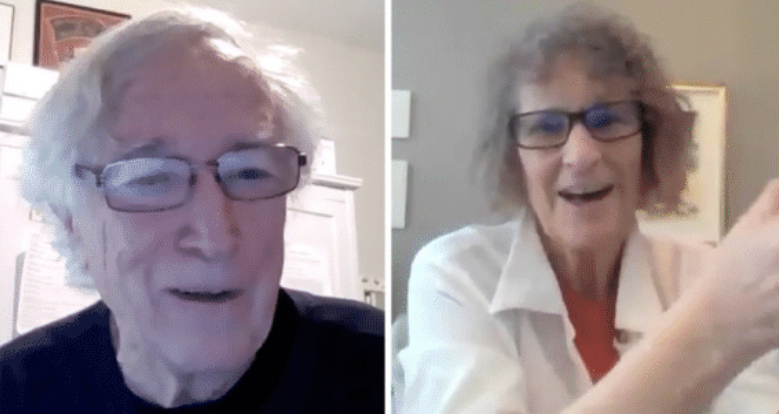
John Lang and Laurell Ritchie
-
John served as Secretary-Treasurer of the Confederation of Canadian Trade Unions from 1978 to 1992. He supported the work of the SACTU Solidarity Committee as a matter of CCU policy, and the CCU became the first Canadian union federation to endorse the SACTU Solidarity Committee in 1981. After completing a law degree, John joined the legal staff of the CAW.
-
Laurell became an organizer with the Confederation of Canadian Unions (CCU) shortly after graduating from high school in the late 1970s. She learned about apartheid through her union work, and helped to bring about the CCU's endorsement of the SACTU Solidarity Committee in 1981. Laurell went on to a long career as an activist in feminist, international solidarity, and social justice work.
Doug Miller 00:02
Oh, she’s got such a nice voice. So John, have you read the letter of consent that we sent, and do you agree with its terms and conditions?
John Lang 00:14
Yes, and I sent you in a signed copy, perfect.
Doug Miller 00:19
Laurell, have you also read it, and do you agree with its terms and conditions?
Laurell Ritchie
I have thanks, good and with that,
Doug Miller
I’m not quite sure how you want to start Laurell or John, but would you introduce first yourself and tell us you know briefly your background that got you into the situation where you became in contact with the SACTU solidarity committee.
Laurell Ritchie 00:46
John, do you want to start?
John Lang 00:47
Well, okay, well, I can’t, I was just trying to think of when the first time we met. But anyway, it was, I was, my background in the labour movement is that I was first the assistant to Kent Rowley, who was secretary treasurer of the Confederation of Canadian Unions. And I, when did I start that around 1972 or 73? And when Kent died in 1978 I was elected to replace him as the secretary treasurer, and so I held that position until 1992 and I think just to briefly, most of the major unions in the CCU, after a long debate, decided to merge with, with the CAW, which had become a Canadian union, and I supported that, although it meant I was, you know, well, I then didn’t run again for Secretary Treasurer when most of the unions came on, CPCU, Castle, a number of others merged with the CAW, and so then I was out of work, and I went to law school and got a law degree, and then got hired by this by the CAW, both in the summer as a student, and then afterwards, when I graduated, I got hired as in the legal department of the CAW, and then I so I worked there in the CAW, until, I guess, 1993 when I retired from the CAW.
So my, I mean, and, well, involvement in SACTU, I mean, SACTU was just always there. I don’t know when you guys started organizing, but in terms of the CCU, I think it’s fair to say that there was certainly an open door for SACTU. I mean, like we supported, the principles, we provided, what finances that we could and we also, I think, in terms of my work, kind of assisted to open the doors to our affiliated unions who, in terms of the CCU structure, had more money to contribute. The CCU did contribute money, but when we operated on a very, you know, slim budget.
And but so, you know, Ken Luckhardt, Jane less so, I don’t remember, but I was, like, attended many CCU conventions, executive board meetings, similarly, the conventions of our affiliated unions and even like educational programs, but not anyway, were regular speakers, and I think the whole struggle of SACTU was something that the that the CCU as a central labour body, but most of our affiliates were, you know, were very active in, and, you know, did the work that was, that that was needed, you know, in in publicizing that. And I have one story that I want to relate, which I’m not even sure I would like to get it kind of documented. But anyway, we’ll get into that.
Doug Miller 04:35
Sure, let’s meet Laurell as well. Then early on in this recording, right, I could ask one of you to also, just for those less young and less informed people are going to be reading this, could you just give us some background on the CCU itself? What does it mean and where did it come from? Right?
Laurell Ritchie 04:58
I think that. John’s the most appropriate person to talk about the CCU in general. I worked within the CCU as an organizer and then an officer with the Canadian Textile and Chemical Union, the Confederation of Canadian unions. The CCU was the umbrella organisation, and it was on the outs for some considerable period of time with the Canadian Labour Congress. And again, maybe John can talk about that.
I came on as not long after high school as an organizer with the Canadian tech Doug chemical union in 1972 and I later became an officer and worked there until 1992 when the CTCU joined Canadian Auto Workers. I had also been active in anti-poverty organizations, and very considerably in the feminist movement, particularly the National Action Committee on the Status of Women, and I think that’s another piece of the history that might be linked in at some point in terms of the support for the anti-apartheid work.
I don’t recall the first time that I encountered the SACTU organizers. What I, what I do remember as my earliest memory, and this would have been in the second half of the 1970s so I was still in my 20s, and while not a newbie to activism, it this experience really, really stuck with me, and this was in the basement of the very dark and dank, somewhat dank basement of the brick layers and masons union, one of the affiliate CCU, and I don’t even recall who made the presentation, but both Kent Rowley and Madeleine Perrant were present. So this is, Kent died in the late 1980s so this was, sorry, Night, night, late 1970s so this might have been, I’m guessing, 76 or something like that. And a presentation was made, and there was and again, I don’t recall whether it was a film or a poster or photographs, but I do remember it was visual in part and I was for the first time, introduced to a man named Nelson Mandela who had never heard of and it became very quickly clear that this was very risky business. This was dangerous stuff that people were involved with. This was, and this was a man that was, at that time, considered, and it’s in as I recall Rob Anders, well into the next Miller, considered a terrorist. And the I, anyway, I, the stories of what I in my Torontonian world considered, stories of people living in terrible slums, the stories of the past laws and the body searches that people experienced leaving the diamond mines just unthinkable for me in my world, in unthinkable indignities and terrible hardships.
I think, probably the most, the counterpart to this, in some ways, in my experience, was helping with the grape boycott work. I mean, it was not central work for me, but as many in my broader community did, I was engaged, although I did visit the California headquarters quite. But, but this seemed much more clandestine, much more difficult in some ways. And I it really, it shook me up. You know, I realized that would take great bravery, bravery to do this work, and that extended to people who were doing the support work. And it when this presentation was made, I think I was not, I know I was not the only one in the room who was hearing this for the first time and again. It was a very dark, little basement board, very small, and there was maybe, if luck had it, maybe 20 people present.
And I know I was not the only one, and it again mattered enormously that both Madeleine Parent and Kent Rowley spoke up to endorse this campaign and to calm any nerves that people might have about getting involved with something where there was somebody labelled a terrorist as one of the leaders, although behind bars the and, you know, it wasn’t soon after, I’ll just finish this part, but it wasn’t soon after that I came to see this as one of, for me, one of the proudest Moments of the Confederation of Canadian unions to CCU, because the rest of the labour movement was not there at the time.
And that’s another interesting thing that I hope we would talk about at some point. Because it’s always seemed to me that there was a maybe not, definitely not by design, probably more by necessity. There’s an interesting study that somebody could do about the role of the Confederation of Canadian unions in Canada, the role of SACTU in in the South African struggles and at another point, the fat in Mexico, these are all unions that were not the central labour body but were absolutely instrumental in moving this forward. And I say that, as you know, still a proud member of CAW in Unifor, whatever the warts are of all these organizations, but that role, that critical role, is worth understanding, not just as a historical footnote, but as maybe something that provides some lessons about how we approach our work in the present day.
Doug Miller 13:06
Wow, thanks so much. What a tremendous intro. So back to you, John, if you would do a little more background on the CCU, and then we can start that SACTU side a little more thoroughly.
John Lang 13:17
Well, I try to do a thumbnail sketch. The CCU was founded in 1968, it was originally called the Council of Canadian unions and changed its name to Confederation of Canadian Unions. I believe it was 1972 or 73 the main driving force behind the formation of the CCU was first Kent Rowley and then Madeleine Parent. They worked this as a team. Their history was that they had organized 10s of 1000s of textile workers in Quebec and had the union pulled out from under them, from, you know, corrupt gangster style heads of the of the American unions.
They had organised into the American union, and they were
turfed out and left with nothing. You know, it was the Red Scare days, and all of that was being behind them. And they managed to maintain, really, it was one local at Harding’s carpets in Brantford, and so Kent particularly moved to Brantford, and then later Madeleine, and they maintained their organisation with the Harding carpets plant and a few other plants that they had organised a hand handful of them, but Kent had always, I mean, from based on his experience, they knew full well the [words missing]
50s to get some of the Unions that had been turfed out of the Congress of Canadian Inions at that time to form a central labour body, mine, mill, united electrical workers, the more progressive unions in the countries you know this, the CLC always labelled them as communist dominated unions, which is, you know, well, that a whole, you know, complicated story to parse exactly what that means. But anyway, they failed to get, because even within the, you know, the left-wing leadership of the unions, they were all into their main thing was to get, you know, back into the CLC, that was their objective. So anyway, but things were building in the country. There were a lot of breakaways, resistance to American unions. And so it was 1968 that Kent called together the, there would be half a dozen unions. Public paper workers in British Columbia came off which had just been formed, CTCU, brick layers broken away in Toronto and formed their own union, the Canadian Union of Operating Engineers. I may be missing a couple of others. Anyway, they formed the Council of Canadian unions. And then they, as I said, became Confederation of Canadian Unions a few years later.
So the CCU, I mean, to we ended up building an organization, there are about 15 unions in the CCU, my time and but we were spread out across the country. Obviously quite thin. Our total membership was, never exceeded much beyond 40,000 so in terms of numbers in the labour movement, we were, we were, you know, quite small, but we were, you know, stressing the need that Canadian workers needed, their Canadian unions, and, you know, publicizing when, well, I suppose what we also have to add, is that in terms of our approach to unionism, we had a more militant brand of unionism that was more, how can I put it? You know, that was, well, in a way anti-capitalist would be, I think, a good way of putting it, and that would be that was always part of our, our, our program.
So that was so, yeah, so we, we had, we were thinly spread it, but we were across the country. We had oil workers in Montreal, the East End of Montreal, the big, big refiner, three or four of the big refineries, they weren’t all organised in Ontario. We had the Canadian textile and chemical union operating engineers, the brick layers. But it was out west, particularly with in British Columbia, with the work of Kmart. And the Kmart stands for Canadian Association of Industrial, Mechanical and Allied Workers, Pulp and Paper workers of Canada. Pulp and Paper workers represented half the workers. Pulp workers in BC came out organised in the heavy industry that exists in truck plants in Vancouver, in the Vancouver area, but also in the mines. And I don’t know what the height I would expect, Kmart represented almost half the mines in in British Columbia. So in BC, the CCU had a much more of a foothold in the major industries in the province. And so for that reason, I think we were all, you know, we were paid more attention to and so.
Ken Luckhardt 19:19
And there was also Castle up in Kitimat.
John Lang 19:23
I don’t want to forget Castle which had had a spectacular victory over the steel workers, which Kent Rowley was, you know, May was up there involved in that and he and so I forget what the numbers were, but it was like of 2000 workers. And I think it was about 1700 to 300 the when the vote came for cast on. And so this was a stunning this. This shook the leaders of the Canadian Labour Congress by. Of the extent of the of that victory, anyway. So that’s, I think, gives you an outline of the of the CCU.
Doug Miller 20:12
Well, absolutely brilliant and it also shows very clearly why there would be such a natural affinity between SACTU solidarity and you folks, you, you, you were pushing the limits, and you were, you were pushing an anti capital, pro labour line.
John Lang 20:30
And outsiders, you know, we were like, you know, I think what Laurel was saying, looking at these labour movements, where the, you know, the unions outside the mainstream had a significant effect on the direction of the labour movement.
Laurell Ritchie 20:49
There’s two sides to that. Sorry, please go ahead. I was going to say that there’s two sides to that. We maintained a different approach to everything from organizing to political work at the same time, we, we also worked with the very good people that were in a lot of these other unions.
And one of the sort of genius parts of the organizing that was done by SACTU solidarity was, you know somebody like Ken and Jane and there were others who would bring us these lists. And I mean, really brilliant organizing. Second to none, they would bring us these lists and say, “look, we need to, we need to find somebody. We need to find an entry point to discuss this, because we think there would be support from the membership if they understood in this union or that union. And do you know folks? Are there people you work with, you know, maybe on health and safety, maybe on women’s work, you know, a variety of other scores and like, do you know good people in those organizations that we might reach out to and begin our work in that union”. So, yes, we were on the outside, but we were all, I mean, what was I mean?
It’s both a comment on the role of, you know, the organisation, the CCU, and its affiliates, and also the astute organizing tactics by the organizers within the SACTU with solidarity committee, and they use those connections that we did have, because there were good people in a lot of those organizations. There were unions that stand out from the rest, I mean, postal workers, etc., that didn’t, we didn’t make any introductions. But in some of the more business union, you know, the America, some of the more business oriented American Union, they really needed some contacts, and we had them.
Doug Miller 23:42
Tremendous I think Ken or Jane, here’s a good point for you now to bring up the connections and get feedback from our friends.
Ken Luckhardt 23:51
I’ll jump in and start. The first formal meeting between the SACTU committee and the CCU in my history. My memory was that we set up our committee in May of 1980 with the mandate of Secretary to represent them in Canada. One of our first kind of occasions was being invited to set up a book table at the CCU convention or meetings in Montreal. This is where I met some of the people we’re talking to today. I had also, personally, I have certain affinities to the CCU because I had done academic research in British Columbia back in the early 70s. So people like Angus McPhee and others from the PPWC were friends. I mean, I knew them. So here we come back from Africa with a book. So setting up a book table at a CCU convention or meeting was quite important to establishing that initial connection with John, Laurel, Madeleine, etc. So that’s kind of the 1980 was the beginning of that relationship in my memory.
Doug Miller 24:56
Does that you? Jane?
Jane Armstrong 24:57
Yes, I just. And to echo both John and Laurell, I’ve been searching as best I can in archives to try and find union references to South Africa, anti-apartheid SACTU, and found the first, I think, resolution endorsing the endorsing SACTU and endorsing, working with the SACTU solidarity committee from a 1981 convention of the CCU. I can’t remember whether it was Montreal or Winnipeg that that convention was in but, you know, trying to track down some of the details of this history has been important in the last six months, but I think you were the first. We do know that we met with Bob White and with Jean Claude Perot early on in 1980 81 and they were solid from then on. But I think yours was the first convention.
Doug Miller 26:19
Okay, the number of issues that come up are, well, not issues so much as, can we talk a little bit more about the way SACTU then went into these various places, SACTU solidarity committee and how that response, you said a little finance, but I understand that even these resolutions can be an accomplishment, because it has to go from the local, you have to have those debates, and then they have to come to the floor. Could we just get into that mechanics a little bit to explore this solidarity that was between the two?
John Lang 27:01
Well, yeah, I think I can, what comes to mind immediately in response to that is that I and, I mean, Jane and Ken, can, you know, confirm this, is that but, but my sense of the, you know, support that we could do, could give, was that by passing a strong resolution in the CCU, and make this public, a resolution of support, then that sort of you know, put the fire to the to the feet of some of the you know, more you know, less enthusiastic, a leaders in the CLC. Now there were some leaders like Bob White, Jean Claude Perot. They were, you know, on board to install it. They didn’t need any support. But there were others, and I think that was one of the ways of you know that the CCU could give support that went beyond its numbers or its financial resources. But there was another thing, and I want to tell this story, which I would, I guess I would like it now sort of documented better. And maybe can you recall some of this.
This story comes from Jim Nyland, who was one of the officers at Castle in Kitimat. I can’t put a date on it, but I would, I would put this, this was kind of well on into so if we’re thinking of starting 1980 this would be probably the end of the 80s. Ken had gone up to Kitimat to give us a talk. He brought lots of materials about Alcan’s investment and activities in in South Africa. And so Castle was in negotiations at this time. They’re in that kind of the final stages of their contract negotiations.
And understand the picture there. Denton island had told me that you could never negotiate with Castle about how much money they were making, you know, and then they just never, they would say, “Yeah, we make lots of money. We could pay you all 100 bucks an hour, but we’re not going to. What we’ll do is follow the pattern in the industry”. And you know, employers can do that. So they were, their wages were really, you know, controlled by the wages in the woods industry. And you try to make your breakthroughs. And of course, there’s enough in sitting at a negotiating table. You can get pretty pissed off at that kind of arrogance of a company that they’re not really dealing with. You know, the argument. So they went in, they brought in one of the top executives from Montreal to finalize the negotiations.
And they, I don’t know if they actually put on the table that they wanted a plausible collective agreement that Alcan had to withdraw from South Africa, but they did something like that, but they got on the agenda Alcan’s involvement in South Africa and then bombarded them for a whole day with all of the information that Ken had provided a week before, or something. And they had a great time doing it, you know, because, you know, and they said that they the, certainly this guy from Montreal, and also their own, you know, bosses were, were kind of quite taken aback at how knowledgeable they were about what was going on in South Africa. And so like so I, you know. And sometimes I have to say that in the telling of these stories, they may get embellished a little bit, you know, but, but there’s certainly a kernel of truth to this.
And it just strikes me as a kind of almost perfect example of how like solidarity work works. I mean, here was, you know, I mean, the, you know, the preliminary work of building bonds with the SACTU solidarity committee Ken and Jane and Brenda and Ken Traynor. We can’t forget, you know, so that we, we knew each other, we were friends, got this information and use this to, you know, to don’t know what to say, well, I was going to say embarrassed, but make, make very uncomfortable. The executives of Alcan, I don’t know if it ever had any effect. I, you know, but in some ways, stuff like this, you know, has an impact that you may never realize. I mean, I wouldn’t, wouldn’t claim that, you know, that Alcan changed their minds about investing $1 in South Africa as a result of this. But it was, it’s, I think it’s still, it’s a great story and would get recorded.
Doug Miller 32:28
It’s absolutely amazing. It’s an exceptional access to management that otherwise they would ignore it in the media. They would ignore the people picketing out front of their offices, and certainly they have no interest in hearing it. And there you guys are right at the table, looking the senior guys in the eyes and telling them their stuff smells.
John Lang 32:52
I want to know, Ken, if you if Jim Nyland had ever told you about this, or if you’d heard it from any of the –
Ken Luckhardt 32:58
had heard the story, and mentioning of Kitimat and Castle brings back a lot of those memories of the earliest SACTU work in 1981 the first official tour with the SACTU solidarity committee by SACTU executive member, Zola Zembe. We went to the Northwest. We did Prince George pulp workers Terrace, the Labour Council under direction of John Jensen, who was with the carpenters union, one of those lefties in the CLC. And then we went to Castle and Kitimat. And I remember travelling from terrace to Kitimat with Zola, who was absolutely shocked at the trees that had been denuded from the mountainside. Melter Yeah, the clearing of trees for the pulp industry. Zola was just amazed and astonished and offended by the fact that the environment had been so destroyed. This is before we were talking about environmental issues. That’s the politics of South Africa.
So we go to the meeting in Castle. It was a small meeting. It was a local union meeting, and we met, amongst others. I mean, I think Jim may have been there at that meeting, and I do remember him very well also at that meeting. Was a young at that time, black brother named Brian Oh Hyman, who later became very important in the work in Toronto with OPSI, but he was a cat. He was from Jamaica, I believe, and was an activist within the Castle local and he and Zola hit it off immediately. And they had went off and had good checks with each other after the meeting ended.
Brian became, then an activist in the jail system in Toronto, where he would get, believe this or not, inmates refused to eat South African fruit that had been brought in by the system to feed workers in prison prisoners. So Brian was quite instrumental, and Brenda Wall would be able to tell you more stories about Brian being an OPSEU activist that time. But that Castle meeting was critical.
And yes, John that, that’s the story. I do remember. Again, documentation is a little bit thin, but I do remember the story, and also Alcan then became a target back here in Eastern Canada by the task force on churches and corporate responsibility, who were targeting major corporations that were investing in South Africa. So those people were picking up on some of the research that Ken Traynor had done to help them make the same argument against the corporation in a more direct fashion than some place in Kitimat. So there’s a lot of stories here.
And while I’m on a roll here, if I’m on a roll, I also the story I want to tell John is that when you arrange for me to go with you to Sudbury to speak to one of the anniversary conventions of mine mill, I forget which anniversary it was, 50th, 75th, 90th.
John Lang 35:55
I think it was 100 I think was 100 so.
Ken Luckhardt 35:59
We were allowed, we were invited to speak about South Africa to the 100th anniversary of mine mill. This is quite important. Good mind mill, long before the CCU politics came into play. Mind mill is documented to a fondness way back in the 50s and 60s. This is documented in our book, “Organize or Starve”. So we’re talking about a union and a confederation has politics that go beyond the CLC politics at that time as an organisation, and I think that’s one of the key themes to this discussion we’re having with the two of you, as well as Jef Keighley last week. The international solidarity work of the CCU, in my view, is different than the international solidarity work of the CLC at that time, because CCU affiliates brought their politics already with them for the most part, PPWC, Castle, wherever you went, the CLC didn’t have those politics for the most part, certainly not the top.
But more important than that, the CLC had to run its international politics through yet an even higher international body, which the CCU didn’t have to do. CCU didn’t have an affiliation to the ICFTU as the CLC did. So the politics of internationalism were very different between the CCU and the CLC, and even though people like White and Perot bucked the system within the CLC, that didn’t mean that the CLC was easy to crack, and we had our struggles with as everyone knows, for many years. But the distinction between CCU politics, call them anti-capitalist, CLC, call them communist. I don’t care what you call them. The politics are different. In international solidarity, all you had to do was take that list to the union as Laurel was saying, show them what the connections are. And I’ll tell another story later about the bulk SACTU. But that’s kind of the way I see the whole CCU versus CLC issue.
Laurell Ritchie 38:03
If I can just add, I mean, you know, you’ve talked about the early resolutions, Jane and can you referred us back even farther to mine Miller as an affiliate, where they stood years, if not decades, before. And there was a mix. Sometimes the CCU led openly, you know, like that resolution, and, I mean, it wasn’t the only organisation, but an important one, with Alcan trying to use bargaining power with an employer to move an employer. And that was all you know, without that was all kind of advertised, you would use that then as SACTU solidarity committee to move others to do something comparable.
There were other times when you would approach us and say, “do we, will we have your support?”. And, you know, there’d be discussions and, and I mean, normally it would the answer would be yes. You would keep that in your back pocket. You would know when the appropriate time came that you would add the name of the CCU or one of the affiliates, but sometimes, if you were a sense shaming some of these organizations into taking action, it didn’t help your cause to say that the CCU was already there, so you just keep us in your back pocket. And so again, a very to my mind, such sophisticated strategy, you know and tactics. Anyways, in developing that support. I’m very sophisticated and a mix of these things.
And I’m so glad that somebody mentioned Zola Zembe, because, and I know his name is Archie, but we knew him as Zola Zembe. And you know, we met many we met other representatives of SACTU along the way. And they were, they were, they were great, each of them in their own way. Zola was a giant, and in he was a man of such depth that no one could doubt the honesty and truth of and the gravitas of what he was saying. So I’ve, I’ve always wanted a moment to just say that he made a huge difference. And I hope the activists in South Africa know that, and certainly Canada recognize that he’s he it was a huge, huge difference that he made his way here.
John Lang 41:21
Miller still alive?
Ken Luckhardt
No, no, he would have passed away, right?
John Lang
Yeah, okay, yeah. I, well, I, agree with, with Laurel, Zola made a big impression on me. Well, he was just so legitimate, right?
John Lang
I mean, so we all, I have another story, if you because this kind of, this ties in that I was prompted from your letter Doug, saying, you know that you didn’t want Harper, you know, being, you know, kind of getting the credit, credit and whatnot, you know, like him going over for Mandela’s, well, whatever it was that he was there for. So he had a similar thing, and we’ve already mentioned, I mean, this sort of tension within the CCU and the CLC. One brush because there were differences, and there were some leaders in there who are very good. But Ken mentioned that at the time, also like this, the head of the CLCs international affairs department, Harper, was really, you know, anti-SACTU and anti-everything. I mean, like, for someone in that in that position, his policies were way out of sync with the membership of the CLC, and maybe even with the leadership of the CLC. And so, but, and so, but he carried a lot of weight. And I don’t know if you’ve been familiar Doug, if you’ve seen the article that was in This Magazine by Marv Gandal.
Doug Miller 43:13
Yes, and I’ve been trying to locate a fresh copy, because mine was on fax paper, that old fax paper you talked about, and it’s turned –
John Lang 43:23
Well I kept, you know, I was also, I think, as I mentioned, on the board, editorial board, of This Magazine. And I’ve kept all of the issues of This Magazine, except that one, which I’ve probably pulled out. I went to check it, and it’s, it’s not there. I got the subsequent one with the letters, you know, from Harper and Paul pirate and Jackson, Andrew Jackson, who were, you know, responding to it anyway. That’s, I wanted to reread that article, because it was a very good analysis, actually, of the role of the CLC.
So anyway, my story is that when Nelson Mandela came to Toronto, was it 2001 this is first visit to Toronto, went to Ottawa and went to Ottawa, and then came to Toronto, 1991 right? So the CLC had arranged to, for, a meeting, I think at the convention centre, one of the hotels, they had a conference room for all the CLC leadership to meet with, with Mandela and so Klaus Miller, who was also one of the longtime activists from Castle in Kitimat, for some reason he was in in Toronto, there must have been in conjunction with the with the CCU meeting. Anyway. He was in the office, and I knew this was and so I said, “close. Let’s go down, okay, Mandela is going to be”, oh, sure, okay. So we went down. We go to the door, you know, the meeting hall, and say who we are. Say, “No, you can’t come in”. And, you know, I said, “well, we’ve been –“ “No, just, just for CLC, no, you can’t come in”. So I said, “okay” so we stood outside. We waited outside. Of course, we could see through the doors.
And one of the things that the kind of, the main thing of this meeting, Mandela, I guess, gave a short speech, but all of these labour leaders paraded up. They had a camera, and they took a picture with Mandela, you know, and I saw all of these guys going up, and, you know, like I’m shaking my head, because, I mean, they’re all supportive of Mandela now, but I knew all the, you know, the effort that had to go in to getting them to do anything, and some of them never, had never done anything, even with all of the work of, you know, Ken and Jane and Brenda. So anyway, here is so they’re walking out. I’m standing by the door, and then and close and I are standing there together, and Mandela comes out, and a few steps behind him, and I, sort of, I looked him in the eye, and sort of, you know, nodded a few steps behind them was the SACTU rep from South Africa at that time. His nickname was Sticks. He was the one after Peter. What was his name? I can’t –
Doug Miller 46:40
Oh, I have it somewhere, but I only ever knew him as Sticks.
Jane Armstrong 46:43
[Name] Was the nomme de guerre that he used, and it took me to find his real name this fall.
John Lang 46:50
Anyway, Sticks was, was there, and sort of gave me this sheepish, you know, a little look. I didn’t know him that well, but he sort of knew who we were, you know. And so Mandela walked by. And now, so that was the recognition that this CCU got for our work.
But it was kind of this thing of, you know, like, you know, all of these people going up to get the picture with Mandela, who had, you know, not well, a lot of, I’m not saying all of them deserve the picture with Mandela, but a lot of them hadn’t done very much. So this is a is a way of kind to a story, to sort of put the history in its proper perspective. You know, absolutely anyway. And that also links. It’s kind of interesting that it was, you know, close from Cassar, because there weren’t very many times, you know, Klaus was in our office in Toronto, you know, but he just happened to be there, and I said, let’s go. And he was so that, so Casa also got its, you know, kind of recognition from Mandela, in a sort of a way, you know,
Ken Luckhardt 48:10
Anyway, that’s a great story John, Jane, you wanted to say something earlier.
Jane Armstrong 48:13
Just going back to your comments about Zola, you may not be aware that Zola published an autobiography, and there is one chapter dedicated to the Canadian connection, and I think at one point he says in it he felt like Canada was his second home. So his autobiography was published by the University of Natal in 1996 but then OPSU in 2011 reprinted a second edition, including a new preface from Zola about the Canadian’s work and their support in the solidarity. So there was this mutual thing that developed. He was back and forth many times during the 80s, while we were operating. But then he came back in 94, 90, 1996, and again in 2000 he actually came for a holiday with his wife in I think it was 96 so there was a strong connection and a strong appreciation for what we did in the face of difficult opposition from the CLC but managed to conquer that.
And just on your point with Harker, there were things we knew and had seen evidence of, but then, more recently, have just read a section in a book by Yves Engler, who’s a progressive academic in Canada, and he’s tracked down connections between CIDA funding the international affairs department of the CLC, to such an extent that I think half the staff would have been gone if it hadn’t been for CIDA. But of course, there was a quid pro quo. Harker came out of foreign affairs as well as we know, and he has tracked that projects that the CLC was supporting in its so called support for unions in South Africa had to be approved by the Canadian Embassy in South Africa, such that they could not be connected to political unionism, i.e. any unions that were working with either the ANC or SACTU underground. I’m hoping to find out more about where he found that documentation, because where there’s some there’s a thread you just start pulling, and you can find more.
Ken Luckhardt 51:04
But Doug, you should have a full show on John Harker.
John Lang 51:11
It was really bad, like he was beyond, beyond the pale.
Laurell Ritchie 51:20
Yeah, it’s like, it’s so, so this wasn’t just International Labour organizations. No, I’m sure you’ve covered this elsewhere, but you know, like that, I do want to come back to a couple of points. Just one. The point about these unions that are these union umbrella organizations that operated, often on the margins, and I just in the case of SACTU, it’s like so many people don’t realize that it wasn’t just, you know, a broadly speaking, a political difference with the mainstream unions, but that it was, you know, a non-racialized union central, you Know. And I know it’s like, you know, comes second nature to people involved in that movement. You know, you know that. But I think a lot of people forget the leadership of SACTU in that and these days, you know, looking back, you know, it’s hard to believe there was such a time that there was. The other thing I want to just make sure it gets covered, if not now at some point, is I really would like to talk about the women’s piece of all of this. I dug this one up.
Doug Miller 53:00
Oh, fantastic.
John Lang 53:05
Yeah. What does it say? I can’t read it well.
Laurell Ritchie 53:08
It’s in French and English, but basically it says South Africa Women’s Solidarity Day, August 9, in French and English. So I am mentioning this. Well, I’ve got all my other stuff too. Everybody’s got all these old ones.
Doug Miller 53:28
But just interrupt briefly, Laurell to ask you maybe to take a picture of those, to allow us to put in our –
Laurell Ritchie 53:35
You got a million of these. Right?
John Lang 53:41
Jane wants one.
Laurell Ritchie 53:43
You know what? Jane, it’s so humbling to have these things now that you can’t wear because you’re not the size you were when you were 20 or 30.
Doug Miller 53:56
They’ve shrunk. They’ve shrunk, I’m sure.
Laurell Ritchie 53:58
But, yeah, they shrunk. I know it. I know it. Okay, I’ll take the pictures. But there’s two things, and this is for me, this is more. This is both because of the political moment that it like the way things transpired in South Africa, and also for some of us, the transition from CCU into the Canadian Auto Workers and I began there at the local level. In 1992 I went to the national office.
In 94 the two things I want to mention, one, there was the meeting, a very small little meeting and Ken or Jane, I am sorry I cannot remember who the other five people were. It was a very small group. It included Hassan Yussuff, and it was at the Westbury hotel, and it was a breakfast meeting with a delegation a SACTU delegation. But by this point, it was, it was it was electric, because they, you know, they had an electoral victory, and they were readying themselves, to, many of them personally, to move from the labour movement into government positions. And of course, that was much debated. How many of them were leaving the labour movement and enticed and lured by government jobs, not to demean those jobs. But hey, what about the labour movement?
The, but, and I’m not sure everybody welcomed this particular comment, but I figured, okay, we’re now at a stage where these guys are, we’re at a different point. There’s a coming of age now, and they’re going to be subject to criticism and critiques about how many people go into government, etc., but a constant refrain for many of us, at least in the latter later years, was, where are the women? Where are the women delegates, and you got to get with the program, guys. And I’m sure you hear about this back home. Well, you’re going to hear about it internationally now too. And anyway, I yeah, that was, I’m not sure everybody welcomed that. It’s my only contribution to the little breakfast discussion, but that was, you know, there was another kind of pressure that needed to happen. Now, I don’t remember the timing, but it had to be before 94 because by that time, I moved into the national office, so I’m guessing 1993.
John Lang 57:02
That’s a good point. Laurell, I mean, because, like in the Solidarity movement, we were, you know, politicizing them as the same way as they were politicizing.
Laurell Ritchie 57:14
Absolutely that. And to me, this is this, like, welcome to the you know, like this was, it had so much meaning to be able to say this, you know, as equals that you know this is now you have to take some leadership on this issue. But, but having said that, then in 90, I’m guessing 93 when I was still at the CAW, like we there was a two year, very short transition period have the CTCU. And so we were at the local 40 office, and we were asked by CAW, and it might have been Hassan. Sorry, yeah, CIW, but it might have been Hassan Yussuff, but to host at our local offices a delegation of women that were there from South African Unions, not by this point, I’m sure it was COSATU rather than SACTU and, but we got, we had, we brought in, I mean, part of doing this was that it was easier thing for CW national to organize it this way is they knew that we would pull in people from other unions and from the workers Action Centre and other community based organisation women’s organizations, and we had a grand morning.
I you know, it was just, it was such a wonderful exchange with these women from some different, some different unions. And I’m not saying that they’re linked, but in my mind, they are, you know, the kind of points that were made at the Westbury breakfast and the opportunity to actually host these women, and again, a sign of developing maturity in in that labour movement. And finally, just mentioned on the this is a little later in the transition with CAW, but we had a one of the things that I did at CAW was as part of my work was organised a few round tables on precarious work, which when it was still a newer issue, and we did a few we used opportunities where the CAW had international delegations coming to visit to do round tables that we. We, with those delegations on specifically on what was happening with precarious work in South Africa or Denmark or etc., and we would pull in some leadership from the CA, W and a few other unions. We actually had the sessions at the Ontario Federation of Labour building talk about full circle many later, and we would invite some of the other unions and the CLC and the OFL delegates to be there, as well as, again, some community organizations. So in in September 2011 we had one of these round tables with metal workers from NUMSA and had an exchange on precarious work and sort of compare and contrast what was happening here in Canada, or at least in the Ontario area, with what they were experiencing in in various industries in South Africa.
So for me, it’s like there’s a wonderful circle that has happened here that has brought us full circle to a point where we can have exchange as equals on issues of common concern,
Doug Miller 1:01:27
Absolutely, and it’s one of the concerns that we raise in our questioning of people when they’re talking about the anti-apartheid movement. Was it hierarchical? Was it sexist? Was it racist, or just even absence of those issues, sort of neglecting them rather than being racist, but neglecting BIPOC people as part of your organizational structure, you know, and women’s, of course, as a huge component. And thank goodness, we’ve made some progress. I hope. Thanks for those comments. They’re really amazing. Ken or Jane, have you got any other ideas here to throw out?
Ken Luckhardt 1:02:09
Go ahead, Jane, I think you had your hand up.
Jane Armstrong 1:02:11
Just on that point about the various elements of solidarity that I don’t think would have happened in the early 90s had it not been for all the work that activists in the CCU and in progressive affiliates of the CLC did to build that strong base and go from there. I know we had a number of delegations came to stay for two-week sessions up in Port Elgin around occupational health and safety was one of the big issues for unions wanting to get more training in, their politics were solid, way beyond ours, for the most part, but some of the technical training around occupational health and safety they wanted. And interestingly enough, I read a PhD thesis which was supposed to I think it was University of Oxford was supposed to be tracking the decline in solidarity from the 1990s on, and again, the lack of talking to trade unionists who were doing a lot of this exchange work over the years is it was stunning to me. I mean, they basically said the union movement kind of abandoned South Africa after 1990 and I’m thinking, what, you know, I knew lots of things were going on. So there’s these histories, these oral histories are so important to document.
Doug Miller 1:04:04
And we saw from to reinforce your comment there, we saw how so many militants from that period went on to continue their activism in so many other fields, and South African anti-apartheid was just built into their DNA as part of that process. So it there’s Hassan Yussuff now, or within at the time, President of the CLC? Well, that wasn’t going to be possible back in the 1980s that a chap from the Caribbean could get to that kind of place.
John Lang 1:04:38
Anyway, those, are, I just, oh, if I press that point, because with mention of Hassan’s name, I don’t know, Jane, if you remember, but you introduced me to Hassan. We were waiting to pick up our luggage at an airport. I think it was in Vancouver, but we weren’t going. And it was that anyway, it was the time that Hassan was running to replace. Have for the position of worker of colour, rep on the OFL. So this was right at the beginning of his, you know, political career in the, in the, in the labour movement. So I was just struck at that maybe, maybe, maybe he, he can take us out for lunch at the Senate dining room or something. If he, if he still talks to people like us.
Doug Miller 1:05:31
I’m sure he’ll open the door if you knock. Don’t worry,
Ken Luckhardt 1:05:37
As John, as John Clark said it, we hope he gets seated in the class struggle section of the Senate.
John Lang 1:05:44
Oh, that’s a good, good line.
Laurell Ritchie 1:05:51
I can’t help but for the historical record here, I don’t know if Guyana’s qualifies as a Caribbean country, but Hassan is from Guyana.
Jane Armstrong 1:06:01
Yes of course and they do include Guyana.
Doug Miller 1:06:08
Yes, as part of the Caribbean Commonwealth.
Laurell Ritchie 1:06:10
Okay, so I learned something. Thank you.
Doug Miller 1:06:13
I do recognize the difference. But anyway, folks, I mean, this has been amazing, and what a sweep of history and what a fantastic analysis and approach of the various things. Any last words, please?
John Lang 1:06:32
Well, I have a comment, oh, can I’ll jump in first, because, like, I think that, you know, it needs to be underlined the tremendous organizing skill of, you know, Ken Lockhart, Ken Traynor, Brenda, Jane in the SACTU solidarity committee. I mean, it was exceptional. And you know, as union organizers, you know, good organizers, when, when you see one and that, in some ways, made it, you know, just easier and enjoyable to work with. The SACTU solidarity committee, because they were, were just such good organizers had a plan, knew what they’re doing, never left a stone unturned. And like I, learned a lot from all of them, just, you know, in working with them. And so I wanted to, I wanted to say that, you know, because you really did amazing work, exceptional work.
Ken Luckhardt 1:07:44
Thank you for that, John. My kind of wrapping up comment would be to go back to where Laurel started, in terms of the initial impression South Africa had for her, and the fact that Mandela, at that time, was considered a terrorist. Let’s contrast that with the Amnesty report on Palestine last week. I mean, Amnesty in those days referred they couldn’t endorse Mandela because he supported armed struggle. They simply could not name him as a prisoner of conscience. And so they hold their position on South Africa was very poor for a long time. Of course, South Africans eventually changed that.
But now, last week, or two weeks ago, they came out with a report condemning Israel as an apartheid state. So I mean, things can change for the better over the course of time, and this is an example of it, but we did work in those days in the midst of the Cold War, and probably the most severe period of the Cold War, and that had a hell of a lot to do with our success as well as our failures. There were many failures as well. We didn’t get into some doors. It was because we were we were associated with SACTU, which was seen by the CLC as a communist union, union with politics which was not allowed by the ICFTU.
I mean 1959 the ICF to went to South Africa and offered SACTU leaders, and they were still above ground, 50,000 30,000 pounds if they would divorce themselves from the ANC. In fact, it said, “Thanks for, thanks for lunch. Well, we won’t be talking about that anymore”.
So the politics were very heavy in the Cold War, and I think that had a lot to do with how we developed our work, the strategic importance of it, and working with people like Laurel and John was such a wonderful experience. Harkers of this world, they’re always going to be there, and we know that. I mean, I remember sitting in Lusaka, Zambia with George lager from the seat Communication Workers. We were meeting with Thabo Mbeki, would later become president of South Africa after Mandela. So we’re sitting having a meeting with him back he’s telling us, based on what he’s been told, is that this SACTU committee would just disappear in Canada, the ANC would get all sorts of support from their labour movement that it isn’t getting now. So, and that’s based on information given to the ANC in southern Africa by Harker and the CLC.
It was a great opportunity for George and I, because I pulled out of my briefcase a letter which we had obtained, which showed that Harker said that ANC is nothing but a front for the Communist Party of South Africa. So I said to Mbeki, I said, “is this the same John Harker that you’re talking about when I was just accused you of being nothing but a front for the Communist Party of South Africa. And it’s telling you that if we get rid of this SACTU committee, CLC will be getting all sorts of resources to the ANC? This is the same guy”. Mbeki put his pipe away and walked out of the room. So that’s the kind of stuff we had to deal with. And it was fun. I mean, it was occasionally sad, but it was fun.
Doug Miller 1:11:04
I, my goodness, what an amazing morning I’m feeling exhilarated and enlightened. Just so much fun. Unless there’s another please, I’m free to talk. And talk is cheap on –
Laurell Ritchie 1:11:19
If I talk any longer, it’s good. I’m going to get into the weeds. Ken will remember the 100 tape together, $100 bill from the Kitimat Zoo.
Ken Luckhardt
I’m glad you mentioned it.
Laurell Ritchie
Special donation.
John Lang 1:11:37
Just to tell the story.
Doug Miller 1:11:40
Please. Yeah, wonderful, yeah, it’s a
Laurell Ritchie 1:11:44
It’s a little embarrassing for anyway, I was invited out to Kitimat, at centre of so many stories, so I was invited to their convention to talk about free trade, because we are involved in the fight against free trade. And Ken, remind me, I don’t, I can’t remember if it was you, but there was a speaker there. It was you, yeah, from, from solidarity to, you know, give an update. I mean, you guys were ubiquitous at all the CCU and conventions and CTCU and other affiliate for many years, we always had updates and requests for support, monetary where we had anything to give, and my union had had peanuts to give, but our hearts were in it. Anyway, I was there for another reason, and I heard the report, as did everybody else. And you know, the guys gave some money and gave support to SACTU solidarity.
And that evening, we went to the big local pub, known locally as the zoo. And I, as I think, is the want of guys who work in fairly remote areas by our standards, anyways, and making bigger bucks than most people, and with or not always, a lot to do, there were drinking contests. And this was anyway, the idea was to up the ante each time, you know, one guy would tear up a $5 bill, put it in the pint of beer and guzzle it. And it was, yeah, so let’s just say me from at the time I think my salary was something just above minimum wage, was pretty horrified. And I don’t live in a frontier kind of town. I would I was a naivete on this one, and anyway, when they got to the $100 bill, I drew the line and grabbed the pint glass and wouldn’t let them drink it up. Ended it on a serviette and kept all the pieces of this bill and said “this is going to SACTU”, and I took it back home. John remembers, because he was in offices nearby, and I still had it on the serviette drying out. I put it together so that, we call it the serial number, the numbers were all quite clear, taped the thing together, took it to the little bank at the corner by our union office, and said, “I wanted to trade this in for a fresh $100 bill”. And the serial numbers were obvious, and of course, they said, “where’d you get that?”. And I said, I took great pleasure in this one. I said, “the animals at the zoo”.
And I sent it in this, I can’t remember if I did it as the one. I think it did the fresh dollar $100 bill, but whatever I sent in $100 to the SACTU office, and I said, this is a donation from Kitimat and Ken. Ken understanding fully what had happened. Sent a very formal note, letter of thanks to Kitimat, thanking them for this additional donation.
Ken Luckhardt 1:16:15
That’s the kind of donation it was hard to make, a sustaining donation.
Doug Miller 1:16:20
Not with, not without, cirrhosis, anyway, anyway.
Laurell Ritchie 1:16:24
I, let me just say that, you know. I think for a lot of us, I know this is not just me, you know, but like in the big picture, you know, you look back at your life, and there’s a few highlights, and I think for a lot of us, whether you know, just to be even on the edges, on the periphery. And that was not the case for people who are deeply involved on a day-to-day basis with the SACTU solidarity committee. You know, we were very fortunate. You know, it was an honour, really, to even be at the edges of this in the fight against the horror that had unfolded in South Africa.
Doug Miller 1:17:13
Wow, lovely bookends to the way you started and where you ended. Thank you so much Laurell, and thank you again, John, if ever you can take a picture of your various souvenirs, please forward them to me and they’ll be part of the archives for that matter. Well, okay, let me say goodbye, and then we can have a chat after okay, then I can stop the recording and we’re not building up this huge thing that I have to do.
Credits
Location by video: