Awakenings
Featuring anti-apartheid activists Mary Boyd, May Chiu, Aziz Fall, Ole Gjerstad, Martha Gordon, Joanne, Amy Kaler, Doug Miller, Dan O'Meara, Andrew Schofield, Gwen Schulman, Stephen Seaborn, Suzanne Smythe, Rose Marie Whalley, and Hassan Yussuff.
[Theme music] 00:00
NARRATOR 00:03
Small Little Foot Soldiers. Episode 1: Awakenings.
On December 5, 2013, Nelson Mandela died. In Canada, members of the political elite rushed to take credit for playing a role in ending the odious system of apartheid. But the story is more complicated, and much more beautiful than that. Indeed, it was regular folks in Canada, from coast to coast to coast, student organizers, union activists, members of churches, and so many others, what one activist referred to as a string of pearls across the country, who drove the divestment campaigns, the demands for sanctions, the boycotts of South African products, built the anti-apartheid movement in Canada, part of a global struggle dedicated to bringing an end to South Africa’s legally entrenched system of racial segregation and white supremacy. Welcome to Small Little Foot Soldiers: A People’s History of the Anti-Apartheid Movement in Canada.
AZIZ FALL 01:12
Small, little soldiers, foot soldiers like us, we are the one who made this thing possible. It was an endless work to convince this bloody country.
NARRATOR 01:26
Small Little Foot Soldiers is a five-part documentary series brought to you by the Amandla! Radio Collective at CKUT FM in Montreal. I’m Thato Molete.
This is Episode 1: Awakenings. Listen in as former anti-apartheid activists tell their origin stories. What prompted them to join the movement? Where and how did they first hear about apartheid? How did they get involved? Spanning the 1960s to 1990s, we hear from students, union members, churchgoers, all kinds of folks wearing multiple hats, or none at all. Their stories are as varied as they are engaging, and together create a layered quilt, at times comforting in its courage and humanity. One that invites community and solidarity. These are their stories.
Dan O’Meara grew up in South Africa. He later moved to Canada, where he played a key role in raising awareness of apartheid and galvanizing Canadians to act. His awakening occurred in South Africa, within the bastion of white privilege, where powerful state propaganda successfully convinced white South Africans of their biological superiority and the righteousness of a system built on a hierarchy of race. But there were cracks in the façade…
DAN O'MEARA 02:58
I was seven years old. I was living in Cape Town in my parents’ lovely home in Newlands. And because of the school I went to, I was required to play rugby in winter, and it’s very wet in winter in Cape Town. And I was given a pair of rugby boots. I wanted to play soccer, I was much more interested in soccer than rugby. And my mother employed what was then called a coloured woman in South Africa who would come once a week to wash and iron our clothes. She wasn’t a domestic servant, because in Cape Town, there was this particular little wrinkle to racism, which said that while black people could do all sorts of menial labour, they couldn’t do the intimate labour of washing people’s clothes, and particularly their underwear. So my mother, like all white middle-class women, employed a coloured woman to do this. And she had two sons, roughly my age, one was a year older, and the other a year younger. And I would then play with them. I mean, I had no understanding that this meant my mother was particularly liberal. She allowed me to play with these kids. But anyhow, they arrived a couple of days after I got these rugby boots. I knew they liked soccer because we had played soccer together. So I put on my rugby boots, and I suggested we have a game of soccer. And because I had this kind of innate white superiority, I didn’t realize it at the time, I said, “Well, I’ll play against you guys.” And I quickly scored three goals and I was very chuffed. And the eldest of them came to me and he said they would not go on playing with me. And I sort of determined what little boys did. I said, “Ah, you chicken, blah, blah, blah.” And he pointed to his feet, which were bleeding and cut up because of the studs on my football boots. He pointed to his brother’s feet. I can still remember, this was in 1956, we are talking about 60-some years ago, I can remember the rush of shame and guilt came over me, and I went into my home, I took them into the bathroom, I washed their feet. And I took them into my room and I took out some plastic bags from my toy cupboard and I jammed the plastic bags full of toys and handed them over in some kind of gesture of, I don’t know what, you know, hopefully they’ll make it better. And they didn’t say a word. They just looked at me weirdly, they took the plastic bags and they went away. And the mother came back a few minutes later with the plastic bags. She put them down on the floor of my room, didn’t say a word, and went out, and she left the house with the boys. I burst out crying. And my mother, an incredibly warm and compassionate woman, came in and she said, “What’s the matter?” And I expected that she would say, “Oh, don’t worry, dear. I’ll buy them a pair of rugby boots.” And she said to me suddenly with a tone of voice that I had never heard in my life before, “I don’t want you playing with those boys.” And I said, “What do you mean?” And she said, “The neighbours are complaining.” And she just said to me again, with a tone of voice that I had never heard, she said, “Dan, it’s not me who’s being a bad guy here. It’s this bloody country. And I’m afraid one day you will understand.” And that was my first encounter with my own complicity with apartheid.
[Music] 06:02
NARRATOR 06:08
The word “apartheid” is an Afrikaans term. It was coined in the late 1930s from the word “apart” and the suffix “heid,” Afrikaans for a condition or state. Literally, apartheid means apartness. In 1943, South Africa’s parliamentary opposition, the National Party, adopted the term to describe its racial policy. Three years later, it won a majority of seats in the all-white South African parliament. It deployed the full arsenal of state power to entrench, consolidate and extend the country’s long-standing system of racial segregation to every aspect of life in South Africa. For the next 46 years, Grand Apartheid, a legalized system of white supremacy, used skin colour, a physical marker that no one could control, to condemn more than 80% of South Africans to servitude and poverty, daily brutalization and humiliation. Apartheid enclosed all people of colour, and particularly the African majority, in a web of rules, regulations, controls, surveillance and violence.
As the celebrated Black Consciousness Movement leader Steve Biko, who was beaten to death in an apartheid jail cell in 1977, said, it was impossible for any black person on South African soil to go 24 hours without breaking one or other of the apartheid laws. All black South Africans lived under the constant threat of arbitrary violence. A ruthless state bureaucracy erased their very humanity, reducing Africans to the status of what an apartheid government minister once described as mere “labour units,” whose purpose was to meet the needs of the white settlers who monopolized all political and economic power.
DAN O'MEARA 08:04
I was complicit in this by the very fact of being a white person and doing an entirely innocent thing that seven-year-old boys did all over the world. So that was the first thing that I kind of instinctively grew to know. Very soon, by the time I got to high school, I knew that I wasn’t innocent. And as much as I loathed apartheid, I shared in its complicity, and I benefited from it. I had rugby boots. I had a nice home. I had wealthy parents, relatively wealthy parents, whereas those boys, they were constantly subjected to the slings and arrows of what white people did to them. But then I also began to learn, assimilate the lesson that my mother’s response was not enough. It’s not enough just to say it’s this bloody country, because we were this, quote, bloody country. And if we didn’t like it, we had to do something about not being involved in it.
NARRATOR 08:55
Andrew Schofield, today a school principal in Vancouver, also grew up in white privileged South Africa before coming to Canada.
ANDREW SCHOFIELD 09:02
Playing as kids in a sugar cane field all day long in the summer sun, and there’s African black workers harvesting sugar cane at the top of the field. And we’ve watched them, and subconsciously, you can say, well, we’re having fun here, but they’re working, and it must be pretty hot with those big axes, those pangas they’re chopping with. And then the tractor arrives to pick them up, and the workers are running to jump on the tractor so they don’t have to walk eight kilometres down to the compound. And so they’re all running, jumping on, and the one guy falls off and gets run over by the tractor. Little kids, we go running up, and I see this black man with his life bleeding out from him. And my first experience of death. And we then go back to the house of the place, the people that we were staying, and it was the white guy, the farm manager, and we’re talking about this, and we’re all shocked. We’re like 9, 12 or 13, 11, 10 years old. We’re shocked. And he waves his hand across, and he says, “Oh, that happens all the time around here.” And I thought, “There’s something wrong with this. This can’t be the way it needs to be.”
NARRATOR 10:03
For some Canadians, travel to the region put them on the visual frontlines of the horrors of apartheid, sowing the seeds of a commitment to the movement. Joanne was born and raised in Ottawa. We’re using a pseudonym for her. Her father’s work took her to the region when she was a young girl.
JOANNE 10:20
I certainly have to pay tribute to and acknowledge my parents, because I grew up in a family where my parents were very aware of what was going on in the world and we would have lots of discussions. But I had a very, very profound experience when I was 11, and that was 1964 and our family went to Botswana for two years. At that point, it was pre-independence Bechuanaland, and my dad was sent as a technical advisor by the Canadian government to help set up co-ops. We had to fly into Johannesburg. And I have an image that’s so burned in my memory of being at a hotel in downtown Johannesburg and seeing different bus stops. And at one, there were white people, and there would be a bus with maybe two or three white people on it. Then there were other bus stops with long queues and buses that were overloaded, and so it certainly raised questions. There was a very, very clear sense that there was a division.
[Music] 11:31
NARRATOR 11:37
Although apartheid only became South African state policy in 1948, it didn’t come out of nowhere, and wasn’t simply the product of fervid racist beliefs by a few white people. Apartheid erected what a South African prime minister called “walls of granite” around the system of racial segregation, power and privilege that had already been put in place by the Dutch, and then the British, over almost three centuries of colonization of the land that came to be known as South Africa.
At the core of the twists and turns of colonial policy was the violent seizure of the land from the indigenous African peoples by white colonists, and the use of state power to create a cheap black labour force to be used where and when needed, on white-controlled farms, mines, factories, households. British and Dutch colonialism established a form of racial capitalism that the National Party government refined into a totalitarian control over the daily lives of the black majority.
It did so by introducing a legal system, 317 laws, fashioned to control the population down to the most intimate aspects of their lives. The Mixed Marriages Act made it a crime for any marriage to occur between a white person and a person of any other racial group.
The Immorality Act prohibited sexual intercourse between whites and blacks.
The Group Areas Act divided South Africa into so-called racial zones. 84% of the territory was reserved for whites only, even though whites made up barely 15% of the population. 2% was reserved for what was referred to as coloureds and Indians. Blacks, over 80% of the population, were crowded into 14% of the territory, into labour reserves referred to, absurdly, as homelands.
The Bantu Education Act segregated all educational institutions, with the black population condemned to a syllabus of menial labour training.
The Pass Laws required blacks, coloureds and Indians to carry internal passports at all times in an effort to control their every movement.
The Separate Amenities Act racially segregated all public facilities: the parks, beaches, bus stops, swimming pools, sports grounds, theatres…
Then there was the Railway Act, the Bantu Homelands Citizenship Act, the Black Administration Act, the Native Service Contracts Act, the Representation of Natives Act, the Asiatic Land Tenure Amendment Act, the Road Transportation Act, the Factories Act, the Public Safety Act, the Suppression of Communism Act, the Unlawful Organizations Act, the Terrorism Act, the Riotous Assemblies Act, the Internal Security Act…
The African National Congress, or ANC, was founded in 1912 and became the dominant leader of the anti-apartheid struggle. While the ANC started out as a relatively small grouping of middle-class Africans and traditional chiefs, by the mid-1950s it had morphed into a mass movement dedicated to non-violent resistance. It adopted a sweeping programme for non-racial democracy, called the Freedom Charter. Increasingly, it faced repression and was banned by the apartheid regime from 1960 to 1990.
Andrew Schofield.
ANDREW SCHOFIELD 15:14
I went to the ANC offices and said, “Hi, I’d like to join.” And I had an interview, and the guy said to me, “You’re not good enough.” And he said to me, “You got to deal with your own internal racism before you will be of any use to the liberation movement.” I thought I would be a shoo-in for the ANC, but my interviewer could see that I had my own weaknesses, so it was a good moment for me too, in terms of waking up.
NARRATOR 15:43
Like Dan O’Meara and Andrew Schofield, Rose Marie Whalley cut her political teeth abroad, in the United Kingdom, then moved to Canada, where she became a teacher and lent her political skills and insights to help build and work with the movement in Montreal.
ROSE MARIE WHALLEY 15:59
Well, my first introduction to the anti-apartheid struggle was the day after the Sharpeville riots in March of 1960.
ARCHIVAL NEWS 16:08
Demonstrations against the South African government’s strict apartheid policies flare into shocking violence. At Sharpeville, an industrial township, thousands gather outside a police station in protest against new laws requiring every African to carry a pass at all times.
[Music] 16:24
NARRATOR 16:31
On Monday, March 21, 1960, in Sharpeville, a township some 70 kilometres from Johannesburg, police opened fire on a peaceful demonstration of 20,000 Africans protesting the country’s notorious pass law, which required blacks, coloureds and Indians to carry internal passports at all times. The tensions in Sharpeville grew steadily through the morning as the police drove armoured cars into the crowd, and South African Air Force planes flew above them, in a failed attempt to disperse the demonstrators. Then, at 1:30 in the afternoon, without any warning, the police used sub-machine guns, rifles and revolvers to fire a total of 1,344 rounds directly into the crowd. By conservative estimates, 69 people were killed, including 29 children. 189 were wounded, many of them shot in the back as they fled. There were no police injuries.
The Sharpeville massacre was the culminating event in a long history of non-violent resistance to apartheid.
Rose Marie Whalley.
ROSE MARIE WHALLEY 17:41
Well, my first introduction to the anti-apartheid struggle was the day after the Sharpeville riots in March of 1960. So I got up and I went downstairs and there was the newspaper. Everybody had newspapers in those days. And there was this riveting picture on the newspaper, on the Daily Mail, of these 69 people who had been shot, these unarmed civilians who had been shot. I was so horrified by this. I remember I couldn’t even get ready for school, and I missed the bus for school. And when I missed the bus, I would have to go to another bus stop quite a way away. And it was down a tree-lined street. There were not too many trees where I grew up, but this is a tree-lined street to this bus stop that was farther away. And I kept stopping at the [trees], I was crying. I was so upset. And I have dirt on my face when I arrived at school, because I’ve been, I’ve been putting my face into the bark of the trees. I remember that. And people would say when I got to school, “What’s the matter? You’ve got dirt on your face.” So that was my first riveting introduction to what was happening in South Africa. Well, I was coming up to 17. I was 16, almost 17.
NARRATOR 18:51
Sharpeville was a major turning point in South Africa. The government declared a State of Emergency, detained 11,000 people without charge or trial, and banned the two leading resistance movements in the country, the ANC and the PAC. South Africa had become a police state. The country’s black majority, already denied all political and social rights under apartheid, was now left with no legal form of organized opposition to apartheid. The ANC and the PAC turned to armed struggle.
The Sharpeville massacre also provoked international outrage, setting off a long global process to isolate the apartheid regime, to make it a pariah state.
The anniversary of the Sharpeville massacre is now commemorated around the world on March 21, the International Day for the Elimination of Racial Discrimination.
[Music] 19:45
ROSE MARIE WHALLEY 19:56
The first time I got involved was with the anti-apartheid movement in London in 1964, which was one of the reasons why I wanted to go to London, because I knew by then, I don’t know how I found out, but I knew that there were branches of the anti-apartheid movement and that London was sort of headquarters of it. So I got involved.
NARRATOR 20:14
Dan O’Meara.
DAN O'MEARA 20:15
When I was in my second year at university, at the University of the Witwatersrand, at the age of 19, I was a delegate to the annual conference of the National Union of South African Students, which was a multiracial student body. And to one of these very fortunate incidents in my life, I happened to meet Steve Biko. I just told him I was overwhelmed with guilt at being a white person. And he said to me, “I don’t want to hear about your guilt. It’s bullshit. You, like every person, white or black, in this country, have to decide: are you part of the problem or part of the solution?”
NARRATOR 20:48
Andrew Schofield.
ANDREW SCHOFIELD 20:49
And then I came to Canada from there, still wanting to carry on the anti-apartheid movement work, while still reflecting on my own internal racism and my motives for doing this.
NARRATOR 21:02
For some activists in Canada, the entry point was the American civil rights movement of the 1960s. Mary Boyd, from Antigonish, Nova Scotia, was initiated into the realities of state-sanctioned white supremacy when she travelled to the United States in her youth.
MARY BOYD 21:17
I was very fortunate after I graduated from university, I went to community college in the States for 12 months. And they were very tense times racially in the States. So during that time, I was exposed to the civil rights movement, and I had actually gone to the Cincinnati Music Hall to hear Martin Luther King the first time he came to Cincinnati. And I will never forget it. There were choirs there, and you know how colourful those choirs can be. And I swear the organ was jumping off the floor. The excitement was unbelievable. And what I was hearing from some of the people were primeval screams, you know, like as if slavery that had been embedded in their bodies, you know, for how many generations, Martin Luther King seemed to be the one who could liberate them out of that. So I was really a fan of his before that, but I was really taken with him. And then, when I was there, some of my contacts said, you know, “Some of us are thinking we should go to the march in Selma.” And I said, “Oh my gosh, I’d love to go.” And so we arranged that four of us would go. And when we entered Selma, we were followed immediately by a car with white guys. And we, we spent our time in the town of Selma trying to get around street corners to lose them. You know, I remember it was a sunny day, but we had no windows in this truck. So when you came out in the bright sunshine, you, you know, you couldn’t see for a bit. And then I saw everybody looking and running, and there was a man there, and I guess he was the owner of the gas station, and he had his hand on his hip like this, and he had a pistol. And what he was saying is, you know, “Get off my property right away, or else,” you know. So we ran to the sidewalk and then looked to the left, and who was coming up the road but Martin Luther King, flanked by his supporters. And across the street was Harry Belafonte and Tony Perkins and people like that. And so we joined the march from there into Montgomery. And it was, it was an amazing thing. And Martin Luther King’s speech was one of the most significant speeches he gave.
NARRATOR 23:44
Around the same time, Stephen Seaborn, as a member of a Unitarian Church youth group in Montreal, heard the call for solidarity with civil rights activists in the United States.
STEPHEN SEABORN 23:55
One summer, 1962 probably, there was a bus going down to Ohio for a training session on civil rights movements. So I’m like, “I want to get on that bus.” So I did, and it was a one-week training, which was quite fascinating. And then the next year, there was another bus leaving Montreal, so I jumped on that and ended up in North Carolina, where we actually were introduced to the desegregation of the Woolworth’s lunch counters campaign, around that time in the early 60s. And then, you know, we got on the bus again, headed back to Montreal, and were told we’re going to stop in Washington. And we did, and there were 250,000 civil rights activists from across the US and Canada, with the largest March on Washington. For Jobs and Freedom was the title. And so I was there, like, it was very educational. And at the front, there was someone giving a really interesting speech, which later was termed “I Have a Dream.” You know, I think it probably had some impact on my, on my later involvement.
NARRATOR 25:14
A summer job one year later, when Stephen was 17 years old, landed him in South Africa and, unexpectedly, in the heart of the anti-apartheid struggle.
STEPHEN SEABORN 25:24
I had a summer job working on a Norwegian freighter, cleaning the engine room, and ended up in Cape Town, South Africa. And there, found my way into a church basement, where the youth group, of which I was also, at the age of 17, was producing leaflets for the ANC. And the leaflets were on the 90-Day Detention Without Trial, a law that had just been passed by the apartheid regime.
The person who met me when we docked in Cape Town, they first of all gave me a training about, look, he took me to different parts of Cape Town, and then up onto the veld, where the first housing for African South Africans was being built, in order to force all that community out of the cities in South Africa, so that the cities would be white by night.
NARRATOR 26:33
You’re listening to Small Little Foot Soldiers, Episode 1: Awakenings. I’m Thato Molete.
[Music] 26:40
NARRATOR 26:43
The reverberations of the struggle against South African apartheid began to take root in Canada, in different forms and in different regions across the country.
The labour movement was a powerful driver in building opposition to apartheid, in South Africa and around the world. Canada was no exception.
In 1980, the Toronto-based South African Congress of Trade Unions, or SACTU, Solidarity Committee was created to build support among Canadian workers and unions for the anti-apartheid movement in South Africa. Through its work with shop floor militants, it won the support of two of Canada’s leading labour leaders: Jean-Claude Parrot, national president of the Canadian Union of Postal Workers, and Bob White, president of the Canadian Auto Workers. All across Canada, thousands of workers contributed to the SACTU Strike Fund, making regular donations through their local unions. They also engaged in audacious shop floor actions in a concerted effort to isolate the apartheid regime.
Hassan Yussuff moved on his own to Canada from Guyana when he was 18. While he went on to become the president of the Canadian Labour Congress, he first encountered the SACTU Solidarity Committee from a truck body assembly shop floor in Toronto. Today, he is a member of the Canadian Senate. For Hassan, fighting apartheid wasn’t just about South Africa. It was also a response to Canadian racism, and it was rooted in his class consciousness.
HASSAN YUSSUFF 28:21
I arrived in Canada when I was 16 years of age, in the middle of winter, it was March, and I didn’t really know anybody here. I went to Humber College and became a welder. I realized I didn’t really like welding. So I left that workplace and ended up going to work at a trailer factory.
My father essentially was a member of the Communist Party in Guyana, but he never talked to me about politics. But the key was that there was a sense of working-class consciousness in the family. But there was no debate about politics.
I started a new apprenticeship program, and that’s where I went to the Paid Education Leave program. And I was able to attend the union’s program in Port Elgin. It was a truly amazing moment for me, because there was about a hundred and something other activists who were taking this four-week program, and we were exposed to a lot of different conversation, with people coming up and making presentation. And I remember a presentation to the Paid Education Leave program about apartheid, and about what was going on in South Africa. How the SACTU Solidarity Committee can get involved, playing a role, and how people could build support for this in their local union, how they can get involved in SACTU, but also how their local union can get involved in this work. I was very much a human rights activist in the movement, very much conscious around racism, because when I came to Canada, racism was still very much prevalent in Toronto. You ride the subway, people just call you names if you look like a brown-skinned person. They didn’t care where you came from, you’re one of them. And I was very much aware and got very involved in the anti-racism work in Toronto to a large extent. And I think after their presentation, I was very fascinated that, oh, I should get involved in the SACTU Solidarity Committee. And I think immediately kind of figured out how I could become involved, and subsequently, of course, my Local was supportive. They were making a monthly donation to the SACTU Solidarity Committee work, but equally, there was newsletters and stuff we were doing in the Local and what have you. And that was basically my orientation into SACTU’s work, through the Paid Education Leave program in Port Elgin.
Being in Canada at a young age without family and some kind of grounding, what the union, I think, afforded me was kind of like an extended family and some grounding. Trying to figure out what my own politics was, I didn’t really know what my politics was. I think I was trying to learn and grow. Gravitating, to a large extent, to my working-class family background, without being conscious that was happening to me at the same time. But I think what the union family did was provide an extension for that. The union movement was rough and tough. I mean, again, there weren’t a lot of people of colour in leadership positions. I think when I got involved in SACTU, it was sort of like, okay, this fits into my own belief about sense of equality and social justice, but also it kind of fits into my orientation as an internationalist.
I was also very active in the Latin American work, with El Salvador, which is a bloody conflict, Nicaragua, another bloody conflict, Guatemala, of course, coups in Argentina and Chile. All of this was in that period, which, you know, as a young person, I was, I was reading lots of Marxist literature.
[Music] 31:50
NARRATOR 31:55
Others came to the anti-apartheid struggle through their involvement in other anti-colonial struggles in Africa. African independence movements and their leaders, like Ghana’s Kwame Nkrumah, were a wellspring of inspiration for people around the world, and laid the groundwork for international solidarity.
KWAME NKRUMAH (ARCHIVAL) 32:13
At long last, the battle has ended! And thus, Ghana, your beloved country is free forever! And yet again, I want to take the opportunity to thank the chiefs and people of this country, the youth, the farmers, the women, who have so nobly fought and won this battle. Also, I want to thank the valiant ex-servicemen who have so cooperated with me in this mighty task of freeing our country from foreign rule and imperialism. We have won the battle, and we again rededicate ourselves, not only in the struggle to emancipate all the territories in Africa. Our independence is meaningless unless it is linked up with the total liberation of the African continent.
NARRATOR 33:43
In 1957, Ghana emerged triumphant in its struggle for independence from British colonial rule. Many others quickly followed suit: Nigeria, Guinea, Togo, Cameroon, Senegal, Madagascar. By the end of the ’60s, most of Africa had gained its independence from formal colonial rule. But Portugal dug in its heels, refusing the demands for independence from Guinea-Bissau in West Africa, and Mozambique and Angola in Southern Africa. In the face of this intransigence, the African populations of these three countries turned to armed struggle, and a decidedly more revolutionary vision of independence to bring down Portuguese colonial rule. Kenyans too were waging armed resistance, in the form of the Mau Mau guerrilla movement, to free their country from the grips of settler colonialism, as were the FLN in Algeria against the French. These struggles inspired solidarity from activists around the world and helped to expand the embrace for the anti-apartheid movement.
Ole Gjerstad, born in Norway, made his way to Canada in 1967, where he took an anthropology course at Simon Fraser University. That set him on the path to a lifetime of activism, writing the stories of liberation warriors, and producing documentaries about these struggles.
OLE GJERSTAD 35:03
I had been working in the forest, I had been working in a mine, bumming around British Columbia. I went to Simon Fraser University to get a degree. And it was a hotbed of the student movement, the leftist movement. And among the teachers there was a person called Don Barnett. He was a, he was a professor there. And he was an American. He has been basically chased out of the United States, unable to get work anymore. Don was an anthropologist. He had been in Kenya. And he wrote the magnificent history from inside the Land and Freedom Army, the so-called Mau Mau, Land and Freedom Army against British colonialism, which was a bloody long-term struggle in the 1950s. And Don went to interview Kenyan revolutionaries who had survived. Many were executed by the British or killed in fighting. Don put together this really magnificent book, published by Monthly Review, called Mau Mau from Within. Now, Don was a Marxist. He was a very charismatic figure. After working in Kenya, he had gone to Dar es Salaam. He was teaching at the University of Dar es Salaam, where he began to hook up with the African liberation movements. We’re talking about the mid-1960s. They had gone back to Angola, a few of them, and made a film inside the areas that were controlled by the MPLA, again, fighting since 1963 against Portuguese colonialism. And so when he showed up in Vancouver, he had this idea of something that he could do. And he began recruiting among his students, including me.
This is, this is the real deal. This is, this is what’s going on in the world. You know, life, the world, changes in the world are not really happening on Burnaby Mountain, or even in Vancouver. What is going to change the system is what is happening in the periphery of the imperialist system. And then, maybe, if we are successful, changes will also come to North America, to the, what we call the imperialist metropole. And our job is really to work with the people who are really challenging imperialism at this time, and do what we can from our relatively privileged position within the metropole. And that’s, that’s how we began in Vancouver. That’s how I became involved.
It only became really personal once I went to Africa. And I, I got to hang out and talk to these guerrilla cadre and leaders who were in Dar es Salaam at the time. And you know, these were serious people. And I realized they are taking us seriously. You know, they’re not writing us off as a bunch of students, or people who are there for their own interest, because we had prepared this visit very well, and we, we had concrete things to offer.
NARRATOR 38:41
University campuses were breeding grounds for anti-apartheid activists. Starting in the 1960s, students from all over the world, including Southern Africa, joined the ranks of the student body on Canadian campuses, opening Canadian students’ eyes to the realities of colonialism, including apartheid. Doug Miller, raised in Ottawa, was one such student whose political awakening, and ultimately his involvement in the anti-apartheid movement, came from exposure to international students.
DOUG MILLER 39:11
I guess when I started at Carleton University in 1965, I, I met my first black people. I grew up in the west end of Ottawa, and there were no people of colour. So it was quite a revelation to end up at Carleton in 1965, which you might remember is around the time of independence in many African countries and other Commonwealth countries that were springing themselves free from British colonial rule. And Canada didn’t have foreign aid. There was no CIDA. It was still part of External Affairs. And all they did at the first, because there was such a desperate need in the newly independent countries for personnel, they brought dozens of young, educated Africans. The first crops out of the high schools and secondary schools that had been started up late in the British colonial rule were then brought to Canada, and of course America. Obama’s dad was part of that, bringing from Kenya airplanes full. And I got involved at International House at Carleton University, where they had a program for people to go to the airports and pick up the newly arrived folks and bring them into International House, get them registered, and then find them temporary locations, and then help find them permanent accommodation. And it was there that I started meeting my first African folks. And boy oh boy, did they sweep me off my feet. I had never, ever met folks like that before. Brilliant, for a start, but also so committed to what has just happened in their countries. The national struggle has just finished, they’re full of energy. The Tanzanians, in particular, with Ujamaa. But as well, there were Zimbabweans who were fighting against, because ’65, I got there, I started Carleton just before UDI, a universal declaration of independence by the white regime of Ian Smith. And South Africans, and oh my, people from all over the Caribbean.
I became very close friends with a couple of Tanzanian fellas, Uli Mabulu and Wadey Masakafuka. Wadey was doing his master’s degree. He’d already done a first degree in California. Uli had just finished high school and was there brand new to do journalism at Carleton. And he was an articulate spokesman of Nyerere’s Ujamaa African socialism, and a fervent proponent of the nationalist struggle. And of course I got educated about what was going on in Rhodesia, Zimbabwe, and then slowly that led to what’s going on in South Africa. But at the same time, I wasn’t very political. I’d come on from the west end of Ottawa. The most political thing I’d ever seen was watching our brand-new TV in the 50s, and the civil rights struggle of the Martin Luther Kings and so on in the States. And so that at least gave me a sensitivity or a sensibility to what’s going on in America, but in Africa, we had no idea. There was no news at all. Well, they got me going. I signed up for CUSO and applied, and I said, “I want to go to Tanzania. I want to learn about this other way of doing things, this African socialism.”
NARRATOR 42:12
CUSO, or Canadian University Service Overseas, was a non-governmental organization founded in 1961, originally with a mandate to send Canadians to teach in what was then called the developing world. CUSO, and organizations like it, were portals for many Canadians to learn about the violence of apartheid up close.
DOUG MILLER 42:31
And CUSO, in their wisdom, sent me to little fascist Malawi, and I had no choice but to learn how to live with apartheid, because Malawi, at the time, was the only African country that had formal relations with South Africa. And that was because South Africa had agreed to fund the President’s dream capital in Lilongwe, where all the other aid donors said, “No, that’s a waste of money. We’ve got schools to build and stuff like that.” And so the South Africans agreed to do that. And so they were quite present in the country. They were also still present in the old colonial structures of the civil service, of the commercial life of the country. And so there I was, face to face with them.
So now I’m aware of South Africa. I’m aware of Rhodesia. I’ve been to Zambia. I’ve met freedom fighters from ZAPU and ANC and Unity Movement in Zambia.
I went and I looked up some old friends at CUSO, and I asked them, “What’s going on? We’ve got to do something about race relations and issues.” And they plugged me into something called the Southern Africa Information Group.
NARRATOR 43:38
A generation later, another cohort of African students helped to inspire Canadian involvement in the anti-apartheid movement. One such student was Aziz Fall. He needed no introduction to apartheid. Born in Senegal to parents who’d grown up under colonial rule, he was raised in an internationalist, pan-Africanist environment. Aziz moved to Canada in 1980 to pursue his studies in political science. He brought with him a revolutionary fervour, rooted in what he had witnessed back home in Senegal, and helped many Canadian activists make the connection between ending apartheid and broader anti-imperialist struggles.
AZIZ FALL 44:17
I was exposed very early to this issue with two events. One was the killing of Blondin Diop, who was actually one of our young activist, Marxist, who was killed, and he was the son of my doctor.
NARRATOR 44:35
On May 11, 1973, Senegalese revolutionary philosopher and activist Omar Blondin Diop was declared dead at Gorée prison, in Senegal. His life and tragic death remained a potent symbol of the revolutionary moment in Senegal.
AZIZ FALL 44:52
And the second event happening the same year was the Soweto event. So that period of my life was already a period where I have started to be acquainted with underground movements in Senegal. It used to be a uni-party system. Political party were not allowed, and I start frequenting movements who were contesting the killing of Blondin, but also the Soweto upheaval and the killings.
NARRATOR 45:35
On June 16, 1976, thousands of black South African students went into the streets to protest the imposition of Dutch-based Afrikaans as the language of instruction in the schools. Heavily armed police and security forces opened fire, killing hundreds of students. This hit the front pages of newspapers everywhere, and led to an upsurge of outrage against the system, internally and around the world.
[Music] 46:04
AZIZ FALL 46:12
Very early, I was, in a way, exposed to this reality, which already also we have in Senegal. At that time, we didn’t have the segregation as South Africa, but it was clear class divide, based on race: white, mainly European and Lebanese. So I was living in a neighbourhood which was halfway. We had slums in one corner and fancy villas on the other. So I was exposed to that kind of environment. And soon I started to be more and more active in this activism.
NARRATOR 46:52
By the ’80s, mass resistance in South Africa was making headlines around the world, spurring international boycotts, demands for sanctions and the total isolation of the apartheid regime.
In Canada, the groundwork laid by a previous generation of anti-apartheid activists had created a ripe environment for bringing more students into the movement and ramping up campus anti-apartheid politics. Five such students who became active in this era are Amy Kaler, May Chiu, Suzanne Smythe, Martha Gordon and Gwen Schulman. Here are their accounts of what opened their eyes to the struggle being waged on the other side of the world, starting with May.
MAY CHIU 47:33
My family immigrated from Hong Kong in 1971. We landed in Trois-Rivières, where I grew up. And I think that’s some of my interest about the apartheid struggle comes from my experience as a racial minority, growing up in Quebec, and in a small town as well. You know, this thing about wondering where I fit, and trying to assert that I fit, while receiving, like, loud messages that I did not.
NARRATOR 48:04
Suzanne Smythe moved from British Columbia to Quebec in 1983, where she later attended university in Montreal. She remembers how this awakening and awareness was growing on her university campus.
SUZANNE SMYTHE 48:16
South Africa was in the news a lot. And I know I always, always one to read papers. Like, I always had a newspaper, this is pre-digital era. And Concordia is a very, was a very active campus, and I think I just learned about things kind of by osmosis, through the campus culture. And I do remember there were protests at Concordia, and I was like, “Okay, what’s this?” I don’t really know that I knew a lot about the issues, except I knew that, obviously, that Mandela was in jail. I knew about the Soweto uprising. And I think I might have learned them in courses, but I don’t think I really knew a lot about the issues at stake, except that there was an apartheid regime and that was it.
NARRATOR 48:57
Amy Kaler was born in Massachusetts and moved to Toronto when she was a child. It was as a student at McGill University in English Literature that she was swept up into the movement.
AMY KALER 49:08
I mean, those were Reagan, Mulroney, Thatcher days. Nonetheless, in high school, I had friends that were interested in more sort of left-wing stuff. So we did things like, we started a chapter of Amnesty International at our school. We went to marches and rallies protesting the use of Canadian territory to test cruise missiles on, and that sort of thing.
NARRATOR 49:33
Gwen Schulman was a teenager in Montreal during the politically conservative years of the early 1980s. She was already active protesting the US-backed right-wing insurgencies in Central America when she got involved in anti-apartheid work.
GWEN SCHULMAN 49:48
My political leanings, really, at the time, right before getting involved, I was much more involved in Central America solidarity work, so around Nicaragua and El Salvador in particular. That was the summer before I started university, and then with the intention of doing Central American Studies at McGill. And when I went, the teacher who would normally be giving those courses was on sabbatical, and I was just crushed. And my advisor said, “Well, I would really recommend that you go into African history instead.” And I mean, I was just kind of like blindsided. I never had really thought about Africa. Didn’t know anything about it. And just said, “Oh, okay.” I started a degree in African history at McGill. And I mean, honestly, within two months, my eyes and brain had just been blown open by this whole other world.
AMY KALER 50:37
As soon as I got to McGill, I was sort of swept into much that was going on at the time, mainly the school newspaper, the McGill Daily. And I think that was how I first became, I don’t know if active at that point is the right word, but more than passingly interested in what was going on in Southern Africa.
MAY CHIU 50:58
It was also one of the first times that I made friends with a lot of other, well, especially, I would say, black students. But again, I was so dumb and immature, and I did, I have to admit, like, I made racist jokes all the time, saying, “Oh, it’s funny. I’m just joking. I’m just joking.” And then after Champlain, I came to McGill University, and I just wanted to do something useful, apart from studying. And it just so happened, it was a timing. McGill and other universities were in the heat of huge student mobilization against South African apartheid and organizing divestment campaigns. So I think part of my impulse for joining the anti-apartheid student movement, other than the fact that it was like the trendy thing to do, was also trying to make up for all my immature, stupid jokes about black people and about other minorities.
GWEN SCHULMAN 52:03
I wanted to get involved somehow, and the natural stepping off point was there was a South Africa committee at McGill, SAC, and so I just jumped right into that right away. And it was a really vibrant little committee. There was a lot going on on campus at that point. We’re talking about the 80s, so there was a lot of fervour. And, you know, I just was in hook, line and sinker. Like, that was it. I was just completely enrolled. I mean, I essentially stopped going to classes and just devoted my life to the struggle, but had very supportive professors, thankfully, who were completely wrapped up in this and really had my back. And in fact, when I failed an anthropology course, one of my professors went on bended knee to the professor of the anthropology course and said, “She’s doing really important work right now. Give her another chance.” So I was very lucky. But again, it was in that moment of, McGill was very wrapped up, we were in the middle of the divestment campaign. And it was really, you know, it was the hot topic. So there was a lot of awareness. Not to say that all the professors at McGill were on board. Certainly many were not. Some actively fought us. The administration was not on board. But there was an acceptance among some people that this was very important work.
MAY CHIU 53:19
It was also not something that I, like, naturally embraced either. I remember going to demonstrations and being always so painfully aware that I was like the only Asian face in a sea of white faces at these demonstrations. But I just found that in getting involved with the movement and organizing, I had a lot more common with progressive-minded white students than, let’s say, for example, I also remember, my first year at McGill, there were other Asian students who would try to befriend me, but they were all from churches. You know, they were very friendly, but I was not like a religious person either. Like, the more I learned about the issues in South Africa, the more that I learned about actually intersectional oppression, and especially class oppression, it just like spoke so loudly to me. And I think that it gave me a context to understand my personal experience. You know, growing up as a minority in Trois-Rivières, my father being a very underpaid restaurant worker, and growing up, like, I just, I didn’t know how to frame it. There was a shame in being so different. I understood that we’re not as wealthy as the other students whose parents had cars and they were able to go to after-school activities. And I think my experience also of seeing how marginalized my family was, other than being ashamed of my difference, it wasn’t until when I learned about the complexity of issues that shaped and defined South African apartheid that I was able to identify and be able to understand more on an intellectual and conceptual basis how that spoke to my experience of being a minority in Quebec.
NARRATOR 55:13
Meanwhile in Ottawa, Martha Gordon’s work as a journalism student and writer opened the door to her involvement in the movement.
MARTHA GORDON 55:22
And I really wanted to be a journalist. So I was armed with my notebook and my recorder and my pens. I wanted to be a journalist. So it was in that process that I was working on the newspaper at Carleton, and then started getting involved in the anti-apartheid group on campus. And then also Ottawa, being the capital, had a lot of anti-apartheid activities, and there was the Ottawa anti-apartheid group that we were affiliated to. It was like a conscientizing process, and the more I reported and got involved, the more I wanted to do more. So there was a crossroads between journalism and activism.
[Music] 56:02
NARRATOR 56:09
This crossroads between journalism and activism will be explored in upcoming episodes of Small Little Foot Soldiers, including the birth of CKUT’s Amandla! Radio, the driving force behind this series. You’ve been listening to the first episode, exploring the awakenings of the people’s anti-apartheid movement in Canada.
[Music] 56:28
NARRATOR 56:37
Coming up in Episode 2: Ideologies. Activists across Canada came to the movement with different world views, different analyses and, indeed, different visions of what a free South Africa would look like. These differing ideologies were the result of personal histories and regional and cultural differences. And underlying it all, the global context of the Cold War and the ongoing ravages and legacies of settler colonialism in Southern Africa and in Canada.
[Music] 57:06
NARRATOR 57:13
Small Little Foot Soldiers was produced by Pierre Loiselle, Doug Miller, Gwen Schulman, and the Amandla! Radio Collective at CKUT FM in Montreal. Content consultants were Amy Kaler, Dan O’Meara, Andrew Schofield, and Suzanne Smythe. Original musical score and voice direction by Chimwemwe Miller. Narrated by Thato Molete, with additional narration by Chimwemwe Miller and Sophie Toupin. Check out the other episodes and our comprehensive archive at amandla.ckut.ca.
Credits
Voices in this episode:
Mary Boyd · May Chiu · Aziz Fall · Ole Gjerstad · Martha Gordon · Joanne* · Amy Kaler · Doug Miller · Dan O'Meara · Andrew Schofield · Gwen Schulman · Stephen Seaborn · Suzanne Smythe · Rose Marie Whalley · Hassan Yussuff
Produced by Pierre Loiselle, Gwen Schulman, Doug Miller and the Amandla! Radio Collective at CKUT 90.3 FM in Montreal.
Content consultants: Amy Kaler, Dan O'Meara, Andrew Schofield and Suzanne Smythe.
Original musical score and voice direction: Chimwemwe Miller.
Narration: Thato Molete.
Additional narration: Chimwemwe Miller and Sophie Toupin.
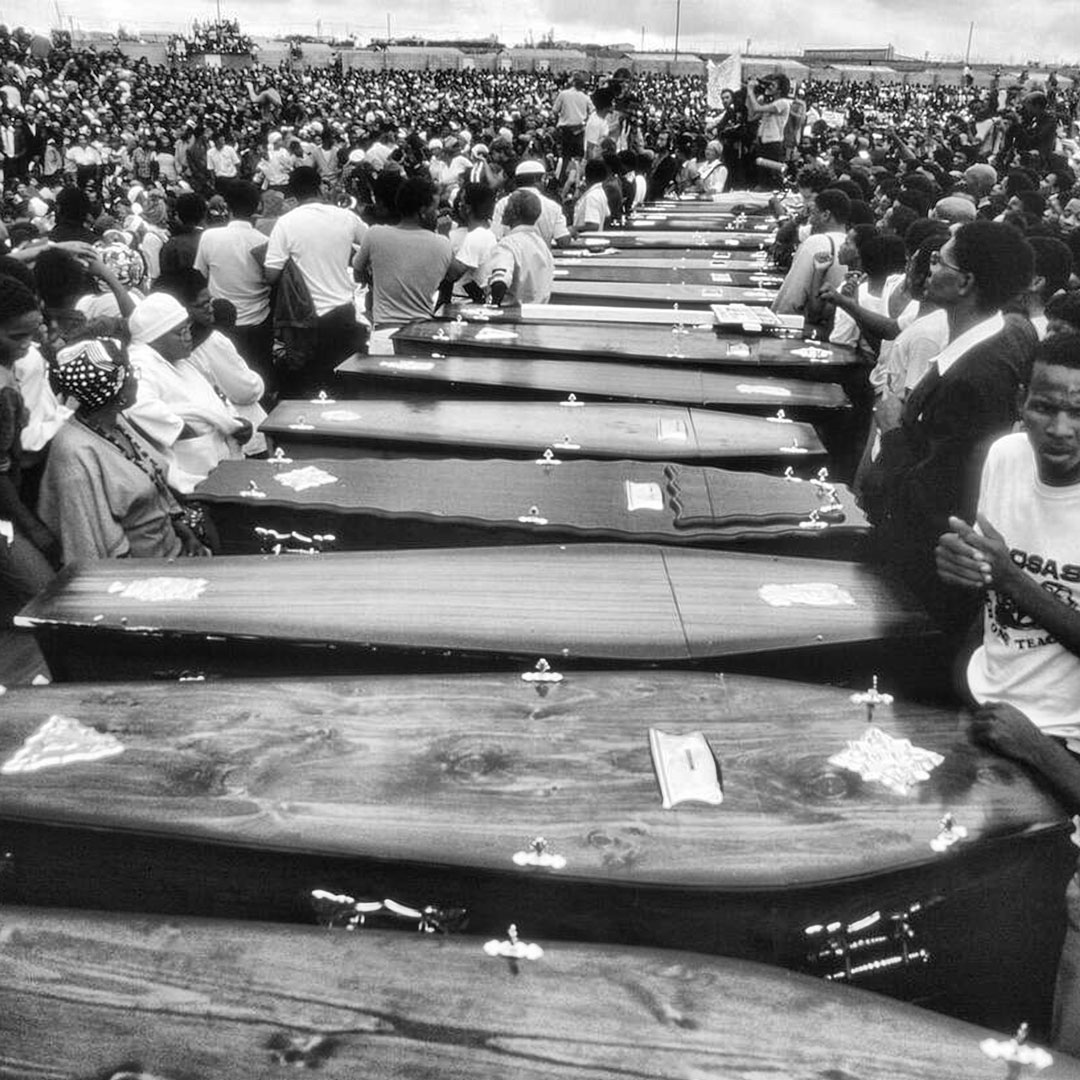
Photo: The coffins of those slain in the Langa Massacre of March 21, 1985. (UN Photo)
*Some names have been changed to protect participants' privacy.
Cite as: Small Little Foot Soldiers: A People's History of the Anti-Apartheid Movement in Canada, Episode 1, "Awakenings." Amandla! Radio Collective, CKUT 90.3 FM, 2026. Transcript.