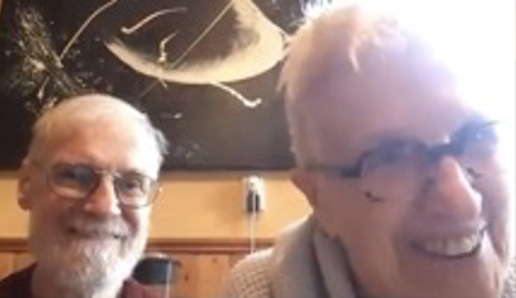
Bob and Jean Rutka
-
Bob came to Montréal from the towns of Churchill, Manitoba and St. Catharines, Ontario. As a journalist with the Prensa Latina news agency set up after the Cuban Revolution, his contacts and Cuba connections provided important networking for activists of many movements in Québec and formidable support to local and international social justice issues.
Jean, from London, England, was an administrative officer at McGill University in Montréal before pursuing a career as an artist. During the 1970s, she was deeply involved as an activist with local feminist groups and was a founding executive member of Mouvement québécois contre l’apartheid (MOQCA).
Doug Miller 00:00
Well, now it’s nice and clear. Everything’s fine. Well, good morning. I’m Doug Miller here in Montreal with Gwen Schulman here in Montreal for the Canadian Anti-Apartheid Activist History Project, and we’re today with Jean Rutka and Bob Rutka, also in Montreal, and want to talk to them about their background and experience with the anti-apartheid movement of the era, and I’m going to start, Jean and Bob, asking you to acknowledge that you’ve read the consent form and you understand and agree to its terms. If you could just acknowledge that verbally now, please.
Jean Rutka 00:35
Yes, we could. Yes, yes,
Bob Rutka 00:36
We have read it and we have signed.
Jean Rutka 00:38
Undersigned it. We’ve sent it to you.
Doug Miller 00:40
Okay, great. That’s wonderful. Well, maybe maybe I could start with you Jean and if you could just tell us a little bit about your background and how you came to know about apartheid and ended up here in Canada somehow involved in it a little bit, the anti-apartheid struggle.
Jean Rutka 00:58
You mean go back to me when I was in England? Yeah. Well,
Doug Miller 01:01
Whatever your history is.
Jean Rutka 01:03
Oh okay. I was born in England. My mother had a very good friend who was black. She had a white father and a black mother, and she committed suicide because she had so much discrimination towards her. So my mother and father were very much against any kind of, how should I put, apartheid with people. You know that you shouldn’t reject people because of their color or their nationality or their religion. So I was very much brought up like that. I experienced Jewish oppression because my aunt was married to a Jewish man who brought over several refugees, and one of them actually shared my bed where I was evacuated.
Doug Miller 01:57
Now we’re talking about the Second World War, aren’t we?
Jean Rutka 02:00
World War, and that had an incredible influence on me because her husband was shot in front of her eyes, and my uncle was able to get her out of Germany, and several other people he got out of Germany. So I’ve seen what discrimination does to people when I was very young.
I didn’t get involved in anything very much until after I came to Montreal, which was in the 1970s, and I ended up working with an anti-apartheid group. And during that period, we had quite a few people come through Montreal who were from Africa, and who were, and I also worked at McGill, where I met with Mtshana Ncube, who was very active in all these things, and he had also happened to get into a lot of discrimination, and it was very much a time when there was a lot of things going on with the women’s movement that I was involved in, and a lot of it was to do with discrimination against anybody. It was the, you know, like the black movement in in the states, and it was also here.
So it it became like that, and I don’t know if you remember, Doug, but you borrowed my car when sometimes to take people around. Representatives are to come to take people around Quebec, and some of them stayed with us because we had room to put them up. So I got to meet a lot of people like that, and I especially remember one woman who I’m trying to say, at 87 I cannot remember her name, but I remember her totally. I remember what she looked like and how she was, and she got stuck here after she’d been around with you because she didn’t have a proper visa to get back into the U.S. to take her plane home.
So she spent the long weekend with us, and the first evening she was here, she laid on the couch. Bob went to bed, and she and I sat up till three in the morning, talking about our families, talking about how she walked out of Zimbabwe, how she managed to get to Europe, and how she came was now working with groups across North America and in England to tell them what was going on in Zimbabwe. Her daughter at that time was in jail, and before she left, she asked if she could send me letters that would go to her daughter, so that people wouldn’t know where she was, and it wasn’t from her.
And so I used to send the letters from her to her daughter, who was in jail. I think she was in jail for about six or seven months after she left. So almost every couple of weeks, I got this letter that I used to send, and I often wonder what happened. Because I lost touch with her, because then Rob and I went to Washington, and we were we were there for a while, so we weren’t involved as much.
I also went representing the anti-apartheid men here. I went to London in in Holland. No, was it Holland? Yeah, in Holland, and there was a there was a meeting there for the various liberation movements, and I represented the group in Montreal there, and so I went.
Gwen Schulman 05:34
Jean, I was at that conference too. That’s so interesting. We didn’t know each other at the time, but I was there as well, representing students. That’s so interesting.
Jean Rutka 05:42
Yeah, and it was a very interesting time for me, and very much an eye opener, really, because I came from reasonably protected childhood with, you know, family around. Even though it was in during the war, I always had family with me, and so it was very interesting to me to meet all these people. I remember very much coming back on the to England on the boat, and I was with a woman who was a doctor, whose name also I can’t remember, which is ridiculous. And she said to me while we were standing out on deck watching the waves, she said, “You know, I would never have believed I would be standing on a boat talking to a white woman so intimately”. And I said to her, “Listen, I came from a very, very working-class family. I never would have believed that I would be on a boat talking to a doctor”.
Doug Miller 06:46
Oh, fantastic! Now, Jane, if we could just place some time time here because I I just can’t believe that you and Gwen were in Leiden at the same time. I think you were in Leiden about 79.
Jean Rutka 06:56
Yeah, yeah.
Gwen Schulman 06:57
But the conference, the conference in in Amsterdam, right? It was women in the movement. Was that the conference?
Jean Rutka 07:04
I think so. Yes.
Doug Miller 07:05
In 19 –
Bob Rutka 07:07
No, no, no. This one was in Leiden.
Gwen Schulman 07:10
Oh, okay, okay, okay, okay.
Doug Miller 07:13
You were representing whom, Jean? Who, did you? What was the group here that –
Jean Rutka 07:18
representing the anti-apartheid group in Montreal. Do you remember the name of the?
Gwen Schulman 07:24
Do you remember the name of the organization in Montreal?
Doug Miller 07:27
Movement Quebecois contre l’apartheid, MoCA.
Jean Rutka 07:31
That was it. Yeah, yeah, yeah. That was it.
Gwen Schulman 07:34
And can you describe that a little bit for us? Who?
Jean Rutka 07:38
Well, it was a group. It was a group of women that got, and men that got together and tried to find out ways where we could make it more and people to understand what apartheid was. And there was also somebody we used to bring people that would come and give talks and things like that. It last, I, it ended up not doing very much at the end because we asked someone to translate a book. We had a translator who was with us, and one of the people in thought it would be better if we all helped with the translation, which made it terribly difficult, and it kind of fell apart, which was very sad. But we used to bring people to Montreal and to talk about things that were going on in in Africa.
Gwen Schulman 08:28
What kind of people, liberation movement?
Jean Rutka 08:33
Yes, liberation people.
Gwen Schulman 08:34
And what other tactics did you use to raise awareness?
Jean Rutka 08:42
To be honest, I can’t remember.
Gwen Schulman 08:45
Did you do any boycott work, or were you going into schools, going to churches? How are you reaching people?
Jean Rutka 08:52
No, some of the people went to CEGEPs. Some of the people went to very various organizations to talk about it, I myself I was working at McGill, and so I was able to get rooms where people could meet, things like that. But I wasn’t as active as a lot of the people because I was working and I had three kids and I was separated from my husband, so I had a lot to do at home, but we did have our house open to people who were staying. So a lot of people in the liberation movements came and stayed at our place while they came here to do do a tour around, not just from Africa but also from Latin America, because Bob was very much involved with Latin America. So we
Bob Rutka 09:46
So we were downtown. I mean, we were downtown. Okay, should we tell?
Doug Miller 09:49
Yeah. So let’s use that as a segue to go back and get your background, Bob, and you know where are you from, and how did you get introduced to apartheid and the anti-apartheid movement?
Bob Rutka 09:57
Well, I mean that that was actually an interesting question. It’s you know it’s hard when you think back, but I was brought up in Churchill, Manitoba, a small town on Hudson Bay in Canada’s north, and it was a, you know, almost like an apartheid village because we did have Inuit, we did have Cree, and we had whites, and of course, although I remember playing with Cree kids, there wasn’t any social mixing or very little social mixing, and so I guess that was a direct experience. Which, of course, I never realized until till much later, until became I until I became a young man.
My, I guess my awareness, my awakening came when I first traveled to Mexico to Central America. You could see, you could see a mirror image of what I basically grew up with, and you could understand why it was happening. And so I guess that was that was sort of the the root of the of a political awakening, I guess, if you want to call it that. Back in Montreal, I got involved with a Latin American working group. I met Jean at a Greek Solidarity Night. Jean was organizing a feminist symposium, and a friend of mine invited me. That’s how we met. We met through a political, political activity.
And my, my role in sort of the anti and as far as Africa is concerned, anti-apartheid basically came through Jean. I mean, we were here. We lived downtown. We met you. I was aware of what Jean was doing. We had people coming through, so it was just sort of a natural evolution.
But I always saw my role in terms of the anti-apartheid movement as basically a facilitator. We had space. We, it was convenient. We had a car, which I think you used numerous times. So we just saw ourselves basically as facilitators for the people who were trying to raise awareness here. Well, that’s at least how I saw my role was.
Doug Miller 12:21
Yeah.
Bob Rutka 12:22
in terms of Africa and the apartheid movement.
Doug Miller 12:25
Gwen Schulman 12:26
Want to get back to MoCA? Oh, sorry. Go ahead, Doug.
Doug Miller 12:28
No, well, just one last thing about Bob before we move back. Yeah, I want to go with, with that too. But Bob, do do you think your your work with Prince and Latina in Cuba had any connection at all to this, especially given well,
Bob Rutka 12:43
Yeah. Well, it was all it was all tied together. I mean, we were we were living during a time of the dismantling of the Eurocentric empire, which has been established over the last two or 300 years. So it all sort of became tied together. I don’t think I, I saw one what was happening in Latin America or in in Asia, the Vietnam War or in Africa as separate from each other. They were all part of this general trend. So I in my mind I don’t think I, I kind of separated them out. Obviously, I was much more aware because of the work I was doing because I was just involved in it all every day.
Doug Miller 13:33
Okay, so so Gwen, back to MoCA then.
Gwen Schulman 13:36
Yeah. So I just want to get a better sense of the membership of MoCA because so often when we talk about the anti-apartheid movement, it was students together. It was members of a church together. It was, you know, union members together. So, with MoCA, was it a diverse group, or was there a particular constituency that it drew from for its membership?
Jean Rutka 13:56
I think it was a more diverse than that. We had a couple of students. Then we had people that were working in offices. There were people who were working in factories. You know, different people like that.
Gwen Schulman 14:13
And what about the language, French, English?
Jean Rutka 14:15
Oh I remember, it was basically English, but there were French Canadians in it, and so it became sort of half bilingual and not, you know, my French was terribly bad at that time because I just moved to Montreal.
Doug Miller 14:29
I can speak to that a little bit as well because actually you were away in Europe when the founding convention took place in, I believe, July 70, 79, and, and it there there was also a good union presence and the World Peace Council had their, the Helsinki Group had their offices here in Quebec in the CEQ the Central d’Enseingement de Quebec and had good support from the teachers’ffederations, and it was basically a group run by the the Quebec Communist Party with Ed Sloan as their motor behind it. You, Gwen probably know his son Will William or Bill Sloan, and Ed Ed was the, the party’s foreign and international relations guy, and so they did a lot. They provided a lot of the organizational energy at the beginning, but as we got going, things diverged a little bit from that line that the ANC and Ed Sloan wanted to run. So so we had some real problems with with them at one point. You remember all of that, Jean. Can you be more specific?
Gwen Schulman 15:47
Can you be more specific about that for those of us who weren’t there? That’s not clear.
Bob Rutka 15:54
Ideological disputes, a problem in, I guess, looking back at any kind of organization, any kind of group, you always seem to have internal struggles related to clashes between personalities, allocation of power, and and so I don’t think those issues are unique to any group that grew out of the anti-apartheid movement or the anti-decolonization movement. I think it’s universal. I think it’s just sort of almost natural. So I think those were the issues: personality clashes, who is going to be running what, how do you allocate tasks and responsibilities, and those are universal issues. I think they are around for, in my experience, anyway, most groups, and I think they were reflected in MoCA, and the other groups that I specifically
Doug Miller 17:06
Specifically the ANC, and Sloan saw MoCA as their creation and that working for them, and because we had relations with Swapo and Zapu, very close relations from my work in Zambia, we were promoting all three movements and seeing a lot of Zimbabwe because the war in Zimbabwe at that point was very hot. In 79, it was in its final stages, so we were hosting Mtshana, who was the delegate for ZAPU at UN, and people that they ZAPU wanted to bring to Canada to to spread the message because, as I say, it was extremely hot and ended up just at December going to Lancaster House and being settled in the imperial capital to the disfavor of Zapu, of course, with an election that was rigged. But in the end, the Ed and Joel felt that we were not dedicating enough time to the ANC and the direction the ANC wanted to take things.
Jean Rutka 18:09
And it wasn’t just that dance. What what upset me most about the thing with Ed Sloan was that he didn’t want people who were not left wing in the group, and there were people that came from various backgrounds and wanted to help with this, and he wanted to cut them out. And I felt that was very wrong, because if you only have people who think alike, and you’re trying to really change things, it’s no point having just the people who want to change things together. You have to get other people in so that you can help them learn about other countries and other things. He was very much against that, and that’s why I really fought against that really hard. And in the end, it kind of, Ed Sloan left the group.
Doug Miller 19:04
Yeah, it just eventually folded of its own volition because we couldn’t we couldn’t get agreement with Ed. He was, thrown wrenches in the spokes at every, at every meeting.
Jean Rutka 19:15
Yeah, there was a woman that had been a nun in the group, and he, and she had left the the Catholic Church because she didn’t believe in what was going on, and but she was not very left wing. But she was coming along, and he didn’t want her in the group. He was horrible to, I mean, to me, that is not doing political work. That’s being a little power trip on people, and that’s what Edward. That’s how I saw Ed Sloan in that group. He may have done good work elsewhere, which he probably did. But in that group, he was poison.
Gwen Schulman 19:49
Okay. How about, how were, because this is this is kind of early in the Quebec anti-apartheid movement. Certainly, quite a bit before I got involved. And I’m curious in those early. Your days, how were you perceived as anti-apartheid activists? How did the broader public or your colleagues, family, friends, how did they perceive the work you were doing as anti-apartheid activists? They open to it or wary of it?
Jean Rutka 20:17
Most people were open to it. I don’t think anyone that we ever encountered was against was for apartheid. They thought it was terrible, but a lot of what, but I found that most people, even though they will say that, and maybe this is unfair because there’s a but, there’s a lot of people that are very much against certain things that are happening, but they just go on merrily with their life and say, “Oh, I’m very lucky not to be there, that or that it’s not like that in this country”, and so you end up with just a few people who are fighting it really hard, and it’s very difficult to get a lot of people in Western countries involved because they’re very used to having all their benefits. And let’s face it: if we were to say, okay, we can’t have all these benefits so that people in the third world, for example, can have more. Nobody wants to give up anything, and until people are willing to give up what we have, some of it, so that other people will live better, then it’s always going to be like that. And I don’t have much.
My, right now, at the age I am, and looking back on what’s happened in the world since I was born, I haven’t got much hope for the world. To be honest, I don’t see that there’s been very much progress. Even the women’s movement has backfired, is back, backing down. You know, you see young women now; they’re being encouraged to be sexy so that a man will love them, you know that kind of thing. We fought against that, and it’s still here. We fought against racism; it’s still here. I mean, we have friends that are that are black, and they still run into racism. Where is it? What, you know, I sometimes feel that what we did was a drop in the ocean, and that it had nothing, and it’s getting worse. Well,
Gwen Schulman 22:34
I think a lot of people though really admire what you did, and would maybe take a longer view of struggle and say you know struggle has its ups and downs, but you know part of this project is I think people draw a lot of inspiration from the kind of work that that you did in the anti-apartheid movement, and a lot of young people are very curious about it. They want to know more because they see it as a tremendous organizing moment, which is why these stories are so important to serve as inspiration for people today, and they are inspired.
Doug Miller 23:08
Yeah, I think Jean, I would like to I would like to take you back to that time again, and and and say you mentioned the name Mtshana Ncube who was at McGill at the time, what kind of role did he play, and how did he work? When
Jean Rutka 23:26
Mtshana was at McGill, he was very much involved in spreading the word about what was happening in Zimbabwe. And actually, we had two or three meetings at our house with with Mtshana where he came and talked to different people we knew that we used to invite over, and he would talk about Zimbabwe to them and what was happening, and also we tried to raise money in in that sense for for things like that. I mean, Mtshana was I feel Mtshana h was a very driving force In the anti-apartheid, my movement here, you know, when he was here, in McAdam and and elsewhere.
Doug Miller 24:12
Absolutely. Okay. Well, and any other people that you can remember working with that that would be remarkable from that period?
Jean Rutka 24:21
Um, can’t remember his name.
Doug Miller 24:28
Yeah, that’s okay. Don’t worry.
Jean Rutka 24:31
I’ve never listened, Doug. I’ve never been able to remember names, even when I was young. But now I’m even worse.
Bob Rutka 24:36
Well, there was one guy called Doug Miller that we knew. Yeah, yeah.
Doug Miller 24:43
Sam Noumoff was in poli sci at McGill,
Jean Rutka 24:46
Sam Noumoff, and it was interesting because I originally started working in the faculties of management, and I worked in three business. University places and at McGill, I was the admin person in the Faculty of Management there. What surprised me most was that many of the professors in the Faculty of Management, when I talked to them about what was happening, were very very helpful, and were very much well. They let me leave, my my dean, for example, Dr. Shapiro. He let me take take time off to go to meetings, for example. I mean, that really amazed me because you know you had that fear, feeling that oh, he’s working. You know, I was very working class I think oh these people you know they’ve got all kinds of things and they’re capitalists and all that but they weren’t all bad which was very interesting for me so I learned a lot from that and we also had black students that came and a lot of them had difficulty, not so much with the professors, but with the other students, with Canadian and American students, who had this “oh, black people are useless”, you know. I mean, it was a, it was a very funny time.
And I found it when I I moved over then to East Asian Studies, and I I went and worked for Paul Lin, who was very much involved with China, and Sam Noumoff, who was very much involved with China, so I got to know a lot about what was going on in China and what was going on with students there. They had an exchange program where students came from China, and I was amazed at how brilliant they were because many of them that came could hardly speak English, and yet they still went to, they were in the faculty of management, some of them, and they still managed to get A’s in their classes, in their, all their things, they just studied, and although they couldn’t speak English well, they understood well, and they were able to get through. And I thought, well, that’s very interesting. That people who basically everyone, every normal person in in that you meet in a white, think white people are superior, and to me it was an eye opener to feel that people in other parts of the world were not less educated, less able to be learned, and I mean recent studies have shown that a lot of people from Africa, for example, in England they’ve got top marks everywhere, which is interesting more than more than white people.
So it was for me working with people that were from other countries and working, you know, every day with people who were from other countries and very involved in other countries, made me understand that everybody basically in the world is the same, and that we shouldn’t be discriminating.
Gwen Schulman 28:11
Jean, you pointed to something interesting, and I ask most of the people that we talk to about this. You mentioned the racism against African students at McGill, and this is in the context of the anti-apartheid movement. And earlier, you had said that people were very receptive to the anti-apartheid activists’ message, and everybody agreed that apartheid was wrong. But did you ever detect within the movement in Montreal racism within it, or and or sexism within the movement? As a woman in the movement, did you ever feel that there was tension that men tended to take leadership roles, or that white people within the movement tended to take leadership roles over black people within the movement? Did you sense any of those contradictions?
Jean Rutka 28:56
Well, there may have been, but for me, I didn’t see that because I had a very strong black woman who was a friend, and if anybody tried to take away her her independence or her role that she was playing, you heard about it. She was involved in the movement, and there’s there’s a lot of of I mean, men did did try. They did men did feel that they knew better. It was sort of like I’ve had men sort of like tap you on the head, say, “Oh yes, that’s nice, dear”, but they soon learn not to say that to me, and I think most of the women that were involved didn’t put up with that at that time, because the women that did get involved were probably very much working towards women’s liberation in many other areas.
Bob Rutka 30:00
And I think there was some. There was sort of like Mtshana was one of the most brilliant men I’ve ever met, so it was it was pretty hard to for I think for anyone who he met or he interacted with to kind of put him down or or to to to walk away thinking oh, I’m kind of more intelligent or or I’m somehow better than him. He was a brilliant he was a brilliant man, and it showed you know a very outgoing personality, very strong. So I think it was a lot of those sorts of people who who, who were able to deal much more effectively with all that nascent racism and sexism that that was very prevalent in the left as well. I mean, was very prevalent in a lot of the left, actually, at that time. It was early days, as early 70s, mid 70s.
Jean Rutka 31:07
Yeah, women were supposed to make the tea.
Doug Miller 31:11
Well, you you were part of the women’s health press and the the university settlement and all of that involved women.
Bob Rutka 31:21
Yeah, because we were- I mean, we were- you know, there was a lot of there were just local community activities as well. I mean, you were you know from early early years, you were on the school board. We were both on the university settlement board at one point. I mean, so so there was, it was just not international solidarity. There was also a lot of local activities going on, and it was maybe at that level that you ran into more of the, or more of the sexism, more of the males trying to dominate than maybe at any of the. I’m trying to think at any of the international solidarity groups, I think those who were involved, and maybe the international solidarity groups were maybe a bit more open, a bit more advanced. Would you say a bit more advanced?
Doug Miller 32:12
Well, I can remember a couple of MoCA meetings where Ed was trying to railroad us, and Jean, Jean had way more backbone than I had to confront the bugger. Yeah, yeah.
Jean Rutka 32:21
Oh, no man could get around me. No, what was interesting was that I had two boys. A lot of women were going on in the women’s movement about men, or this manner that or the other. My kid, my boys are not sexist. But what really made me happy was they were not, they had no problem with anybody of color of any kind. In fact, Jim used to be on a makeup team of kids from the East End. There, not East End. Where was it? Down by Saint John, Saint Dougie, Little Burgundy A baseball team. and he was on a baseball. He was the only white kid on there. He had around seven or eight friends that were black that used to come to the house. I mean, we had it. I used to find it was wonderful that sometimes people would come, and I would always make have extra potatoes and extra carrots and things like that because they’d all end up eating.
So we’d have this whole room full of people of all different colors, and I used to think how nice that is. And you learned a lot about people from other countries that they were no different. I mean, when that woman from Zimbabwe came, and I spent so much time with that weekend. She had the same issues that I had about her children. She wanted the same things for them that I wanted for my children, and so you realize that everybody in basically on Earth is the same. We just happen to be a different color because of where we are, where we are originated, or moved to, because of the climate. That’s all. And so, if only people could understand that or accept that, I don’t think we have so much tension about there.
But then you’ve got, well, you come right down to it, there’s a lot of black people I don’t like. I mean, let’s face it. Look at look at in Africa with the dictators that are there, that are treating their own people so badly. How do I? You know, people just ask me. Well, how are you supporting that? Well, I don’t support it. It doesn’t mean that I don’t support freedom for, for people here or in the rest of the world, you know, and I think that’s something that you know a lot of people think. Oh, I really like like all black people, or I all like all Jewish people, or I all like Chinese people. How can you like everybody? You can’t. And I think that’s something that, in in in a lot of the movements, people didn’t understand that you could that not all people are nice to you.
Doug Miller 35:12
Well, well, Gwen, how how we how are we doing?
Jean Rutka 35:18
Well, right. No, she’s
Gwen Schulman 35:20
talking. Well, I guess I guess really, what do you know? Do either of you have anything else to add? Do you? I guess one last question would be: Do you think there was something special about the anti-apartheid movement? Did it stand out in any way, or you know, similar to any other international solidarity movement?
Jean Rutka 35:39
No, I think it was a good movement. I think it did help people, even if it, even if, well, look, we had an anti-apartheid movement, and it was very wonderful time when so many nations in Africa won out, and we thought that that was going to be wonderful, and things will be better in the future. Unfortunately, it got taken over by very conservative, what would we call them? Tyrants. I don’t know, but you know. And so it ended up no different than what the British and the and the French and the others people did. They did the same kind of government, and they kept people down, which was very, very disappointing.
But I think at that time we we felt at least I felt that the groups that I worked with, that and I met people that were working when I went to you know to London and to England. I found that I met people who were working very hard for people, and when we were in Washington, I met people who were working very hard for freedom for other people, and I think that made an impact. Unfortunately, things now are not very good.
Bob Rutka 36:56
I think, in terms of that of the question, no, I don’t think the, just my experience because I worked a lot with Latin American solidarity groups. No, I didn’t perceive any difference. That’s an interesting question. I really didn’t perceive the anti-apartheid movement or the organizations that were dealing with that issue here really any different from any of the other solidarity groups for the other regions of the world. I found them, they were both. I mean, basically, each group kind of had its, its own dynamic, but I mean, the problems were were were similar. How people reacted to each other was similar because we were all out of that same age. So I didn’t. I that’s an interesting question. No, I don’t think there was anything particularly special or unique. I guess the word is unique. I don’t think there was anything really unique about it. I think it was just part of a of a of a more global movement at that time. As, as part of as I think I said earlier, as part of that sort of the decolonization of the world, if you wish. I don’t quite know what the word to use.
Jean Rutka 38:09
Yeah.
Doug Miller 38:11
Yep. I I think with with that, and and and I thank you very much for your your contribution. We we appreciate it. It’s all.
Jean Rutka 38:19
I wish I had a better memory for some of the things I don’t remember.
Doug Miller 38:23
Oh my goodness!
Gwen Schulman 38:25
Okay, that’s in this case with all of us.
Doug Miller 38:28
About 40 years ago, my goodness, I also had hair. So –
Bob Rutka 38:34
We all did.
Doug Miller 38:36
Yeah. So, so with that, I’ll thank you very much for your contribution, and, and wish you good day. If you, I’ll turn the the recorder off now.
Credits
Bio:
Bob came to Montréal from the towns of Churchill, Manitoba and St. Catharines, Ontario. As a journalist with the Prensa Latina news agency set up after the Cuban Revolution, his contacts and Cuba connections provided important networking for activists of many movements in Québec and formidable support to local and international social justice issues.
Jean, from London, England, was an administrative officer at McGill University in Montréal before pursuing a career as an artist. During the 1970s, she was deeply involved as an activist with local feminist groups and was a founding executive member of Mouvement québécois contre l’apartheid (MOQCA).