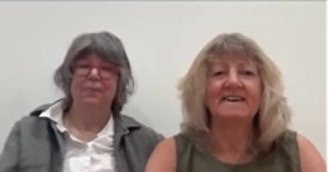
Jane Armstrong and Brenda Wall
-
Jane Armstrong from Saskatchewan, Jane worked at the Canadian Air Line Employees Association and poured her energies into supporting the SACTU Solidarity Committee. She organized cross-Canada educational tours of South African labour representatives, raising financial aid from Canadian unions to sustain SACTU's underground operations and strike fund as well as lobbying Canadian unions, provincial federations, and national bodies to adopt and take action on divestment and sanctions against the apartheid regime. She played a key role in collecting the interviews, material and other artifacts for deposit to the Library and Archives Canada SACTU Solidarity Committee fonds.
Brenda Wall Born in Australia, Brenda came to Canada in the early 1970s and studied at the University of Alberta where she joined the Free South Africa Committee. She was part of a 1976 sit-in protest at a cricket tournament in Edmonton that involved a South African team. Brenda is co-author of Organize or Starve!: The History of the South African Congress of Trade Unions and participated in the creation of the SACTU Solidarity Committee in Toronto. She was awarded the Order of the Companions of O.R. Tambo by the government of South Africa in 2024 for her role in helping to free South Africa from apartheid.
DOUG MILLER 00:07
There we are. Good morning. I guess it’s good afternoon. Brenda Wall and Jane Armstrong, could you first please give me your name and where you’re at, one by one? Where are you sitting now?
BRENDA WALL 00:22
I’m Brenda Wall, and I’m sitting in the Toronto Reference Library in downtown Toronto, June 8.
JANE ARMSTRONG 00:31
Jane Armstrong, obviously same place, June 8.
DOUG MILLER 00:36
Good stuff. Well, just at the beginning, in formality, is that we ask you to acknowledge that you’ve read the consent form and you agree to the conditions therein. Brenda, do you agree?
BRENDA WALL 00:50
Yes, I agree.
JANE ARMSTRONG 00:53
I agree as well.
DOUG MILLER 00:55
Okay, good stuff. Well, we begin usually with a very broad question, and it’s up to you to decide who should go first, but just give us a little bit of background about yourself and how you learned about apartheid led you to the work you got involved in.
BRENDA WALL 01:14
Well, I was born in Australia and sort of a social democrat growing up, I guess, and heard about apartheid was heading to Canada with my first husband in 1972 and decided that we would go through South Africa and Southern Africa to really see for ourselves what apartheid was all about, and so we arrived in Durban in 72 bought and stayed there for a bit of time, almost got thrown off a balcony of a distant relative who was an Afrikaner because of our perceptions of apartheid, just on being there and going into the townships and seeing for ourselves what a part, what the abhorrent apartheid system was like. So then we traveled up through Africa in a van and went to Canada to study. So that’s that was my beginnings to hear about apartheid, Jane.
JANE ARMSTRONG 02:14
I think in my case my first knowledge came from a very progressive history teacher in high school, Armand McCaig, who I later learned went on to be on the board of Oxfam many years later, but that’s my first memory of learning something about apartheid,
DOUG MILLER 02:37
And that was.
GWEN SCHULMAN 02:39
Sorry, I’m going to dive in here, just introduce myself quickly. Gwen Shulman, part of the project with Doug and co-interviewers. So we’re really going to focus quite a bit on the work that you ended up doing with SACTU solidarity committee. So I was wondering if you could both speak to what was the SACTU solidarity committee and your involvement in it, how it came together.
BRENDA WALL 03:02
I’ll try to be brief, and so that Jane has a chance as well. But in 1976 I became. I was at the University of Alberta at that time, and became involved with the Free Southern Africa Committee. It was after the Soweto uprising that there was a lot of activity in Edmonton, mostly around the students and the student movement in solidarity with Students Against Apartheid, and we formed the committee, and actually many of us were arrested on a cricket pitch in September of 1976. It was an Oppenheimer-sponsored cricket team. I’m sure others have talked about this, coming through to at the time of the Montreal Olympics, and trying to show that, you know, “we are, we are a mixed race cricket team”, and so on. We demonstrated against the Oppenheimer-sponsored team. 61 of us were arrested, put in jail overnight, and out of that we were eventually acquitted.
But out of that became a movement, and we had George Poonan, who was an older SACTU trade unionist involved in the 1930s in Durban in the textile industry. He and his wife, Vera Poonan, both members, active members of the South African Communist Party, as well, they were suggesting that we need to educate people in Canada about the apartheid system, especially the unions. So we began working with the unions in doing that solidarity work, and then Ken Luckhardt and I wanted to become more involved in the volunteer work with SACTU. We had James Stewart and other SACTU representatives come through. We said, “How could we become more involved in this SACTU work? And you know, we’d like to work directly with the movement”, and George Poonan said, I’ll write you a letter to John Heidse, Secretary, the sorry, the General Secretary of SACTU out of London, and we took that letter.
We arrived in London in the fall of 78 and said, “Here we are”, and began working with SACTU. Then I’m going to skip a lot, because I’m sure a lot has been covered elsewhere, but we eventually interviewed SACTU comrades in in southern Africa, in the frontline states. Many of those interviews have been lost, but we’re hoping there’s eight trunks of materials of SACTU comrades, photographs, taped interviews, notes, and everything that we produced that went into eventually the book, Organize or Starve. John Heitzel, we said, “We’ve got so much material here, the research we did, and the photographs and interviews. The material is so rich, we need to put this into a book”. So we were commissioned to write the book, “Organize or Starve”. Out of that.
When we came back to Canada in 1980 they said, “You can’t just disappear into the ether. Would you work for us? One of you work full time and the other person do you know get work, get a job?”. So we agreed to do that when we came back to Canada, and I’m going to pass it to Jane, because we met in May 1980 to begin that work.
JANE ARMSTRONG 06:25
Yes, and at the time Ken Traynor, my partner, and I had just moved to Toronto, maybe a month earlier, but Ken had been a CUSO cooperant in Southern Africa and had met Doug Miller and Ken and Brendan, who Doug Miller, and it was Doug who was the catalyst who put the four of us together, otherwise we wouldn’t have known each other, and so we met on one very hot day, and we each put $20 into a pot on the kitchen table to produce some letterhead that was back in the pre-computer days to get started, and Ken and I committed, to the same thing that Ken and Brenda had, one of us would work and the other one will work full time on a voluntary basis for SACTU, and that was the origins of the committee in 1980.
BRENDA WALL 07:26
So I worked in the office. The office was at Broadview and Danforth in the east end of Toronto, on the second floor above a greasy spoon restaurant, and there was a fire soon after we arrived there and had books and materials burned. That was the only place there was a fire. There was no electrical fire, nothing. So we figured that was CSIS or whoever it was at the time under my trying to undermine the work of sector. So the postal workers gave us an office that was just up the road on Broadview in the East End of Toronto gave us an office, gave us, you know, materials, the chance to do the work from there, and we built a committee around, at the time, George Poonan, his nephew was there, we had, we had other people like Jay Nair, who was Billy Nair’s brother. We had a number of people, Sam Gindin from the Canadian Auto Workers, Hassan Yussuf, later communication workers folks. We built a committee gradually. There was sort of a central core group. We built one over the years gradually with people from the trade union movement, so we had the broader SACTU solidarity committee of trade unionists.
Then we had sort of a core committee of at the time, at the beginning I did the work for two years as a volunteer, and Ken taught at TMU. Now Jane worked at CALEA, the Canadian Airline Employees Association, and Ken Traynor, when he was back from Botswana, did the work, so you know we had various people full time in the office, but for most of the 80s it was Ken Traynor and Ken Lucar doing the full time volunteer work. I got a job with the Labor Council, Jane became part of the Canadian Auto Workers, so it was those guys, plus Vince Greason, who worked out of the office for the bulk of the time during the 80s doing that work.
JANE ARMSTRONG 09:26
Yes, and I think from my perspective the early years of building the committee and our credentials with the labor movement, because we were young, we were in our early 30s. I worked for a small union, eventually the CAW, but we weren’t known in the labor movement. So, I think what was crucial were several points. One was Ken and Brenda had enormous. His credentials with the publication of the book, with having worked with the movement in particular with SACTU for several years, so that gave a lot of weight to who we were and what we stood for, and then secondly SACTU was very supportive, in particular Zola Zebe, understanding that we needed to bring comrades to Canada, and Zola met very early on with the leadership of the Canadian Auto Workers Union and the Postal Workers Union at that very first meeting with Bob White at that time it was UAW, later CAW just cemented their relationship from then on. He never doubted what SATU was, its crucial alliance with the ANC, and the support that needed to be built in the labor movement, so that meant doors opened, but he was white, was very clear, and so was Jean Claude Perot, who was the head of the postal workers. We had to do the work local by local by local across the country, and from the get-go we worked in both languages, French and English, and we just started with what was recommended to us as the most progressive locals that we could get into by getting an invitation to speak at a local membership meeting. Usually, we had no more than 15 minutes to be able to convince the members at that meeting that sector was worthy of support, and that they would take action, and including financial support. So we just worked local by local, province by province. We brought the comrades on tour and organized those tours across the country, and that was also crucial.
BRENDA WALL 12:02
There are two things, as well, I think, are important to speak about that happened from the beginning, that we had the letter from John Sewey, the General Secretary of SACTU, saying we are working on behalf of SACTU, so we are not just another anti-apartheid group, and many people sort of say, “Oh, well, you must have worked with Tickle Sack and the anti-apartheid movement. Yes, when we converged in different ways, but, but we had the unique, you know, responsibility to work on behalf of SACTU, and always had that letter with us, and, and it was also cemented by the tours that Jane said, Tozamile Botha from the Ford strike, I think that was even at the very beginning in 1980 and Tozo Mille Machete from the Mine Workers Union. The other thing that’s important is that we had a link with the underground work. This is something that’s often criticized at Oil SAC, too, is here, and the above ground unions were, you know, were there, but SACTU was nowhere to be seen. We had many visitors with us, and I distinctly remember Tosamili Machete from the Mine Workers Union at the time. He was in our house on behalf of SACTU, speaking to Sydney Mufamadi, who then became, now I think, or recently was the Economic Development Minister in South Africa at the time, was an underground trade unionist working with SAC, to, so you know, we had those links, Pat Clancy from the Auto Workers, you know, took money across the borders to SAC to comrades, and so on, so you know, we had a link, which couldn’t be exposed to many, but and we chased around Cyril Ramaphosa, the president of South Africa. Now we chased him around after Paul Puret, the CLC representative, who was trying to keep him from us, that he was the link between the mine workers and SACTU as well. So you know, I think those two things are very important to remember, that we had the, we had the responsibility from SAC to itself, and we had those comrades with the links to the underground work. I
JANE ARMSTRONG 14:18
Just want to say, in order to do this, it ended up as Brenda mentioned, the two of us ended up working full time in the labor movement, and we also shared a house, we shared cars. You had to do a lot of that in order to be able to have support the work, and you know, support the rent, the groceries, you know, the background for them, the two kids to be able to work full time, and we were immersed pretty much 24/7 so Brendan and I after we finished our paid labor would head to the office on Broadview, and I remember a number of things. I remember proof reading back and forth the publication that we did to support sanctions on what is it, Trafficking in Apartheid was the book and Traynor did a lot of the research, in fact, in the library that we’re sitting in, but it was Brenda and I who had to proofread all of the numbers and the data that was in that publication, so we would do that in the evenings, and sometimes we went to the meetings ourselves. If there were two or three bookings for the same day, we’d split it up as to who went where, so we just, and typing and writing the newsletter.
BRENDA WALL 15:58
I, you know, the guys traveled across country because they were doing the full-time work, but you know, if the meeting was in Hamilton, an hour from Toronto, or a couple of hours St. Catherine’s, or so on, we would go, we would show the film Last Grave at Dimbaza about apartheid, and then we would talk about the trade union solidarity that’s necessary to local union meetings, I mean, that was it, in those days there were big local union meetings, and, and many of us went out. There were probably six or seven of us who would go out to these meetings. One of them, Rumiana Petrova, is was on the global sumwood flotilla recently. It’s like, you know, we’re still, we’re still active.
And I was a member of OPC, the Ontario Public Service Employees Union, as part of my job, and in 1986 I was seconded by the President of OPSEU for, I think, two months to get rid of the anti-apartheid products in the Ontario government, any of the government institutions, the colleges, the jails, and so on, and I think a highlight of my work was a black worker, who was the leader of the Toronto jail local here, he’s sadly passed away. O’Brien Hyman, a great orator, and he took me through the jail. We went to speak to the prisoners and the correctional officers, and they all were united in trying to get rid of the South African huge institution-sized cans of South African fruit, so workers were very engaged in the boycott, divestment, and sanctions issues in those years, especially when they could do it hands on like that.
GWEN SCHULMAN 17:34
Can, do you recall to what extent, for instance, when you were in the prison, to what extent the prisoners were even aware?
BRENDA WALL 17:40
They were because of O’Brien and others, yes, of the correctional officers, because yes, they spoke about it ahead of time, before I even came into the prison, and yeah, very much so.
GWEN SCHULMAN 17:53
Can I ask another question? Presumably in this incredible mix of, for you two working full time in paid employment, and then seems like you kind of had a second full-time job with the activism. I both of you somewhere, well, all of you somewhere in there had kids. Can you talk about the experience of them when you start throwing some children into the mix? How about how you experience that?
BRENDA WALL 18:16
Well, I think we were the, Ken Luckhardt and I were the first to have children, Tanya Mandisa Luckhardt was born in 1982 So, yes, at the height of activity, and we, she slept around with us, either came with us to meetings, and probably to this day a little bit resentful of that. I’m not sure, the younger one, not so much, but Tanya was, was the one who was, well, you know, she was at the Eden strike, and you know, carrying signs and everything along with us, alongside the sac to work, and she came with us, but others were born a bit later, and so didn’t have that, didn’t sacrifice as much as she probably did.
JANE ARMSTRONG 19:02
Went on various meetings, and a lot of daycare and evening care.
BRENDA WALL 19:09
At one point –
JANE ARMSTRONG
There was after, it was 1990 My sons –
BRENDA WALL 19:12
Right? At one point, there were eight of us living together in a small house with one bathroom, right, six adults, so it was Ken Traynor, Jane Armstrong, Ken Lukehart, and myself, Stephen Benedict, and Rumiana Petrova, who were part of the committee at the time, and two babies, so it got a little bit crowded, and there was lots of childcare shared, which helped in the work as well, of course.
JANE ARMSTRONG 19:40
It’s important too that the core committee that Brenda mentioned, my recollection is we met on Mondays because there was enough work happening that we had to strategically meet as to who was going to go to which meetings, Tuesday, Wednesday, Thursday, and the following weekend and. Planning the tours, and then the broader committee that we had gradually built with representatives from a variety of unions in the Greater Toronto Area met once a month, because you couldn’t ask people to come to a meeting once a week, so they came once a month, and they were extremely important in the role of building broader support for conventions and big meetings, so that they helped us organize around getting resolutions passed at various locals across the country through their own unions and their own conventions as well, they would come for pizza and beer on the nights that we had to collate the newsletter.
So the newsletter we had done in in-kind solidarity with various unions, so it came out four or five times a year, so one issue would be run on the photocopiers of, say, the Canadian Auto Workers Union another time with OPSEU, and then we had to collate. They were usually eight pages long, six to eight pages, and we had these huge trestle tables set up with a lot of beer, and we rotated around the table, and had to staple them, fold them, and get them ready to put in the post office, and we sometimes finished at 2am in the morning, but we couldn’t have done it without these broader committee meetings once a month to keep up with the work, and then we had packages that we would put together for various meetings of the materials that we sold to be able to pay the telephone bills, etc. They were pins, posters, t-shirts, all of that kind of material was sold to be able to, and the book we were able to keep the money from the sales of the book in Canada to be able to pay for the actual work of the committee, so that all the money we raised for the trade union movement and locals from coast to coast went directly to Sati. Nothing was taken off for our work. We paid for the bills of the work via the materials that we sold,
BRENDA WALL 22:23
I think it’s important because Jane and I are doing this together, and it’s important to make the point that we as women were equal in this relationship, you know, I think we felt that very much so in the work that we did, and, and there were some strong women on the broader committee as well, so you know, looking back, people are quite amazed that there was that, you know, that that relationship, and that we felt equals in this whole process, which wasn’t the case in many other anti-apartheid groups, or any other progressive groups at that time, and certainly not the leadership of the unions. So, yeah.
GWEN SCHULMAN 23:06
Absolutely. Okay. Thank you. That was prompting one of our further questions. So, Doug and I, in this project, try to, you know, the anti-apartheid movement was a wonderful thing and had a lot of attributes that I think you know, future current generations really want to learn from, but we want to be careful not to create kind of a hagiography of it. We want to also look at where some of the weaknesses and divisions were. So, in your experience, in terms of gender, if there was respect and equality there, do you recall any, or thinking back on the movement, any kind of critiques around well, either sexism, racism, any kind of thoughts on where the movement had stumbling block from your experience?
JANE ARMSTRONG 24:00
I think we wished that we could bring, could have brought more women comrades to Canada, but the struggles were pretty international in terms of who ran the trade union movements. It was pretty much men in the world over, no matter where you looked, whether it was Canada or South Africa, and the women were. I remember, what’s the slogan? If you struck a woman –
BRENDA WALL 24:34
you struck a rock. You struck a rock.
JANE ARMSTRONG 24:36
I mean, the women were intensely involved in the anti-apartheid struggle in South Africa, but were tending not to be the leadership in the unions, because a lot of them were domestic workers, they weren’t mine workers, they weren’t on the factory floors of the Ford Motor Company, and the same was true. Here it was predominantly white men who led the trade union movement at the top and at the local level, so would it have been good to have had more women come? Yes, but we did get Phyllis Altman was able to come.
BRENDA WALL 25:18
Maud was Maud’s last name, I’ve forgotten.
JANE ARMSTRONG 25:21
Yes, so you know we did what we could on that scale, but we also, in the work in the local unions, we talked about the role of women in the struggle,
BRENDA WALL 25:35
And I think we would have liked to have had more Black workers involved in our work, but at that time Black workers were not included in the trade union movement leadership for the most part. O’Brien Hyman, who I mentioned, was an exception. We had Dave, and I’ve forgotten his name, on our committee, was he from the food and commercial workers? We had Hassan Yussuf, who’s now a senator in Canada. Hassan Yussuf was a local Canadian auto worker, and he was very much involved in the early years too, but we didn’t have the broad, you know, Black anti-apartheid movement that we perhaps would have hoped for. We, yeah, within the labor movement, there were, you know, from time to time we connected with those who were involved in the anti-apartheid work, and I’ve forgotten the names, but you know, who were Black Canadians involved in the struggle against apartheid, but was a different. It wasn’t that within the trade union movement, it was the broader anti-apartheid group, and we would connect at times, but we didn’t have as many Black workers and women involved as we would have liked, but that’s yeah.
GWEN SCHULMAN 26:50
Any connections with Indigenous, the Indigenous communities and nations in Canada?
BRENDA WALL 26:57
Not at the time, no, it was later when Oka, and so on, occurred, but during the 80s, I don’t remember, and the suddenly the trade union movement wasn’t involved in the same way that they are today. Yes, solidarity.
JANE ARMSTRONG 27:12
Our focus on behalf of SACTU was the trade union movement, and to that extent, if there were Indigenous leaders within the trade union movement. They would have been very rare. Mike Desalet from Winnipeg, ended up to be, I think, the CLC human rights
BRENDA WALL 27:42
Director,
JANE ARMSTRONG 27:43
And I met him early on, and I think he had been involved in Winnipeg in anti-apartheid work there, but again, employers discriminated against who they hired, whether it was the black workforce or indigenous, so you won’t be in the trade union movement if you can’t get hired by the employers, so there were a lot of fights happening around a range of issues around racism and sexism in terms of hiring.
BRENDA WALL 28:20
Probably Ethel LaValley was one of the first leaders, Secretary Treasurer of the Ontario Federation of Labor, but I think again that was the 90s, early 90s, late 80s, early 90s.
DOUG MILLER 28:33
I’m a bit interested as well into the two things: one, one, the scope across Canada, and the kind of relationships you had in different parts of Canada with what kind of unions and, and also the fact that in fact it was at the shop floor that you were talking about that you started raising considerable funds for the strike funds.
BRENDA WALL 28:53
Yeah, well, as Jane said before, it was Ken Traynor and Ken Luckhardt and Vince and Rumiana, who would do a lot of the traveling to other parts, but to speak to conventions and local unions, but we did what we could locally, but within OPSEU, for example, because of the fact that OPSEU was so outspoken, they had Zola Zembe come and speak to conventions, they had other leaders, they had, they, they, you know, they seconded me for that work, that you know, they, they began the work within OPSEU, it spread to other locals, so we went out to the locals to speak and, and gather funds for the USAC to strike fund, so that was it, basically, we, if we could get in through the leadership, certainly with Bob White and the postal workers, Jean Claude Perrot, we were able to, you know, get the okay and go ahead from the leadership, and therefore went out to the locals and were able to get them to invite us to speak, and from that the unions gave donations. Donations, and a lot of it was donations on a monthly basis, which added up to, well, it was something like –
JANE ARMSTRONG 30:06
a million dollars in today’s, yeah –
BRENDA WALL 30:09
Yeah, yeah,
JANE ARMSTRONG 30:11
Almost $900,000 in today’s salary that we raised in that period in the 80s to-
DOUG MILLER 30:19
Send that all went directly to the strike fund in South Africa.
JANE ARMSTRONG 30:22
Yes,
BRENDA WALL 30:23
Yes,
JANE ARMSTRONG 30:24
We had a little bit of a reunion just recently. Ken Traynor and was seeing some photographs that had been taken in 2024 including a photograph of a woman who is now the assistant director of elections, Janet Love and Ken Traynor said, “I know that woman”, and he had gone with Pat Clancy to Swaziland to with suitcases filled with money, and Janet had met them to collect the money and smuggle it into South Africa, and they, of course, had not said anything to us about who it was they met on the border, and nor should they have said anything, but that’s the first time Ken Traynor had seen Janet Love and was able to put a name to her face, so you know, after all, yes, 20 years kind of thing.
BRENDA WALL 31:30
Yeah. So the money that we raised, yes, went directly to the SACTU strike fund, and sometimes physically, but probably others have spoken about the Canadian Labor Congress and the battles we had with them and they were supporting the ICF to you and all its red baiting at the time it’s anti-communism and I remember Zola Zembe, Archie Sebecco standing up at a union meeting somebody said, “What about giving money through the CLC and the ICF to you?”, and Zola said, “You may as well just throw that in the ocean and you know, maybe it’ll get there, maybe it won’t, so, but if you give to this SACTU Strike Fund, we’ll guarantee it gets directly to the workers. Yeah.
JANE ARMSTRONG 32:10
We have found, on occasion, with academics interviewing us in the last, say, half dozen years, asking us about, you know, the strike fund, and we said, “Look, trade unionists understand what underground work is. When you explain to them, they work underground when they occupy a plant, they work underground when they want to surprise the employer with actually organizing a union that’s organizing underground, because you don’t want the employer to find out”, so you were able to explain that on a very simplistic level, and then explaining on top of that, you layer on the security forces, the dangerous operations that they were involved in, and you know, Robben Island Prison, and all of that. They understood how much you need to financially support underground work, so.
BRENDA WALL 33:16
And they did a lot of that in preparing for the research, like they would, they would get the manifolds for the dock workers to know what was being shipped in and out of Vancouver, the port, and so you know gave that information to Ken Traynor for his research on the trafficking –
JANE ARMSTRONG 33:36
Underground work that we have used to do the work here –
DOUG MILLER 33:42
I I’d like to, I mean, you referred to 2024 I think there’s something very special happened in May of 2024 and I would really like you to talk a little bit about how that came about and what it felt like to stand beside the President of South Africa and get a medal.
BRENDA WALL 34:01
For me. It was the highlight of my, my life and the work I’ve been doing, but I want to pass to Jane to talk about how it, how it came about, because you know it was, it was Ken Luckhardt, and I received the Oliver Tambo Award, that’s given to those who are involved in international solidarity against apartheid, and it was an amazing, amazing honor, but it was through Jane and a lot of the people that she worked with, and who did the work, so I’m going to ask her to talk about how it came about
JANE ARMSTRONG 34:41
About in the summer of 2023 early summer of 2023 there’s a long distance phone call, and which normally I would not pick up on my cell phone, but IYeah, I did, because it was said South Africa, and I thought anyway, it turned out to be who we knew as Sticks or Balfan Yaga, who was a SACTU rep who came to Canada in the late 80s, and I didn’t recognize his voice, but he introduced himself, and I said, “Oh my gosh, it’s been 3035 years”, and so he said he’d been talking with Hassan Yusuf, and they had decided it was time to put together the formal application to the South African government to honor the work that Ken and Brenda had not only done with SACTU in southern Africa but also within the labor movement in Canada, so we worked together along with Jeff Keighley, who was a trade unionist from the Canadian Auto Workers, who lived out in Vancouver and was very active in anti-apartheid work on the West Coast, as well as Mo Sheik, who was the South African High Commissioner stationed in Ottawa. So, between us, we put together the application, and it was officially sponsored by Mo Shake and Six is first name.
BRENDA WALL 36:30
Oh, Bafu,
JANE ARMSTRONG 36:32
No, his formal name, oh, sorry, 70 age 70, evaporation of names, but sticks bafugyanga, and those are both his nom de guerres, but Safingo was his last name, anyway. They formally sponsored the application, and then we had to sit and wait. It’s like the national orders in Canada, you put in the application, and then you just wait. It’s a very secretive process as to who gets selected, and then I think we heard a week before the ceremony that they had received the award. So, yes, it was an honor, and I should say they are the only two Canadians, aside from Brian Mulroney, to have received this honor, so it was.
BRENDA WALL 37:28
And it was an amazing ceremony. We met some wonderful people who’d been doing the anti-apartheid work in the same years that we had, from the Netherlands, from the States, from other countries, and I was so proud that Jane could come with us, and said it was just Ken Luckhardt, myself, and Jane who were there, and Ken Traynor couldn’t make it, because, yeah, the four of us, you know, began the work in Canada, gave up jobs, it was, it wasn’t just Ken and I, and yes, we had, you know, given up our studies and work earlier to go and work for SACTU directly and then part of, you know, wrote the book together with SACTU.
But the committee, you know, was really the should have been the recipient of the award, the SACTU solidarity committee for the work that went on throughout the 80s and I think, you know, I didn’t get a chance to give a speech, but we were able to give speeches in the, in the rehearsal ceremony the day before, and we talked about that, we talked about the work of the committee, but no, it was an amazing honor and a beautiful ceremony, I think the best food I’ve ever eaten in my life, the spread.
DOUG MILLER 38:42
And it reunited you with a lot of old comrades.
BRENDA WALL 38:45
Yes, oh yes. During that week, we stayed an extra five days, and Bafu Sticks connected us with up to 20 comrades that some of them we hadn’t seen in 40, 40-five, years, still going strong, still fighting, and yeah, it was, it was extremely emotional, and we were so honored to be part of that. Yes.
DOUG MILLER 39:11
Tremendous honor. Gwen I pass to you.
GWEN SCHULMAN 39:17
Well, I guess that question was part of the legacy of your involvement in the movement, so maybe if you could reflect a little bit on what you think the legacy of the anti-apartheid movement is itself, but also how you think the legacy is for you personally in the evolution of your lives, having been involved in that movement?
JANE ARMSTRONG 39:47
In my case, it shaped the politics and the rest of my life. If it still does, you know, in the 1990s I carried on doing work within the trade union movement as the national rep with the Canadian Auto Workers Union, but international work as well on a number of fronts, and with Kailash Satyarthi at Child Labor in India, support for that work came from our union and others.
But I think one of the legacies that’s really important, and I believe Sam Gindin mentioned this in an interview that he did with you, is until our committee did the work at the ground level, any international issues tended to be referred by every union and provincial federation of labor and local labor councils, city labor councils tended to be referred to the CLC. If you raised something at those meetings, oh, the CLC is the only one, Canadian Labor Congress is the only one who does international work.
We broke that by the work that we did, and what happened by the end of the 1980s is the steel workers set up the Humanities Fund, which was its way of doing international solidarity from the steel workers. The Canadian Auto Workers Union set up the Solidarity Fund. CUPE set up its own fund, and in fact, Brandon worked with CUPE’s national office around various issues, but they, CUPE, maintained support solidarity right through the 90s, and I believe still do have some connections. The teachers unions again did, started doing work with teachers’ federations, so we, we broke that, and although the CLC, I understand, is trying to grab some of that back, I don’t think it will ever go back to the way it was. Workers understood that they were, they were bright enough to be able to make their own decisions about struggles and the importance of an injury to what is an injury to all.
BRENDA WALL 42:25
I think we, we, we also personally gained so much confidence in, in public speaking and things like that from the years of the SACTU work, and I think we modeled it on Archie Sebec, Zola Zembe, particularly, but others who were amazing public speakers and knew how to connect directly with workers and their issues, and I think you know to this day there are people who say, “Oh, I’m getting so scared, and my daughter is in the unions, so scared of speaking to, you know, a huge audience”. It’s like, give me a chance, I’d love to, like, I mean, we were, we got so confident and so good at it, I guess, and speaking on behalf of SACTU, and, and you know, delivering the kind of speeches, but we always had in the back of our mind that that history of the, Zola and others gave us in how to do that, how to connect with workers.
I was lucky. I worked, I had a checkered career in the union movement, you might say, but I was lucky to be able to work with OPSEU for the last 10 years of my life, and I was given the chance to coordinate their social justice fund, and we took, we took comrades from our union to South Africa. We particularly took them to, you know, just to strikes, to union meetings. We took them to the Stephen Lewis Foundation projects in Cape Town and Johannesburg, because our union was linked on the HIV aids work as well. We had two funds, a solidarity fund and an HIV AIDS fund. So we were able to take workers. We also took them to Malawi to the Makupo project, so workers connected. They could see where their funds were going. They connected with unionists, and that’s been lost a little bit. I think some of the opposite work, they still might go to Central America, but nobody’s taken them back to Southern Africa. But 2008 and 2012 I was able to take comrades and leaders to South Africa and Malawi, and that was, that was great to connect that work as well.
GWEN SCHULMAN 44:38
With thinking back, is there anything that you would have done differently, or that you would have liked to have seen the movement, or specifically SACTU two solidarity committee do differently?
GWEN SCHULMAN 44:55
It’s okay, to say no.
BRENDA WALL 44:58
Yeah, I mean, I think people look today to the Palestinian solidarity work, and they, they look, they’re looking for, you know, how we did it in the anti-apartheid ideas, and especially the SACTU solidarity. It’s a very different reality now. I think, you know, there’s some unions that don’t even meet, they’re online, or whatever, you know, so people don’t even have to go to their local union meetings. Of course, there are strikes and picket lines and other ways of showing solidarity and large demonstrations, but that nobody’s able to do the work that we did, sort of slogging, you know, somebody was volunteering in the office, the others were out speaking to local unions, nobody, nobody’s able to do that today as much, I don’t think it’s so, I think it was, it was really a great model of how to, how to connect with workers and get them involved in international solidarity, and it was unique, I think. So, I don’t know that we would have done anything differently.
JANE ARMSTRONG 45:56
We spent a lot of hours debate and strategize how we make our next move, because there was a lot of politics within the union movement, not just on international affairs, but on other issues, and you had to navigate all that, and we were young, we were in our 30s, we didn’t, hadn’t been in the trade union movement for 20 or 30 years to have all that experience to fall back on. We had to talk to people who we trusted to give us advice, and then we had to make the decisions on every stage as we went, and which conventions to try next, which locals to try next, all of that thing, and I, we learned a lot about strategic organizing challenges that we used for other campaigns over the years.
I would like to mention one thing, and the academic world workers do not tend to write their own histories, I mean, Studs Terkel did, and there’s a few others, but not many, and I spent a great deal of time in the last five years trying to track down every possible mention, whether in a PhD or master’s thesis or a journal article or a book, any mention of the SACTU Solidarity Committee to see what they said about us and to keep a bibliography, and I was a bit stunned by how little there was. To the best of my knowledge, there are still only two chapters that actually explore the depth of the work that we did, one in Ronnie Kasrils’ book, and the other one in Zola Zembe’s autobiography, but in many of the academic works that are often quoted, there are a lot of errors about who we were, what we did and how we did it, and trying to create splits between ourselves and the emergence of COSATU, the Congress of South African Trade Unions. When, if they’d either asked us or even read our newsletters, they would know that we had supported COSATU from the get-go, that COSATU, SACTU, and the ANC had issued a memorandum of support for each other out of Lusaka in 1986 and we had hosted COSATU comrades from South Africa as the SACTU Solidarity Committee in Canada, taking them to various public sector units. They were out of the public sector, municipal workers, so there’s a lot of erroneous statements, and then those statements made by South, you know, recognized academics in the field around apartheid, and then they get quoted and re-quoted subsequently in books that got published later on in the 1990s and the 2000s and it’s disappointing because we’re all here. There is primary source material, but it’s important to be to read with curiosity and a critical perspective and check out sources as to what the trade union movement did and what we did.
BRENDA WALL 49:28
Yes, just thinking, because when you mentioned critical perspective, there were organization anti-apartheid groups who, who like, who liked to give critical support of the ANC and SACTU, to you know, so their take on the anti-apartheid work was different to ours, because we worked on behalf of SACTU, as I mentioned before, and I think we learned discipline, I mean, we, we were so disciplined, we, we worked so hard, and academics don’t work as hard.
GWEN SCHULMAN 49:56
I want to throw in the question before we run out of time, both of you have alluded a few times to the Cold War, and how that, how that affected the movement and your work. Could you, you’re speaking to a generation that doesn’t know about this, could you kind of try to app your dad in a way that people can understand what the impact of that was on your work and on the unity in the movement.
BRENDA WALL 50:24
How long do we have?
GWEN SCHULMAN 50:27
Sadly, only about seven minutes.
BRENDA WALL 50:31
Take it away.
JANE ARMSTRONG 50:31
You know, the Cold War emanated from, let’s put it this way, the United States hated communism more than they hated Nazis. That’s the simplest way I can put it, and so at the end of the war, the Second World War, the McCarthy era happened in the states, there was this red scare, and you know, we were all going to be taken over in trade unions. If you’re a capitalist, we’re the equivalent of communists, and you hear that today, you know, Republicans and Donald Trump and others calling trade unionists, you know, we’re all communist, and that perpetrated penetrated, sorry, many of the institutions in society, and the trade union movement was part of that. So the trade union movement to some degree split those that wanted to purge, and many did purge leftists, and any that they thought were related to the Communist Party, you know, it was like the McCarthy era, only within the trading vote, and so by the time you got to the 1980s it was at the height, I mean, the Berlin Wall was still up, you know, you still had spy versus spy happening, and so it permeated the trade union movement, and they tried to brand the ANC, and anything it was affiliated with the South African Communist Party, the SACTU, other NGOs as communists, and you couldn’t support them, and we fought against it, simple as that. And quite frankly, we won.
BRENDA WALL 52:27
Yes, that’s right. Yeah,
DOUG MILLER 52:33
Wow.
BRENDA WALL 52:34
We almost joined the Communist Party, but we didn’t. In fact, I was at John McLennan, who is a good communist way back in, in the 80s, went to his 80th birthday party on Saturday, and I was remembering that Zola Zembe, Sebeko said, you know, “Maybe you guys should join the Communist Party, because, you know, there’s some good comrades working with us”, we didn’t, but no, we were very close,
JANE ARMSTRONG 53:01
Yeah, yeah, we were sort of like fellow travelers,
BRENDA WALL 53:04
Yeah.
JANE ARMSTRONG 53:05
But you know, we just talked about what the struggle was about and what racial capitalism was, and workers got that, so they pushed aside any attempts by upper level leadership to say this is communism. They understood at the grassroots ground floor level that this was about fighting the corporations and fighting racism.
BRENDA WALL 53:38
I think we were always very clear, and that was where we were different from a general anti-apartheid group that we knew it was apartheid capitalism we were fighting, and it wasn’t just racism, it was the economic system of apartheid based on the oppression of workers, and in this case, Black workers, but was that was workers related to that. Workers in Canada could relate to that. So that’s why we were effective as well. I think it wasn’t just a general anti-apartheid group. Yeah,
GWEN SCHULMAN 54:12
I think we’re out of… well, we’re essentially –
DOUG MILLER 54:14
Centrally, because we’re down to the last three minutes. But an amazing story. Any just general overview before we quit from each of you?
GWEN SCHULMAN 54:26
Any final thoughts?
JANE ARMSTRONG
Well, just to say, if anybody is curious, we spent also the last five years gathering as much primary source material as we could from people’s basements, newsletter. newsletters, posters, all that, and depositing it, depositing it with Library and Archives Canada. They’ve been very supportive.
BRENDA WALL 54:55
Sorry, and talked about no props, but here, we produced this beautiful booklet, which talks about how it all began, and this is the story of us going to South Africa and getting the award, but it’s a beautiful document and a record of the sector and a tribute to it.
JANE ARMSTRONG 55:16
A bit of a curiosity, because we deposited all this work from 1980s and then I had to go back to the archivist and say we thought we’d had the last chapter, but then there was another chapter, which was the award in 2024 and I sent off the original materials that we collected in South Africa, including our security badges, that kind of thing, off to the archives, right after 2024
DOUG MILLER 55:44
You might also add that SACTU alumni, as we call ourselves, have a website where almost all of this material is available.
JANE ARMSTRONG AND BRENDA WALL 55:54
That’s right, SACTU solidarity alumni archives.org.
DOUG MILLER 56:00
We’ve got it right. Fantastic. Gwen, how do you?
GWEN SCHULMAN 56:07
Okay, that’s it. Well, listen, I just want to thank you both. It’s we’ve been wanting to talk to you for so long. Thank you for agreeing to do this. Your contribution is just invaluable. You’re both very eloquent and brave women. Thank you so much, thank you,
DOUG MILLER 56:22
Thank you, thank you, bye
JANE ARMSTRONG AND BRENDA WALL 56:24
Bye.
Credits
Interviewers: Doug Miller and Gwen Schulman
Location: Toronto Reference Library, by video call