
Suzanne Smythe and Andrew Schofield
-
Andrew is a high school principal in Vancouver. He was born and raised in South Africa, where he joined the anti-apartheid movement. He moved to Canada in 1988 and pursued graduate studies while continuing his activism. He later returned to South Africa and worked for the African National Congress in the lead up to its first non-racial elections.
Suzanne is an associate professor of Adult Literacy and Adult Education at Simon Fraser University. In the early '8os she moved to Québec to pursue her studies. She became involved in the anti-apartheid movement at McGill University and co-founded the Amandla! radio show, the progenitor of this documentary series. In 1993, Suzanne moved to South Africa, where she did frontline work in support of the movement in the lead-up to the country's first non-racial elections.
Gwen Schulman 00:00
Doug, I think you should probably lead the interview, and I’ll jump in when I feel like it’s necessary.
Doug Miller
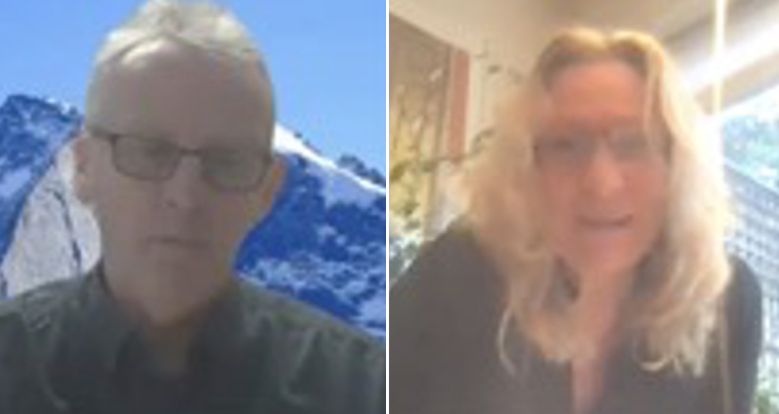
Okay, good stuff. So we’re here today, on Friday, first of December 2023 interviewing Suzanne Smyth in Vancouver, and Andrew Schofield, who appears to be in the mountains of BC somewhere. Then I’m Doug Miller from Montreal, and then with Gwen Schulman from Montreal, and we’re interviewing Suzanne and Andrew about their role and activities during the anti-apartheid movement, and before we start, Suzanne and Andrew separately, I thank you for sending back the consent forms. And I just wanted to verbally attest on air here, that that you’ve read the conditions of it. Do you understand that we’re going to archive this material and that, in fact, it’ll be used by others, for publications, for podcasts and educational work of all sorts? So can you just verbally agree that you read it and agree to the terms and conditions?
Suzanne Smythe and Andrew Schofield
Yeah, for sure. I agree.
Doug Miller
Okay, thank you. That’s, the formality done, and that’s all we need to do on the formal side, this is a ballpark, and we haven’t done a lot of two person interviews, so I don’t know who wants to start first, but the ballpark one is, we’ll, we’ll start with, with Suzanne, and ask you just Suzanne to give us, can you just describe your background, where you’re from, and what kind of experience you have in the world and what was your introduction to, whatever led you to the anti-apartheid activist that you became?
Suzanne Smythe 02:02
Um, so I grew up in Kitsilano, which is Musqueam unceded, Musqueam territory in Vancouver, and
we’re obviously settler family. My mother’s family are settlers from 17th Century Quebec. They came to Quebec in 1759, and my mother came to Vancouver in, I guess, the 1960s and my father is fourth generation Canadian and fourth generation Vancouverite. So one of the, one of kind of the early settlers in Vancouver, where my great grandfather and great grandmother, and so we were raised in a kind of Catholic in home.
My mother was Catholic from having been raised in Montreal, and she was raised in a convent, the Soeurs Grises, if you know that place, and my father was agnostic, but we went to church every, every week, but my mother followed more what they call the social gospel in the Catholic tradition, because there’s different kinds of Catholicism, less and more conservative. And, you know, in the 60s and 70s, there was a member father Bolin was a kind of an activist priest who was the head of our parish, and we had to go to catechism, and we had to go to Sunday school and all those things. So I don’t think for a moment that I get my values from the Catholic Church, but I do, I think some social values came from, like my father’s history, and my grandfather, you know, working on the docks like they were.
My great grandfather was a Teamster. He had horses where, like right at 25th and Main, what is where it is now. And my grandfather worked on the docks, and then slowly, kind of worked his way up from the Empire stupid Doug ring on the so they were very union positive people. And my mother was kind of a
lefty Catholic, I guess you want to say. But, you know, we grew up with very different values. Like, I think my brothers have different values. Like, we all kind of had different values growing up, but the home was one where there was, you know, a lot of talk. Like, like, big NDP supporters and things like that.
So we did kind of grow up with social values. I can’t say my parents were activists in any way and in high school, I don’t remember being an activist. I think the 80s in Vancouver high schools or early 80s, I don’t know that we were involved in any well, I guess that’s not true. I was in an outdoor program, now that I think of it called Quest, which had its huge problems of its own. But part of the work of Quest was to part of what we learned in Quest and were involved in in that program, which was part, we took a year off our high school, we, you know, went into the mountains and we hiked and we went canoeing. And some of that involved protests against what was then the South Moresby and Clayoquot Sound protests.
And it was really interesting, because at the time, that was all about saving forests from Macmillan Blodel and the older kind of legacy forest companies. But really it was about Indigenous land rights. But it was never really framed that way, but looking back on it now, that’s exactly what it was, was Indigenous resurgence and the beginning of a land back movement that I think is still going on, but now that I look at it back, now, that was kind of the start of it, but I think settlers like myself were, we were involved, from the perspective, like there was an allyship around shared interests with protecting forests. But it never really got down to also that we are on unceded land, like that land is stolen. And so, yeah, I was thinking about that the other day that a lot of, I guess, that was an early experience of activism. And so when I went to university, you know, I was kind of drawn to those movements and things.
But I honestly think I just showed up to an anti-apartheid meeting one day because I met Jamie, I think, or something, and he’s-
Gwen Schulman
So now you’re talking about in Montreal.
Suzanne Smythe
Sorry, when we moved to Montreal, well, there was a lot, yeah, but I lived in Trois-Rivières for a few years before I moved to Montreal for three years. I think, I think it was actually Rick Gaye. If you remember Rick Gaye, he was a friend of mine, and he said, “let’s go to this meeting and see what’s going on there”. And I think I met you and Jamie there, and I think we hit it off. I think that I joined the anti-apartheid network because I wanted to hang out with you.
Gwen Schulman 07:49
That is as legitimate reason as any other.
Doug Miller 07:55
So what year are we dealing with here? What kind of this would be?
Suzanne Smythe 08:01
86, 85. so I graduated in 83 and I moved, I went to tour the air. It was supposed to be just for a year, but it ended up being three years and or two years maybe, and then I moved with, I met a Quebecois in Trois Rivieres. We moved to Montreal to live on the plateau, and I went to Concordia for a year, and then I moved to McGill, and I think it was 86 okay?
Doug Miller
And was it a steep learning curve for you around what apartheid was, or did you already kind of come into it being fairly versed in what the system was and what the issues were, well.
Suzanne Smythe
So this is, I mean, I think when I was at Concordia, I had my courses at the Loyola campus and a couple at the downtown campus in Montreal. And I don’t remember knowing, I mean, South Africa was in the news a lot. And I know I always, always want to read papers like always had a newspaper. This is pre digital era, and Concordia is a very, was a very active campus, and I think I just learned about things kind of by osmosis, through the campus culture. And I do remember there were protests at Concordia, and I was like, “Okay, what’s this?”.
I don’t really know that I knew a lot about the issues, except I knew that, obviously that Mandela was in jail. I knew about the Soweto uprising. I knew kind of those, and I think I might have learned them in courses, but I don’t think I really knew a lot about, like, the issues at stake, except that, you know, there was an apartheid regime and that was it, okay.
Gwen Schulman 09:45
Before we move to Andrew, I’m going to dive in here Doug, before we move on to Andrew, with his kind of origin story here, just tell us about your recollection about setting up the radio show Amandla, because that happened very early in your involvement, as it did with me at the Southern Africa committee at McGill.
Suzanne Smythe 10:07
Yeah. So, um, so I was kind of floundering around in my first two years of university, like I did a year at 12, year I did, and then I worked in Trois Rivieres and messed around, and then I went to Concordia, took sociology classes, messed around, so by the time I got to McGill, it was like, I actually have to, like, decide what I’m going to study. So I went into political science, and I think that around the same time that we went to that first anti-apartheid meeting, I was in a course taught by, is it Schiller? What was his name that?
Gwen Schulman
Schindler
Suzanne Smythe 10:48
Yeah, so Schindler’s course was kind of a politicizing moment, because he had a TA, who was helping with that course. Name, I want to say it’s John T or John, and who was a white South African liberal, let’s just say that. But I didn’t know at that time how to place people on the spectrum, but he wasn’t happy with how Shingler was teaching the course. And then in the tutorials, he would kind of give us other stories about what’s happening in South Africa. And I think we ended up reading. I ended up I do remember kind of reading and being part of a lot more conversations about South Africa through that tutorial. And I also think that there were, I do remember being at CKUT, that there was an event to CKUT, or something that we went to as a class, like, not formally.
I know that Schindler was getting upset about it, and I don’t think he, I think he knew that John was giving, you know, giving the students additional material in the tutor, in the in the in the classes, than he was teaching, which was a very much, I don’t know how to say it, a very kind of typical western enlightenment philosophical kind of course. And then I also was taking another course on Third World. It was called at that time, third world development. And I can’t remember the guy’s name, but it was so boring, like he would just talk and talk and talk. But the readings we were, you know, we had to read a lot of anti-colonial things.
So I think there was a huge for me, a huge politicization just in that one semester. And then when you and I started the radio show, I do think that it was because it was kind of, it had been influenced by those experiences in the in that tutorial and in the in the anti-apartheid activities that we were starting to attend, we were like, the news is so different to what we think, what we know is actually happening.
Gwen Schulman
So, yeah, maybe just to add to it, I mean, Schindler was a formidable foe of the anti-apartheid movement. He actually actively blocked a lot of what we were trying to do around divestment. And, you know, he, he chose sides, and it was the side of the anti-apartheid regime. In many instances, it seemed, you know, he was a very outspoken when we tried to bar the South African ambassador from speaking at McGill, there was Schindler saying “no, right to free speech. Bring him on. Let him say his thing”. And we were like, “but why? Everybody knows what the system is. Why are we going to give him a platform to spout all of his racist stuff?”. So Shindler was, you know, he ended up being somebody that we did battle with. I didn’t realize that you had taken a course with him,
Suzanne Smythe 13:50
Yeah, and I, I knew that was, I kind of knew that was happening as well, but I was like, new in the university, and I didn’t know his history. But I do, you know, here it is like, and it’s happening right now in our university, when people try to clamp down on this idea of free speech, as in, you know, let’s hear the side of oppressive regimes, because we don’t get to hear from them enough. It can politicize people in ways that they don’t necessarily, you know they might, it might have the opposite effect of what they intend, right? Because I do know that that course was politicizing for me, because, just because of all the things he refused to teach.
Doug Miller 14:36
Well, we’ll come back to the show in a little while, but let’s go to Andrew and ask you the same question. Andrew and I know, of course, we’re going to Well, I’ll let you speak for yourself. But can you give us some of your background and in South Africa and what it was like where you were growing, and how did you come to vision apartheid as an opponent?
Andrew Schofield 15:00
Other than as a subject of it that otherwise would have gone along with it. Like many young white fellas, I don’t know, hard well, easy question, living on Musqueam territory at the moment, and then being born on the unceded territory of the IsiZulu Nation. I was very lucky to have liberal parents, and my mom was Polish, and she experienced fascism during the war in Poland. Her home was bombed in September the second in Warsaw, and from there, it was a long journey for her to go from Europe to Ethiopia to Cape Town.
And my dad was an English liberal. He was born in the UK, but he immigrated with his dad. His father and mom very early, probably in about 1920 1931 or 32 somewhere there. So on my father’s side, his dad experienced the First World War trenches, and he wanted to get out of Europe, because he felt Europe didn’t have much to offer the world, if that was all that they had to offer. And so he became a town planner in south in Durban, coastal city, but he was also in archaeology.
And I never met this bloke, but as a person who influenced me because he would, he became president of the South African Archaeological Society in the 50s, at the height of some of, well, 50s, 60s, 70s, was the height of racism, anthropology and archaeology and but he was the one guy, and I’ve seen his publications and whatever, who said, “No, this is not done by Phoenicians and Greeks, these carvings, these gold iron work of animals and the spectacular, beautiful gold work from Mapungubwe Mountain”. He said, “no, this is done by local metalsmiths, and you don’t need to have aliens coming from Mars to go along and build those Zimbabwe Ruins and ruins of Masvingo”. And so he challenged the racist interpretation. And my dad passed that challenging of a racist interpretation orthodoxy down to me.
And then on my mum’s side, having experienced fascism, she arrived in Cape Town, and her initial immediate thought was, well, I’ve seen this all before, and it doesn’t end well, that’s what she said to Suzanne, and I think when she would explain her background. And so she was a the only midwife in District Six, which was at what was called a coloured, mixed race Township. And so she’s the only white nurse working in District Six. And that sense of humanity and racism or fascist society, national socialist society, which is what South Africa was, that was passed to us, and then growing up in racially segregated tropical coastal city, it’s impossible not to see the racism.
And then there were some formative experiences along the way there, apart from the segregated by gender and race schools that you have just growing up as a kid and wondering, does this make sense, and what’s happening here and so there were two or three experiences that crystallized the viciousness of racism for me and the uncaring, cavalier racism that I was part of, and then, coming out of Secondary School, we were conscripted straight into the military and so going into the military, I went in sufficiently brainwashed to think, Well, I’m doing this, and as part of my contribution to fighting communism.
And I don’t want to be upholding a racist state, but I want to be part of the struggle against global Communism. And the propaganda was that, you know, these people want to come along and steal our wives and steal our girlfriends and rape babies and do all of these things and behead babies. And this was the propaganda of that I grew up in at school as well, and the vice principal of the school, and was a racist, and, you know, virulent racism. And in our classes, in our history classes, these are some of the comments which they would make and although it was a liberal school. And so then we are in in the Namibian operational area, and we there’s a, we are doing a guard duty the one day, and we are guarding a Cuban prisoner of war. And myself and Desmond Curtin were there, and we have six hours to stay. Look at a Cuban lying in a hospital bed in Ashikati. And eventually we managed to get some form of a communication with this guy.
And he has the arch evil lying in the hospital bed, frail and weak, and he has next to him a Bible, and in the Bible is picture of his family and his girlfriend and a letter. And I remember that was one of those moments that I’m thinking, well, is this the enemy? Because I’ve also got a picture of my girlfriend in my pocket, and I didn’t have a Bible because I wasn’t one of those. And we would only go to the Bible, the church that gave us the best food, and in the military there, and that had whatever So, so he was, this is the evil that I was supposed to hate. And then years later, when I was doing it, finished up writing some stuff, and went up here in in Vancouver. I went for a beer to read this draft chapter that I was writing. And there are some blokes sitting next to me, sort of my age.
And then we started talking when I finished doing my reading. And there were Cubans as well. And we looked at each other and I said, “You’re in Angola”. And they said,” ja”, and we said, and they said, “Yes, and so are you”. And said, ja. And we hugged each other, and we had a tear, because we knew that in a different ideology we would have been we were shooting at each other and on opportunities and but now we’re drinking beer in the same pub on Main Street in Vancouver. So it was a beautiful moment of reconciliation for us.
But coming back to, I think the other thing around formative influences. You know, there were many of those kinds of things where you think, what is my society all about, and is this normal? And you know, playing as kids in a sugar cane field all day long, in the sun, in the summer sun, and there’s African black workers harvesting sugar cane at the top of the field. And we’ve watched them, and subconsciously, you can see, well, we’re having fun here, but they’re working, and it’s must be pretty hot with those big axes, those pangas that they’re chopping with. And then the tractor arrives to pick them up, and the workers are running to jump on the tractor so they don’t have to walk eight kilometres down to the compound. And so they’re all running, jumping on the one guy falls off and gets run over by the tractor, little kids.
We go running up, and I see this black man with his life bleeding out from him, and he’s just urinating. And my first experience of death. And we then go back to the house of the place people that we were staying and was the white guy from the mine manager, the farm manager, and we’re talking about this, and we’re all shocked. We’re like 12 or 1311, 10 years old. We’re shocked nine.
And he waves his hand crossing. He says, “oh, that happens all the time around here”. And I remember looking at this man, tallish guy, grey hair, whatever, waving his lily white hand across the fields like that, saying with that, and I thought there’s something wrong with this. This can’t be the way it needs to be. And then, and then, years later, my folks took us on a European holiday, and we’re in Schiphol airport in Amsterdam, Mister in and we go out, and we’re in the parking lot because we had London 10 hours before the next. It was just delay after delay because of the mist. We’re playing with some Dutch kids, and it was just very normal. And I thought, well, kids around the world are normal, and why can’t I play with black kids? And what’s wrong with this? Again, what’s wrong with our society?
So those are the military shaped me in into, you know, seeing those kids. We’re walking through abandoned SWAPO base, and I kick a can of, you know, bully beef, a tin can of food, and I and I think, oh, that’s booby trapped. This thing’s going to explode under my feet, and it rolls away, and it doesn’t explode. And that sense of relief that comes over you, I’m still alive, and I’ve got my legs, and so it wasn’t booby trapped. And I picked it up, and it said, a gift to the people of Namibia, from the people of the Netherlands.
And I read that, and I thought I was in that place. And I played with those kids that day at Schiphol airport and their government is supporting the people that I’m supposed to be fighting. Why are they and they are democracy. They’re European democracy. Why are they doing that? Maybe I’m missing something.
And then the last incident, we were on a troop train leaving Cape Town, and the stations were segregated. And so first was the white sort of area, which is where we got on, and we were in our uniforms, and we were thinking, we’re going to defend the country and whatever. And as we go down towards the coloured and African, indigenous African parts of the station there, the people were seeing the troops on the train, and they started toy toying and dancing and throwing Viva fists, and my head was sticking out of the window looking, wondering why these people not supporting us, and we’re saving them from Communism, but they don’t want us doing this. And I kind of must have turned my head and I didn’t see that, and a young African guy had come a little bit closer to the train, and as I turned, his hand hit my face as the train is going away, and the sting of that, and I thought, wow, he really doesn’t want me doing this. So what’s my justification? Why am I doing that? So that’s where the thinking started really ticking in when I was about 17, 18, 19, and then on to university, where we went to liberal University.
And the situation in South Africa just got worse and worse, and we had to make decisions, and we couldn’t just keep sitting on the fence. And so we then, when we would get called up for our once a year, we would do camps one month or three months, and we’d be around by Christmas, and they would call us university folks up. So after the second or third camp, I felt I was advised by a ANC underground guy, Mike Sutcliffe, who was a lecturer at Natal university, that I said, “look, I can’t do this”. And he said, “No, you have to. You’re more useful to us inside the system than out. And you need to go in and report out when things are happening”.
And he gave me a phone number that I would phone from the Navy base or the marine base, and we were at Marines base, and we would phone out when we were going for a township suite or an occupation of one of the townships and some of the townships were probably the size of Gaza City. And we would circle the township, and we would do a sweep going through, looking for weapons, weapon stashes, ANC and Communist Party and PAC literature. But, you know, we could never find anything. We never found a single thing. Because we would go for the briefing, and then after the briefing, and we get our timelines and target lines, and then we do the briefing, and I would go along, the phone out and say what time the incursion was going to occur, and then nothing was ever found. And so I think the phone number that Mike Sutcliffe gave me was a pretty good phone number was somewhere in London, and then, and then from there, I then came out and carried on. And then I came to Canada and met Suzanne, and then eventually we married, and I’ve got a second country to call home, and most people don’t have a house.
Gwen Schulman
I want there’s one little thing that I’d like to before we move on. Andrew, you when do you remember under what circumstances and how you made first made contact with organized anti-apartheid forces?
Andrew Schofield
Well, would have been through, I think, through Mike Sutcliffe, and then that was an indirect contact. All he did was he just gave me a phone number.
Gwen Schulman
How did you know, he was ANC. I mean, that would require a lot of trust on his part to tell you that?
Andrew Schofield
Okay, ja, he, he was a progressive lecturer prof at the university, and, you know, after taking courses with him and his colleague and I was a National Union of South African students in New South. And so after time there’s the trust has developed, and there are a couple of communist, white communists, and they, yeah. We just got to know that you’re not an informant.
And that also, I think my mum’s politics, my mum had been a founder member of the end conscription campaign, and so there was that. And then my dad, as a liberal, he was still an insurance broker, but he was the only insurance broker prepared to insure the businesses of Indian and African people, and there was much less, of course, insurance around African because of business and job restrictions and whatever. But quite a lot of business was from the Indian community, and many of those people within the in the Natal Indian Congress, which was an affiliate of the part of the freedom movement. And so many of the people in the NIC, such as Ella RAM Gobin was Mohammed Gandhi’s granddaughter, and Merwal Ram Gobin and yeah. So there’s a whole group of these, of these people who knew me from when I was a baby.
And so I they trusted, you know, my father as a liberal insurance broker, the only one doing business and insuring Indian businesses. And so they, they, I think through those structures, we were legitimized and so was interesting kind of intersectionalities.
Doug Miller 31:30
Well, just, could you just give a little bit of time date frame to some of these events?
Andrew Schofield 31:38
So 79 was when I graduated. June 80, 81, and 82 is when we were in doing our national service, so called, and probably around about June, July, 80 is when we were leaving on the train in the station that incident, and then we’re in the operational area, and couple of the two tours, so that was around about 80s as well, 81 and then I think I finished up in 82 there. And then we were doing camps when we would be reporting out. I didn’t report out on my first two camps, which would have been about 83-84 and then 85 was when I was doing some reporting and around about the so called commemoration of the Republic. It was a big commemoration for the South African Republic, which the white guys were pushing. But it generated, as Suzanne was saying earlier on, it generated a massive politicization and a much deepening, a deepening of the political process. So when the first and second states of emergency were called, that’s when we’re doing some of our camps.
Doug Miller 32:55
Yeah, okay, great. That’s wonderful. Thanks a lot. Well, now we’re going to talk intersectionality across the across the Atlantic and all that, but back to Suzanne, let’s get a little more into the details of setting up an anti-apartheid radio show and what you remember from all of that going on there.
Suzanne Smythe 33:26
So one of the things that so I had, I think I mentioned that I met a Quebecois in Trois Rivieres. And when we met, I spoke very little French, and he spoke very little English. But we moved to Montreal together, and, you know, this was, was Levesque still in power? I kind of think he was still –
Gwen Schulman
What year would this have been? 1986
Suzanne Smythe 33:57
85,86. No, Bourassa, right, wouldn’t have been the back. I don’t think, no, I think he passed away around then, anyway. So he was part of this purlin movement, right, of a Quebec nationalist movement that was prevalent at the time around separatism. And I remember as I was starting to go to these meetings, I was spending a lot less time at home. And as we got the radio program going, I was spending a lot less time at home. And I remember him saying, “You know what? Why would you care about apartheid or what’s going on in South Africa when they’re here?”. We are late breakfast on the [ French word]. So there was this, you know, we’re oppressed on our very own land here. And I was, yeah, so there. Was, I do remember kind of an emerging tension in that relationship, because Gwen and I, if remember, like we would get together and sit in, the is it? What was the name? It’s not the Peel. What was the name of the mantra of the McGill right outside of the CKU station?
Gwen Schulman
There was the ground floor of the Student Union Building. That’s where we did all our blog there.
Suzanne Smythe
Yeah, and we would go through something like that. Else’s, no Sadie’s, I think 80s anyway, yeah, yes. So we would sit at Sadie’s. We would meet earlier in the on a Wednesday after, I think, I had a class, and we would write out our scripts, and we would have interviews, and we didn’t have a long time, like, I think you only it only became an hour later, right? So we had half an hour, yeah, and we thought, and we prepared so much, because we didn’t realize at first how, how much you can, how long it actually takes to say things. But if you remember, I still have that first script of our radio show in the archives.
Gwen Schulma
It’ll get archived with all of this. Oh, you have, oh, good. It’s in the copy of it,
Suzanne Smythe
Yeah, on that computer paper stuff. Anyway. So I remember, I remember doing way more research, and you were taking history, right? So you were in history, Gwen, in African history. So you were the one who had, I think, a lot of the ways of situating things in their content, in a context. And so that was, like, I would, you know, I think that you brought that to the So our goal was to kind of interrupt mainstream media and some of the ways that they were mischaracterizing and often just completely, you know, misinforming around Canada’s role in sanctions and the so called Black on Black violence.
So Andrew will have, Andrew was, I think maybe you were still in South Africa then, or maybe you had already moved to Vancouver, and I hadn’t met you yet, but we were very concerned about interrupting this discourse of the so called Black on Black violence, because that was being orchestrated through, you know, the American and Canadian and forces CIA, etc., from outside.
So I remember doing a lot of research at the library. I remember never being more immersed in newspapers and finding everything we possibly, I could, possibly could about, you know, alternative newspaper. And I’m trying to remember some of them now. I do think the New Left Review was one. There was another one. Is it Sechaba? There was a newsletter that –
Gwen Schulman
yeah, which we would have gotten through, CIDMAA, the documentation CIDMAA Centre. CIDMAA provides, yes and material to us. And then there was also the Centre for Developing Area Studies at McGill that had a documentation centre. And we would race up the hill, that’s right, and do a lot of our research up there, because they had very like, you know, precious resources for us, and we’d photocopy stuff and underline it and then –
Suzanne Smythe
Bring it back and write it up. And I remember Dan O’Meara was super supportive, right? He was at the time at UQAM. Was he at UQAM?
Gwen Schulman
Not yet, he was still so he’s been interviewed for this project. Oh, wow. With the radio show. He had not become a professor at UCAM yet. He was South African member of the ANC. Didn’t speak French yet, so he was busy learning French. And one of the employees of CIDMAA, very instrumental, yes, in educating us and providing information. Yeah, absolutely.
Suzanne Smythe
So that’s what I remember, is we would run up there, we would compile all our things, and then we would run back and get our script, and it would be, you know, and at first we would laugh, giggle, because we were so nervous. But I do remember, like learning so much, and did way more research for the radio show than I ever did for any of my courses. And I don’t know how I got through my courses, because I think this was the main focus.
Doug Miller 39:34
Yeah, yeah, absolutely. And, and what kind of support did you have others, for instance, to interview, for instance, South Africans coming through or living here, Namibians. What kind of resources did you have in human terms?
Suzanne Smythe 39:50
Well, Gwen, I think you might remember that more, because I think you were the one who had more of the contacts. And I think we were also attending meetings at CIDMAA at the time. So we went.
Gwen Schulman 40:00
People did come through. We knew about it, and we would not, come on. Yeah, yeah. People, can’t remember people we interviewed, though me either. And you know, there were a few interviews, but I think it was mostly kind of little news dispatches, bringing people up to date.
And as you said, Suzanne trying to counter the black-on-black violence narrative was one of our key priorities, because that narrative had really, really taken over the mainstream press. In Canada, I remember that as the instigation for the show, quite specific. So there was a lot of, you know, analyzing what’s actually going on the ground in South Africa. We talked a lot about the Inkatha Freedom Party and its role, that kind of very retrograde nationalist presence in South Africa that was being used by the regime to push this narrative and create havoc and divide the movement and everything. So we did a lot of research and reporting on that, I recall.
Suzanne Smythe 41:05
Yeah, I do too, that was kind of our main, our main goal.
Gwen Schulman 41:08
and we did a lot of stuff on Mozambique too. We covered the front-line States a lot, and Namibia.
Doug Miller
Did you get in like you mentioned the professor Shingler, who was anti anti-apartheid advocate. Did you get any blowback or feedback on the show as a result of your initiative?
Suzanne Smythe 41:28
Not from Shingler.
Doug Miller
No, but anywhere.
Suzanne Smythe
Oh, um, I don’t think so. I don’t know how many people were listening.
Gwen Schulman 41:38
And also, you know, at the time, it was a campus radio station. It didn’t have the antenna power that it developed later, where it became community radio, and then later with the Internet. At the time, it really was campus broadcast, but I am sure there were forces at the university that were giving the station a hard time about what we were a lot of what we were broadcasting, because they were so staunchly anti-divestment, you know, yeah, at that point to divest.
Doug Miller 42:10
So the station, or your rather, your show, then became part of a broader gamut of activities that were going on in the anti-apartheid circles in town. Were you in contact with all them in as well?
Suzanne Smythe 42:28
Yeah. So, I mean, when I look at it now, that was, I feel like that was, like one of our major projects. We were really, I remember being, you know, really spending a lot of time on it, but I think in a way, it was more consciousness raising for me, right, like, as Gwen said, it didn’t have a huge audience, but sometimes to make change, you need, like I’ve learned since, right, that you start somewhere that feels meaningful and impactful, and you do it and you don’t worry about, you know, how many people.
Like, if we only do things that we think are going to have a high impact, then sometimes we, you know, we don’t build the ground, right? We don’t create the relationships and the knowledge to move forward in a good way. So, I feel like that radio show was, for me, a huge consciousness raising and learning, like learning how to parse a lot of different perspectives and material, learning how to take a perspective, learning how to communicate that perspective, but still being fair, but also, you know, basically critical reading. And I do think that was completely formative in my later life, right?
Suzanne Smythe 43:50
And I remember we were also, hey, it was like a training ground, yeah, absolutely, and, and so we don’t always know what things become. I mean, I also, we were also going to protest, like in Ottawa. We were part of the divestment of McGill. That was a big that was a lot of the work, of our work at McGill. And I know that we had, you know, I remember other friends and colleagues, Jamie and May and who were part of that.
I remember protesting downtown at the embassy. I remember going to CIDMAA meetings, so I think the show was for me anyway, kind of the centre of our work, but we were doing a lot of other things. And when I went home in the summers in Vancouver, I ended up connecting with the anti-apartheid movement in Vancouver, so that there was then. And then I was going back and forth, you know, to finish my degree in Montreal, and going back in the summers in Vancouver. And both organizations were starting to kind of merge for me.
Gwen Schulman 45:02
But did you notice any kind of substantive difference between the anti-apartheid organizing in BC compared to what was going on in Quebec?
Suzanne Smythe 45:16
Yes. So again, at the time, maybe not, but now, yes, so, and this is how Andrew and I met was at anti-apartheid organized, a SACTU dance. I can show you the poster in a minute.
Gwen Schulman
Oh, wow.
Doug Miller
A SACTU dance.
Suzanne Smythe
South African Congress
Suzanne Smythe 45:41
I can show it to you.
Gwen Schulman
Yeah, most of our interviews for this, with SACTU people.
Suzanne Smythe
Oh, wow. So that’s so that we where we met, Saturday, May 28 of course, there’s no date on it. Year. Everyone knew it was a poster on the, I think we got that from a telephone pole or something you did. Yeah, I think it was 19. That was 1988 I think.
Doug Miller
Can you please give us a good, clear photocopy of that, or picture that’s, I have a lot of posters from also our time in South Africa, which we offered to the Museum of human rights. They are they. They said they were interested in them, and we scanned everything and sent it to them, and then they never got back to us. So, I can send you what I sent them.
Doug Miller 46:40
Just as a side note, here, we’ve interviewed over 25 old Union militants from this act to connections, including people in the Vancouver Committee, which was apparently one of the most dynamic in Canada. So yeah, it was that you would be mobilized by them above others.
Suzanne Smythe 47:02
Yeah. So we were part of that. I Well, the first thing I did was when I was back in the summer, that summer for work, I think I went to that dance, and that’s how I met Andrew and a bunch of others, that’s how I kind of got connected to the Vancouver anti-apartheid movement. I would say a couple of differences, and maybe it’s also because now time is moving on, and things are getting more tense in South Africa, but we’re also learning more and building relationships in those movements.
So I don’t know that they are differences in kind of that there’s an inherent difference between Montreal and Vancouver, but in Vancouver, we had an anti-apartheid, we had an ANC member as part of the anti-apartheid network named George La Tom, who is in South Africa. He went back to South Africa. He is from Johannesburg originally and was in exile in Vancouver. And what George brought to the table was an understanding that of connecting the anti-apartheid movement with Indigenous movements here.
Suzanne Smythe 48:15
So I do have some letters that I found when we were writing. So Herb George was, I believe he was the Squamish nation, either a counsellor or a chief, I can’t remember, in the 80s, and we were working with them to connect the, you know, Indigenous land rights in Vancouver, right as kind of on unceded, on the shared territories, right of Squamish sail with tooth and Musqueam nations, and what was happening in South Africa. Trevor Manuel as well, who was, I think he recently passed away. And anyway, he was also, I think George was connected with him and an Indigenous leadership in the interior. I believe he was, I have to look at where Manuel was from. I should know that.
But we have a friend named Glen Coulthard, who’s done a lot of historical research, or research on indigenous, early Indigenous liberation movements and resistance and how they connected to international movements including Palestine and South Africa. So I can share that with you, if it, kind of like for me, it was part of conversations happening here that were not happening in Montreal because it was pre-Oka. But, you know, I don’t know to what extent those connections were being made later, because I Ieft Montreal in 1991.
Gwen Schulman 50:02
So I want to bring Andrew back into the conversation. Andrew, when you arrive in Canada, I mean, you are coming from such a different context. You’re coming from the belly of the beast and moving to Canada, do you recall what your initial perceptions were of the anti-apartheid movement in in British Columbia, was it hard for you to find it when you did find it? Were you impressed or you depressed?
Andrew Schofield 50:37
I left South Africa the weekend before I left, I drove around the different parts of the segregated city, taking photographs and slides, because I knew that I would be doing talks on South Africa from a South African perspective, and so I was so I knew I was, I was going to be carrying on some involvement in terms of an educational piece. And we’d been, I’d also been part of the some Saturday schools which were running in the townships, where we were starting to pilot anti-apartheid curricula, or post-apartheid curriculum. And so I took all of that with me. And then I came to Canada to do a master’s degree.
Gwen Schulman
What year was this Andrew?
Andrew Schofield 51:32
1988, 89 and 90. And then so I And so immediately I also wanted to be involved in the anti-apartheid movement. When I left South Africa, I arrived in Heathrow, and I went to the site, to the Canadian Embassy to get my visa, and they said, “no, you’re not going anywhere. You’re a South African. There’s a travel boycott against you and this should have been applied for earlier, and you won’t be going”. So I then was stuck in London for about seven weeks, eight weeks, and then I went to the ANC offices and said, “Hi, I’d like to join”. And I had an interview, and the guy said to me, “you’re not good enough”. And he said to me, “you got to deal with your own internal racism before you can will be of any use to the liberation movement”.
And so for a person who’d been doing all this stuff with NUSAS, we’d been in the townships doing on Saturday schools who had people sleeping in our house, foreign youth from National Education union was hiding in our house and showed me around the townships quite a bit. I thought I would be a shoe in for the ANC and but my interviewer could see where that I had my own weaknesses, so it was a good moment for me to in terms of waking up.
And then I came to Canada from there, still wanting to carry on the anti-apartheid movement work, while still reflecting on my own internal racism and my motives for doing this, but my initial meetings, I went, I would go to, always to the antibiotic network meetings. But I was very frustrated with the reasons why people were going to those meetings. And it seemed to me more that it was about their own political trajectory, and that this was one of the cachet things to be involved with, and so I questioned them, quite as I was a bit more outspoken those days, and I would question people why they were doing this, and I would challenge them on their hypocrisy and say, this is wash it, and “you guys are just here for your own stupid reasons”. And even comrades in the BCTF, who were like, they didn’t need to be there.
Gwen Schulman
Sorry, in the beat, in what?
Andrew Schofield
The British Columbia Teachers Federation, they were there and I was always attacking them for the slowness of their operation, and that we needed to be doing more. We need to be doing more. And this is not enough. The main area of work was around the Shell boycott and arranging boycotts of Shell gas stations, and then also promoting the sanctions movement and deeper thinking around sanctions. And so there we put together a position paper, and then a summary document which went out to all the members of the Antifa network, which was like churches. The United Church had a representative there, and all of these blokes, right? And the Sinn Fein, there was a Sinn Fein rep. And then the Liberal Party had some reps, two lawyers from the Liberal Party.
And so there was all of these different people as well. And so we’re trying to educate them and their organizations and so I was frustrated. And the chair of the anti-apartheid network at the time, his wife was an African Canadian, and at one time, she was asking her husband, the chair to say, like “kick Andrew out”, and “he’s crossed the line here” and I think I had, but I mean, the situation in South Africa was shit, and we needed to say stuff, and we couldn’t just sort of look at each other and make buttons.
Suzanne Smythe
I don’t think that’s what it’s fair to say to characterize everyone in the anti-apartheid –
Andrew Schofield
Oh no, but that’s how I was. I was frustrated, and I felt we should have been doing more, and I didn’t think that that was enough. And so, however misguided I was, that’s what I was saying. But now, 20, 30, years later, I see the same person. I met her, and I apologized for and she said, “well, we were all young then”. And so I think, ja, we were young and we were, we were impatient, because we knew what was going on, the shootings and the extra judicial killings and all of that and so yeah, I don’t apologize for being passionate about what we’re doing at the time, but I have learned that maybe that sometimes wasn’t the best strategy. I think people forgave us for that too. Sometimes many people did.
But you know, the good thing was, is that we didn’t fragment the organisation, and the organisation was bigger than just one or two South Africans who are pushing for more. Yeah, but it was very valuable political learning experiences about the importance of strategic compromise. Sometimes you have to keep your values and your passions to yourself and just be careful about how you move, because you could have divided the organisation, could have destroyed it, which would have been counterproductive.
And there, there was, I think, some more political leadership, like Suzanne has mentioned. There was also Peter Mahlangu, who I remember, came out and had a meeting with some of the people, just some of the ANC folks, and just say these are the goals, how we wanted to achieve this, the importance of networking, the importance of umbrella structures, which were multi with that would incorporate organizations with different values, and that we had to keep The, in the foreground, the importance of the anti-apartheid struggle, and that might mean that sometimes we would have uncomfortable bedfellows, but suck it up. It’s a whole lot better than the township life. And so there was some good, really good political education in that.
Gwen Schulman 58:17
Were you a member of the ANC at this point?
Andrew Schofield 58:20
I joined at the end of that. And, and so, yeah, and then when Mandela was released, then I was I finished up, and then went back to South Africa. And then we’re starting to build the structures of a legal political organisation, and transition from an underground movement, liberation movement to a legal political organisation. And so there was a whole lot of those dynamics which are very different to the anti-apartheid issues here in Vancouver that, that, and the movement stuff that here in Vancouver, but there was a lot of political learning that I took with me back to South Africa, and the formation of SAT, to the South African democratic teachers union was that was just going on, and they were negotiating the Constitution, and some of the people negotiating the constitution were vanguardist Bolsheviks. And I was coming from a Gramscian political mobilizing strategy, which is much more developing the consciousness of the people within your organisation, and very different strategy. So we were proposing a constitution for SADTU that was based more on Gramsci and structures.
The end result was a Bolshevik top down structure to SACTU, which immediately split the white teachers away. And at the launch Congress, Jay Naidoo was chairing that, and I put up my hand saying, you know, “comrades, it’s not too late. It, this structure, this is a constitution based on foundation list politics, is going to result in not, a weakened movement”. And that’s exactly what happened. And straight after that, NAPTOSA was formed as a countervailing force to SADTU and was a lost opportunity in terms of educating conservative white and Afrikaans teachers into what was going on inside our own country, because still many people didn’t know, even though Mandela was released and negotiations were going on.
But I was really inspired by Judith Butler’s work around anti-foundationalist politics and her book and the possibility of organisation, organizing and anti-foundational politics, and that’s what we’re trying to do within that union movement. But there was still some vanguardists which elsewhere –
Doug Miller
So that’s the period 1994 is it then? No, that’s the only 94, period, yeah. Yeah, which was an extremely difficult time in South Africa.
Andrew Schofield
Well, Suzanne was there with me, and also you were together by then. By then, when did we get married?
Suzanne Smythe 1:01:22
Can I just correct the record first, because I don’t want to say something that’s not right. Trevor Manuel is a South African politician. George Manuel passed away in 1989. I’m sure you know George Manuel, right? So, inaugural chief of the Assembly of First Nations, and he was actually just commemorated a stamp last year, what do you know? But, so George, he did work with George Ly Tom, who was the ANC member here did do a lot of work to maintain relationships with the movement that George began
around Indigenous rights and resistance that was global. He went, George Manuel went to Tanzania, he went to Zimbabwe. He went to a lot of different places. And so for me, I think that was just going back to, that was one of the main differences in the Vancouver movement.
There’s also another person, and I know you’re coming to the end of your interviews, but Tom Sanborn is a friend of ours. He was part of the anti-apartheid movement, and he was involved in a lot of things that we weren’t involved in. We were in our early 20s. We were coming and going, we were partying, we were going to meetings, we were doing all that. But the older, the more mature people in that group were doing a lot of the legwork, to be honest, and the political work. And Tom Sanborn would be one of them, and he’s still a good friend of ours, and we reconnected after many years, when we move, you know, maybe about eight years ago, through mutual friend. But Tom would also have a lot, a lot to he knows a lot about the Vancouver movement that I wouldn’t Andrew and I were just in Vancouver for a little bit of time, like, I would come back and forth, but these guys were kind of doing that work over many years. Okay, so when we wrap up, you should give maybe get us in touch. Like, yeah, get us in touch with him.
Gwen Schulman
I want to dive back into your experiences and a little bit of the question that I asked Andrew before, but in the opposite direction, you’re leaving Canada and moving to the belly of the beast. So you have this anti-apartheid experience in Quebec. You have anti-apartheid experience in British Columbia, and now you’re moving to South Africa and remaining involved as an anti-apartheid activist. Can you tell us a little bit about that experience? Do you remember what your impressions were and how well equipped were you given the training that you had had in Canada?
Suzanne Smythe 1:04:14
Um, not very well equipped. Well, yes and no. So one so not well equipped in that I was really naive. I felt like I understood who was who a little bit and I understood some of the political discourse from our work on the on the radio show, I had met a lot of South Africans, the you know, there were all there was a lot going on in Vancouver, Doug, you’re right. Like Andrew and I also went to a Harambe festival. And I think it was 1989 we have the poster for that too. And it was. Yes, you know that play: you hit the woman, you hit the rock. You strike the woman, you strike the rock. And we had frontline state activists coming through Vancouver. I remember being in a backyard garden party with a lot of them. So we were, we were meeting people, talking with people, and so going back to South Africa, some of those people you know were in South Africa, like Martha, for example. And oh, my God, what’s her name? She was in the union.
Gwen Schulman 1:05:41
Marie-Helene.
Suzanne Smythe 1:05:43
Oh, Marie, yeah, she was like, live close to us in Joburg, so I also go for the project. So, so we lived in South Africa, we found an apartment in Yeoville. This was before Maya was born. Maya was born in 96 and we moved to South Africa in 93. In January of 93 I went out for a visit the summer before, and in that summer before, I actually travelled around on my own to the Cape and Joburg and also in Durban visiting literacy program, because by then, I was teaching in a literacy and adult program here in Vancouver, and I had the summer off, so I went to South Africa, and I spent a lot of time in the cape
visiting like Khayelitsha and townships there, and that was also very politicizing. So by the time Andrew and I, Andrew got and I got married that Christmas, and moved right back to South Africa, like two weeks later, and found an apartment in on Yeoville Street on Houghton called Houghton Gardens.
And it was like the perfect place for us to be. It was kind of right in the downtown Joburg. We had an active ANC group right there who lots of people who lived in that community, and it was probably one of the most multiracial, the most multiracial ANC networks, I guess you would call them. We had meetings up on the corner on Rocky Street, you know, once every week, sometimes and so, you know, as a white person coming into Joburg, not knowing anything about South Africa, really, it was amazingly easy to be become part of the movement, and at one point we were being asked to take on leadership roles in that in the ANC right, especially as we got closer to elections, which was kind of like I thought so, I mean, we didn’t say no, but I do at the time, remember thinking that while the ANC was pushing for a non racial government, and there was a lot of violence at that time in 93 and early 94 before the elections, and Andrew and I got involved as ANC representatives on the so called, on these peace committees that the UN had set up.
And so it would be like the ANC, Inkatha, the National Party and the Democratic Party and maybe the South African Communist Party would all sit around a table and talk about how we were going to deal with the violence. And one of the things we did was go out into the townships with like vests on as different members of our parties, but also members of the UN peace committee. So and then we would go off into the townships and try to keep groups apart.
And so for me, that was really well, let’s just say that after the four or five times, you know, going into the middle of extreme violence, and the first time I had seen, you know, people who had been killed, I was finding it really hard. So I retreated. I didn’t think that I could be a reliable person to be with, driving around and getting out and, you know, trying to interrupt violence. I was I just wasn’t cut out for it. I was too nervous. I was so I used to work in the so called Joint Operations Centre to dispatch people and to be the radio person, while Andrew and a bunch of other folks from the ANC in the Yeoville ANC and others would be out in the field in places like Tokosa. Remember Tokosa was a real hot spot, and other places in the in the sub in the townships around Johannesburg. So I think that was one way of really becoming immersed in that movement.
But just going back at the same time, there were comrades in the ANC movement who were starting to say, why are all these white people kind of rising to the top of the leadership and making all the decisions? And I have read Fanon, you know, and that was one of the things that was formative at McGill and Wretched of the Earth, and I actually just read it with my class this year again. And what you know, it never fails to open up truths right about colonization, and I never realized it at the time, but now I do that although the movement was oriented toward a non racial South Africa, there was still a lot of white supremacy, a normalization of white supremacy in the organisation that I experienced being in Yeoville, that we were able to kind of move in and kind of unconsciously just start making decisions. And you know, isn’t this great? We’re all working together. But when I look at back on it now, I think, I think it was really problematic in many ways.
Doug Miller 1:11:32
Andrew, you, you seem to have had another role while you were there. We heard snippets of it there.
How did you see it?
Andrew Schofield 1:11:46
Then the one after Chris Harney’s assassination, and Mandela was asked to be on TV by the by declare, to calm everything down. Mandela and the ANC pushed for the, a national peace accord wasn’t a UN thing, and that flowed from Harney’s assassination, and it became an Act of Parliament to set up national and local structures, and then, and so that gave it and the ANC were then governing, although they didn’t yet have state power, and was an example of how, like I said, the ANC was affecting laws and affecting structural change, because that flowed a hell of a lot, put a hell of a lot of money came flowing into the peace structures, and that they were there existing by law. And then ja and Suzanne was working in the radio rooms, and I would be out with the team.
And the different branches asked for they asked Susan and I to be involved, because I felt that we had a fairly decent line of political analysis, and that I wasn’t going to be the kind of person I was, maybe in the anti-apartheid network in Canada, and that I would be able to build bridges within the unit that would go out when there were marches. And then we would have negotiated with the leaders of the different marches beforehand to agree on routes for the marches to take.
So then you would have 20,000 ANC comrades coming down Kumalo Street. And then theoretically, the Inkatha people would be, 8000 of them from the hostels, would be on another road and kept quite awake. Occasionally the two would cross, and that’s when we would be dispatched to, “bring us your leaders. This is not going to happen”. And stop that from occurring. So stop the different fractions from fighting and ja, and sometimes also the heavy handed approach of the South African police when they would be just shooting at marches.
Suzanne Smythe
And at us.
Andrew Schofield
Yeah and at us. And so we would have the little flag, and we’d have to walk in between them and tell them that you’re not shooting. And purish or kame was another amazing person that we worked with, a remarkable, beautiful man.
Suzanne Smythe
Oh, my god, he would just take his flag and walk right in the middle of an all out battle and these cops.
Andrew Schofield 1:14:32
And in Afrikaans, he’s saying, to perish. Our translator is saying “you mustn’t go there. You’ll be shot and perish”. Or responded in Afrikaans, “Well, that’s exactly why we have to go there”. And there, he puts up his flag and starts walking. And then behind him is Bronwyn Wilson. She puts up her flag and starts walking. And I’m thinking, well, fats, now I have to walk. And so then I then walk, and along we go. And then the Bronwyn Wilson. Person, yeah. And then as we go, the shooting stops, and then we start carrying on. So, yeah, so that was the peace committee structures, and they needed us there because I think we had some reflective political analysis and skills that wasn’t going to make things worse at that time.
Suzanne Smythe 1:15:23
Now to say something quickly, a little piece. Andrew’s mother was a Quaker, and well had joined the Quakers in South Africa. Bronwyn Wilson Thompson, who became a dear friend, is a Quaker, and the Quakers were really had at this point in the struggle played an incredibly important role. And I think that needs to be acknowledged that many and they all went they were picked up, they were put in jail, they were harassed, unbelievably, by the South African regime, because they pose such a threat to because they were from with a, you know, a faith-based organisation.
I’ve never met more brave, well, there’s a lot of brave people in South Africa, and the Quakers were, some of them very much principled about their support too. It was, oh yeah, like that, yeah. Sorry, Andrew, I just wanted to –
Andrew Schofield
No, you’re bang on. Because many of the white Quakers who went who their military service were part of the end conscription campaign. And Magnus Malan, the South African Defence Minister, made the comment when ECC were banned, that this is one of the most subversive organizations in the country, and because you would have people like Richard Steele, who are Quakers, who would go to prison. But for every Richard that went into prison, it caused another 100, 200 white liberals to think about going into exile or doing what I was doing, going in and reporting information out. And so the there was a steady trickle of mostly Quakers, who are religious objectors and part of the ECC movement who helped to clog things up for the government, for the racist government, was just another small component of a much broader ocean of struggle, right?
Doug Miller 1:17:40
And can you take us now to that big election?
Suzanne Smythe 1:17:47
What a day.
Andrew Schofield
We were monitors for the ANC. We were ANC monitors. We were going door to door before the election. Of course, putting, you know, interviewing, doing all of the traditional, classical electioneering stuff. But then we would also be printing up pamphlets and dumping them on buses that were going into the townships with election material and all the rest of that, and putting up posters with flour and water and postering and all of that kind of thing. We started a screen a screen making. Kind of backyard. We had a screen printing co op in Durban during the pre during the negotiations phase. So we’ve got some of the township the T shirts “join hands to save the peace process”. And those were co ops, and that were part of teaching Marxist economics to the comrades following Gramsci’s whole approach. And so we would have all of these young comrades in our in our garage in Durban north, and buying the tea, putting money together in buying a t shirt, adding value to that T shirt, identifying surplus value, surplus value extraction, and then how we can add value by a tie dye, where, who might buy a tie dyed t shirt? This, Suzanne’s got one there.
Gwen Schulman
Wow.
Andrew Schofield 1:19:22
So that’s a dyed t shirt, right? And you can see, with the tie dye, we felt well those, the students might be more interested in buying those. And then also arm bands for Soweto day and June the 16th. We would make those out of out of strips for bandanas or tying around your arm, so all of that, and we’d sell them for a rand or $1 but that would be a 50% markup. And then how is the profit distributed equitably, as opposed to the capitalist model, where profit is centralized? And so all of these kinds of things we would then use as part of the conversation to teach the comrades about.
Suzanne Smythe 1:20:00
I just say too that right up to the election, So I was then working in at Wits and in adult education, and we work closely with literacy groups. And so Martha Gordon was, I think she was editor of Learn and Teach, which was an incredible magazine, still one of the best, like, I wish we had it today. It was large. It was a large, maybe a three size magazine with, you know, the print large enough for folks to read who don’t have glasses, because many of the domestic workers in Joburg and the people reading the magazine in literacy groups and so on. You know, couldn’t even get prescription glasses right. Plus, larger font is easier to read. And they did so much political education.
So all of us, there was so many ballots that got, I think we have the old ballot somewhere. We had these practice ballots. So in the I volunteered my friend Betsy, who’s in Vancouver now, at the Yeoville Adult Literacy group. We would bring these ballots in, and people would practice stamping them, right? And, you know, they we weren’t saying stamp this one, but what they had was a colour of the party and then the photograph of the leader, and so there was Mandela’s photo, and so people could just scan down and see Mandela. So from a literacy and access point of view, it was, there was a lot of rough drafts and a lot of revitalizing and like, sorry, redrafting those ballots. There was endless arguments about them from the different parties, but there was a whole literacy campaign around voting, which was, like, super exciting from my perspective as a literacy educator.
Doug Miller 1:21:54
Wow, this is a spectacular. So the election occurs now. And of course, it was epic and well recorded.
Suzanne Smythe
We hardly even had time to vote. We were so busy we went. We missed all those epic lineups and those stories because we were, I was in the joint operations. Andrew was monitoring some of the right some of the, there were some problems in some of the voting booths, but not that much. By the time the election came, it was like a miraculous day. And it was over three days the voting too. But I remember, Andrew, you and I went to our local place to vote about eight o’clock at night, just before it closed, and there was nobody there.
Andrew Schofield 1:22:40
It was anti climatic. We went, we voted. We went.
Gwen Schulman
Even worse, if you’d missed your chance to vote, what would –
Andrew Schofield 1:22:52
And then we were at Nazareth, at the, as election scrutineers,
Suzanne Smythe
Yeah, and we were a week and a half, two weeks for the results to come out.
Andrew Schofield
Yeah, we were ANC scrutineers, part of that whole team. And there was the National Party scrutineers as well. And then there was also the UN monitors were there as well. And one of the things before the elections, in fact, maybe even before Suzanne came out when I was doing work for in the ANC. I was teaching in a white only school in a village in a town called Ladysmith. And the referendum on whether we should there was the whites only referendum that on whether we should continue the negotiating process. And so De Klerk put this referendum on, but it was only for white folks.
And I was asked by members in the ANC to go and be part of to infiltrate the national party election machinery in Ladysmith to see how they organize and fight this campaign. And so I was then part of that local National Party Vote yes campaign, and we would go along. And there would be these young Afrikaans men that I was, and I was their age, right? But these were, these guys were much bigger and stronger rugby playing farmers than I was, and they had these pickup trucks. And the pickup truck would be like, full of vote yes posters, and they just drive right up on the curb, stand on their bakkie, the pickup truck, put the stuff up, drive on. And because they’re using these huge, big bakkies, these pickup trucks was just fast, fast, fast, fast, fast. And they were able to get these posters out, and then they wanted vote yes buttons, and we were in the operation room for the National Party. The guy gets on the phone, and they track down where that in the Western Cape, they had extra vote yes buttons. The National Party Office in the Western Cape had extra buttons, and they could send 5000 to us in Ladysmith. And in two days they had them there in Ladysmith.
And I’m thinking, holy shit. Now the ANC is going to fight against this machinery, because the National Party had been fighting elections since 1948 since before 1948 so the ANC didn’t know how to fight an election. And so, you know, then I was reporting back to the ANC structures about how the slick machinery of liberal democratic electioneering goes and so there was another part to the whole understanding what was going on and how to do these election things, because we, in the ANC, had no idea. And then we would have these American advisers which would come in, and how can we trust some of these people? But that comes to Suzanne’s point again, also different aspects to political, education, work that was going on.
Suzanne Smythe
There was, for sure, always an awareness at the ANC oval meetings that there would be spooks
and they were, they were everywhere.
Doug Miller 1:26:25
Yes, of course, they were good at that. Yeah. So, my goodness gracious, the election occurs. We get the change. My question, I guess, who’s supporting you during these all this time, when you’re doing all this activism, how were you putting bread on the table?
Suzanne Smythe 1:26:46
We weren’t. We had jobs. we had no children, and we were in our mid-20s.
Doug Miller 1:26:57
Oh, you so you were working, and this is all just part of the regular, oh, there you go. Energy.
Suzanne Smythe 1:27:02
It was also like there was no sense of not. We also partied quietly, like we weren’t staying at home drinking tea either, like I worked at WITS in the adult education, department of adult education, in the Faculty of Education. And Andrew, you worked at ESP.
Andrew Schofield 1:27:21
Education Support Project, okay, the non-governmental organization that was involved in doing township schools, and when education collapsed during the liberation struggle, organizations, ESP, was probably the largest in the country, running Saturday schools and trying to keep education going in the townships in some of the liberated zones.
And then we’re also involved in doing policy work for the National Education Coordinating Committee, NEC that had been banned, but when Mandela was released, NEC was unbanned, and so then I did fair amount of work for them around teacher education and teacher development. And then we helped with sat to negotiate the new teacher development and appraisal policy. Again, the pilot project was destroyed by the by one or two Bolsheviks vanguardists who didn’t appreciate the mass movement that we were developing within SACTU for teacher appraisal. But that was another political battle that I lost, and the consequence then was that teachers didn’t get to know about teacher appraisal, and it just became a top down, authoritarian same old, same old way of doing things.
Suzanne Smythe 1:28:46
It was quite incredible how fast the international community came into kind of dictate, like the democratic education and popular education movement and literacy for the people, and all the things that we were involved in before the elections. By 1990 end of 1994, 95 it was like the New Zealand outcomes based model, and we spent all our time being asked to, like, go to meetings, which we did for like, two years after the elections. Then it was rebuilding. Andrew and I were both in education, rebuilding education structures for a non racial so they don’t say anti racial, they say non racial, which is part of the South African discourse. But it just became, I Yeah, we just, we’re developing outcomes language. Here’s an, and how to assess people, and then we would have to give tests to people, and then they would fail those tests. And you know at one point that the same yoga, yoga, adult literacy group, two years later.
You know, we had learners who really wanted to get qualification so that they could apply for different jobs. And, you know, I guess, become part of the capitalist economy, right of credit, you know, credentialization. And you know, they had to have been given tests, and we had to report the test scores. And if people didn’t pass they had to retake it. It was just like so antithetical to what we were imagining education could be. And I think that’s the story for the economy as well, right? It was just a huge neoliberal takeover of the democratic movement.
Andrew Schofield 1:30:40
There was no nationalization, there was no there was nothing like that. And even on a small scale, there was no cooperatives, the reconstruction development program, the RDP was in place, was national policy, but the access to micro financing and alternative models of economic development wasn’t occurring in the townships, wasn’t occurring anywhere, and it was still captured by the big economic players. I suppose, kind of naive maybe to think that something else might be possible. But
there was some really good critique, even from some, some of the Marxists and within the ANC and Yeovil, who wrote some really good economic critiques. Dale, Dale McKinley wrote a really good economic critique and sometimes the they were ostracized within the ANC as being too extreme and you know, maybe so, but maybe not. Maybe, if we were not –
Suzanne Schofield
We should have listened the PAC, the Pan African Congress, were marginalized by now, within the ANC movement, the black consciousness movement, the South African Communist Party, and there was this kind of arrogance, to be honest. I think that you know this, the ANC middle way was the best way. And now I think that the PAC was absolutely right, that you know that what happened was just a transfer of capitalist power from one group to another, without a change in the economic system at all.
Doug Miller 1:32:35
So with this kind of reality facing you, at what point did you decide to leave, leave it all and come back here?
Suzanne Smythe 1:32:47
When we had Maya. Well, for me? So Andrew was working a lot. Andrew had a great job in the Education Department. Righ,t Andrew, in what’s now Gauteng, the province where Johannesburg was used to be called Transvaal, Gauteng, and I was working at Wits, but you don’t get mat leave in South Africa, women don’t get mat leave. You get six weeks or something, but you have to beg for it. So when I had Maya, I was work, you know, I stayed at home. Eventually had to get a nanny to go, be able to go back to work, which I didn’t want to do. But you get, you have to push into that way of life, right? And Andrew was away a lot.
And there was a lot of violence at the time, not anymore, I mean political violence a little bit, but another kind of political violence, I think, which was the violence that was going on in in societies, right? So most of that violence was happening in the townships. There was a high amount of sexual assaults and assaults against women and children. There were a lot of random shootings. There was a lot of hijacking was a big day thing. I mean, my aerobics instructor didn’t come to aerobics one night. He had been shot in the head at the corner of the street from because they wanted his car.
And so these things like, we can understand and situate that violence within the whole history of so that of the trauma of South Africans, the house of Africa, you know, unfolded in its oppressive history. And so I could do that from a political point of view, but I was having a really hard time doing it on an everyday basis. And I could not take Maya out in a stroller to the corner to get milk. Could not go out by my I didn’t feel safe. I wasn’t very safe going out. No one was nobody was safe going out, walking alone. When you went out, you went out with groups of people in their cars, like you went in a convoy for dinner, and you left, and it was just getting, for me a little bit much, but for Andrew, I think it was a really hard move back to Canada.
And I had a I remember a friend saying to me in South Africa, you know, it’s always good to have something to move away to, to move to not to move away from, like, if you’re leaving, don’t let it be because you’re running away from something. Let it be that you’re running towards something. And I understood what she was saying, but I do think at the time I was running away, I was also lonely and raising Maya. You know, we were raising Maya by ourselves, and Andrew’s family was far away, and my family was far away. And I don’t know if I had postpartum depression or something, maybe a little bit, I found that year after having Maya really, really hard, I think also, we were just coming down off the adrenaline of those two or three really exciting years, and they were in a regular country with regular problems.
Andrew Schofield 1:36:28
Yeah, well, we we’d been there for seven years, and the local government elections had just occurred,
and we’d been talking about it. And what would I do if we came back here and, and, well, you know, we’ve got two countries we can go to. And the initial thinking, well, we’ve been seven years in South Africa. We’ll go back to Canada for seven years, and then we can always come back to South Africa for seven years, and then I would, you know, while I went to become a teacher and recertify as a Canadian teacher, I would start another degree over here in in Canada, and which is what we did. So I was coming and slightly different to Suzanne, I was coming back to something, I was going to something which was to do an advanced degree over at UBC here, and with the possibility, because in the policy world in South Africa, people were getting policy contracts and work who had no experience in the townships, and I had a master’s degree and experience in the townships, but these white folks with doctorates would be getting policy work and their advice and their work was being taken more seriously,
Suzanne Smythe
Even if they weren’t South Africans in South Africa, I’m sorry I have to interrupt. I do need to run to another meeting now, but I’m going to let you continue with Andrew, if that’s okay.
Doug Miller 1:38:02
Absolutely. It’s okay.
Doug Miller 1:38:05
Gwen, what’s your feeling? It’s almost two hours.
Gwen Schulman
Yeah. I mean, I think unless, unless there’s something. I mean, definitely I want Andrew, I want you to finish your thought there. Suzanne, let’s say bye to you, because you need to run. Is there a final thing you’d like to say before you zip off?
Suzanne Smythe 1:38:20
No, thanks for doing this. It’s like it actually was. I’m sure lots of people have said this. It’s an opportunity to kind of think about things I haven’t thought about for a long time and put things together in ways that I haven’t been able to before. And so, I really appreciate the opportunity, and we’re very good listeners, and you asked very good questions, and I can’t wait to see what comes out of this project. So, thank you so much for including us.
Doug Miller
Suzanne, amazing. We thank you very much for your contribution. So off to a meeting. Good luck. You can sign yourself out there. Yeah. Thanks so much, Doug. We’ll look forward to seeing you hopefully in in a month.
Doug Miller 1:38:59
For sure, you won’t get away without it.
Suzanne Smythe
Okay, take care.
Doug Miller
Bye, Bye.
Suzanne Smythe
Bye
Andrew Schofield
Bye Suzanne.
Doug Miller 1:39:08
Yes, sorry, Andrew, can you? Can you complete that thought then?
Andrew Schofield 1:39:14
Yeah, so I was coming to something, and how we after two years, I finally got qualified to teach here in Canada, and I was just finishing up doing the basic research for the thesis in South Africa and started teaching and restarted my career here. But I think one of the things that’s important for me as a school administrator now, as I say to the kids as well and my teaching colleagues, is that I do, everything that I learnt in South Africa, I do the opposite of here. So, the top-down administration, the racist, near fascist administrative. Approaches which we are witnessed in South Africa, in South African schools, I do the opposite here, and it I try to build an anti-racist school and a school that understands the role of education in shaping people around patriarchy and chauvinism, and I try to undermine that every time I walk around the school, every movement, every interaction with every kid, I try to apply what I learned in Canada during the anti-apartheid days and in South Africa during the struggle, I still applied every day that I interact with a kid or with a family and so I think.
I still am involved in the anti-apartheid struggle right here every day in school. And a slogan that we use is that racism never sleeps, and so neither do we. And you know, we don’t live in a post-apartheid utopia here at my school. I think there’s racism here at my school, which means that I have to be doing stuff about it, and that’s a continuation of the apartheid struggle, but just in a different form. And I think those are some of the lessons which I learned around alliance politics and mobilizing people around a dream of anti-racist and post patriarchal society, where men are men and are respectful, and I can speak for myself and for the values which we try to go along and have here but are defined not by stereotypes and constructs of a vicious society, but of what is value, of value to you as a kid.
So, I try to keep those things alive and then different positions which I’m involved in, yeah, I still take for the anti-apartheid struggle, because I don’t think it’s over yet. It’s the form that it took in South Africa is still one historical moment of that liberation struggle, and that it’s just takes another form now, and we just have to and now with social media, we have to be a little bit smarter again, and we have to be a little bit more, perhaps playful. And so certainly, I think it’s important to keep using the word apartheid and educating people into as to what that is and how the forms and shapes that it takes. And so, yeah, that’s concluding things thoughts around that.
Doug Miller 1:42:44
You make me proud of teachers. You make me really proud of teachers. That’s what we should all be doing. Thank you so much for that, Gwen.
Doug Miller 1:42:56
I mean, we actually usually ask for a resume summary. I think you just did a magisterial one right there. Beautiful.
Gwen Schulman
Wonderful way, wonderful way to wrap up, Andrew. As they say. [French word] Oh, always, yeah for sure.
Doug Miller 1:43:17
Any, any last word.
Andrew Schofield 1:43:32
Well, also like Suzanne, thank you so much for your time and for being part of this, the international folks. When I first, when I came, I mean, it was, it’s just so important for the BCTF to be supporting the teachers in South Africa during those times, and the international voices of solidarity were so important for people, when we would come out and have realized, “wow, oh, there are other people who think like us, and that’s so international solidarity is so important”, whereas now what we face with the climate change and global warming and all of that, we need another kind of international solidarity and how we work, that we don’t even have the language to deal with that, but I do know that somewhere in there, what we learned in the apartheid struggle is valuable to these different intersecting aspects of injustice and horseshit.
Well, I’ll get to do it every day, every time I’m out there with you. So I’m looking forward to that. I’ll get some more coffee, and I’ll go and harass teenagers and make them better than what they think they are.
Gwen Schulman
Okay, get back to work there. Andrew, damn right.
Doug Miller
Thank you so much.
Andrew Schofield 1:44:41
Okay, you guys, thank you so much. Take care. Bye.
Credits
Suzanne is an associate professor of Adult Literacy and Adult Education at Simon Fraser University. In the early '8os she moved to Québec to pursue her studies. She became involved in the anti-apartheid movement at McGill University and co-founded the Amandla! radio show, the progenitor of this documentary series. In 1993, Suzanne moved to South Africa, where she did frontline work in support of the movement in the lead-up to the country's first non-racial elections.