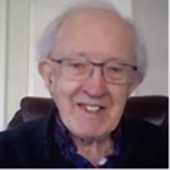
Michael Murphy
-
Michael moved from Ireland to Canada and then to Zambia in 1969 as an adult educator before becoming CUSO country coordinator in Lusaka and then Blantyre. He was a key member of the staff and volunteers in Southern Africa advocating progressive, activist support for the Southern African liberation movements. He settled in Saskatoon in the late 1970s and worked with Oxfam Canada and later Development and Peace, keeping apartheid on the provincial conscience as well as other social justice issues. He passed away in 2025.
Doug Miller 00:01
Somebody’s got to keep the old man. Great memory, just very short, as my brother says. Michael, I have to repeat that, unfortunately. So you, you, I’m, I’m here today with Michael Murphy in Saskatoon, Gwen Schulman in Montreal, and myself in Montreal, Doug Miller. We’re we’re going to interview Michael. And Michael, you’ve read the you’ve read the consent form and the conditions that are in that, and you’re agreeable to this being recorded and saved and used for purposes of public education.
Michael Murphy 00:36
Yes.
Doug Miller 00:37
Okay. Okay. Thank you, Gwen. Go for it. We’re recording now.
Gwen Schulman 00:41
Okay. And just again for format purposes and standardization, when we edit these down and use them, Michael, I’m just going to start by asking you to introduce yourself, your full name, and where you’re currently residing.
Michael Murphy 00:56
My name is Michael Murphy. I live in Saskatoon. Have been here for the last close on I guess 40 years now 3540 years. I’ve retired some years ago. That’s it.
Gwen Schulman 01:11
Great. Okay. Thank you so much. So we like to we always like to kick off these interviews with the following question, which is: Do you remember a moment or an incident where you first became aware of apartheid?
Michael Murphy 01:25
Yes, I do. I grew up in Ireland, and when I was 18 or 19, the South African rugby team came to play in Dublin, the Springboks, and they were very famous and very tough, and so on. And my friends and I were keen rugby fans. So I had another friend who was a little bit more advanced politically than the rest of us, and he said, “You know, what’s going on in South Africa? This apartheid business sucks. Let’s stay home”. We did. So that was the first. I knew very little about apartheid in South Africa, but that was the first act.
Gwen Schulman 02:12
Well, clearly your friend said just enough to convince you because it must have been a hard thing to walk away from. All right. So then, from there, when was your first engagement with anti-apartheid activism? Well, after I mean, that was a gesture, an anti-apartheid gesture, but in a more kind of sustained and organized fashion.
Michael Murphy 02:33
When I went to Zambia with with CUSO. Before that, I hadn’t taken part in any. I think, as far as I remember, any sort of political solidarity activity, but I went to Zambia in 1969 as a volunteer, and I think the the orientation program that we got before we left was very good, was very political, and gave us a good handle on what was going on in Southern Africa, and especially in South Africa, so that was the beginning. And of course, spending two years in in Zambia. Well, I wound up spending four years in Zambia, where there was constant reference to apartheid people coming through the arms struggle, the ANC, the PAC. It was it was almost on a daily basis. There was some connection in terms of what was happening in South Africa.
Gwen Schulman 03:31
And can you flesh that out a little bit for us? What was that? And in day to day, when you talk about people coming through, why were they and were they contacting you directly as a CUSO representative, just talk to us a little bit about that.
Michael Murphy 03:44
Well, I was a volunteer for the first three years, and I was a staff officer for the fourth. And it wasn’t that there were people coming through on a daily basis, but inevitably, one met people who were connected with the movement in some way or another with the liberation movement, and we had regular volunteer meetings, and very often on those agendas would be updates and information as regards what was going on in South Africa. A field officer, Doug will relate to this for sure, meant contact with ongoing contact with about 45 volunteers. I think we had in in Zambia at the time, and both at meetings and in terms of newsletters, communications, and so on, the liberation struggles were, were there always. This wasn’t just South Africa. Of course, we’re talking about Mozambique, Angola, Guinea-Bissau, even Zimbabwe was not independent at the time.
Gwen Schulman 04:53
So here you are, a young man who’s working for a Canadian NGO in Southern Africa, in Zambia, and. You’re being exposed to liberation politics, to liberation movements and struggles directly. Do you remember your emotions and your thoughts at the time? Because that was not everybody who had that opportunity, and for people, young people today, not that much opportunity to be able to do that now. So you know, tell us about that exposure to those politics and those individuals.
Michael Murphy 05:26
I guess the major thing would be the introduction to the idea and the practice of liberation movements. The idea that there were people who were militarily fighting against the, the regimes in those countries, but what I what I do recall was how, how unquestioned that was. It was remarkable, where the idea that you would say, you know, “I’m a pacifist, I’m not up for that”. That that never came up. It seemed to be that volunteers automatically accepted that these wrongs were such that military struggle was called for. At the same time, recognizing the importance of education, both amongst ourselves and education in Canada.
Gwen Schulman 06:17
What was CUSO’s position on armed struggle at that point and support for the liberation movements?
Michael Murphy 06:27
Good question. I would say that, of course, there were divided opinions in in our region, East and Central Africa. I think the question of support for liberation movements was a given, but not everybody at the national office would have agreed with that. The national board and so on, and indeed in some of the other regions of where CUSO operated, and CUSO was overwhelmingly funded by the government of Canada through CIDA, and so CUSO did not go about advocating armed struggle as the solution of Southern Africa. But in terms of sympathies, in terms of education, and so on, and that was that was how it worked out. I we, we never provided any form of grant to the to the liberation movements. No, we never gave money. There was, I don’t know if you remember it, Doug. There was a strange business to do with providing watches for the leadership. That was before that. As I remember, it was in in in Dar es Salaam, and I’m not sure whether it was the Frelimo or the ANC, but that was that was minuscule. It was more a matter of oh, let’s move on.
Gwen Schulman 08:00
Yeah, that definitely raises some questions. I wonder if there were plans for those watches in terms of, you know, communicators or something. I want to talk about again, I feel that I want to emphasize that it was a special time in terms of people from around the world having frontline exposure to liberation politics and liberation movements, and so you, as an individual, coming into this situation and having that kind of immersive experience, how did it influence your own politics and worldview?
Michael Murphy 08:40
Oh, very much so. I think you know, given, given Irish history, I came with, with a fairly good understanding of imperialism, colonialism, but in terms of the world outside, yeah, working with CUSO certainly broadened my horizons. I would say my politicization began in in Zambia in 1969, 1970, and has continued ever since. It was certainly, I think, for many CUSO people, a trigger that set us on the road to politics analysis. Does that answer your question? Yep. Yep. In part. Yeah,
Doug Miller 09:32
As you, you stayed in CUSO through through several postings and positions, you saw how the region of CUSO, the East Central region of CUSO, promoted support for the cause of the movements to the point that they even decided that they would set up an office in Lusaka and staff it. To support, provide support to the goals of the liberation movement, especially the refugee and the people that they’re in their care, but as well education and around the issues. That struggle must have, you saw it close up, and when you were dealing with the national office, what were the what were the elements of the the debate and the discussion and the I don’t know if there were confrontations, but that kind of thing?
Michael Murphy 10:31
Well, there was the larger debate within CUSO as regards what constitutes development, what is development, what are the ways to achieve development, and I think the mainstream within CUSO would have been well, we send volunteers, and later on we provide some money to promote development in the third and the third world. And I think within that, the focus on armed struggle, on liberation struggle was relatively minor. I think for some people was a distraction, and wasn’t universally shared. I’m not getting quite to the core of your question, Doug.
Doug Miller 11:16
Well, it seems to me that within the NGO world, the contradiction between the discussions of what is development, and I remember the whole debate about root causes of underdevelopment, and that debate I think was quite energetically carried on in particularly our region, and I also think Latin America, but certainly other regions didn’t want to change the model of relationship that those debates implied with their funding agency.
Michael Murphy 11:47
Yeah, I would say that if the East Central Africa region had been able to, there would have been fully voiced public and so on support for liberation movements in Southern Africa, but it wasn’t possible within the organization, despite that empathy, support, solidarity with the liberation movements.
Gwen Schulman 12:14
So can you can you explicitly state why it wasn’t possible?
Michael Murphy 12:19
Again, public profile, again funding. There was always the concern that if CUSO steps out of line, then CIDA would pull the funding, and that would be pretty well the end of CUSO.
Doug Miller 12:33
And in fact, we saw that example with the SUCO issue, which was the French counterpart of Cusco, dating back to that campaign against Angola, or where Angola, Quebec were zones a liberator. So, yes.
Gwen Schulman 12:54
Doug, can you elaborate because listeners are not going to know what you’re referring to?
Doug Miller 12:58
The CUSO had a francophone wing called SUCO, and they tended to follow the nationalist politics of Quebec very closely, and included in that was people who wanted to get involved in anti-apartheid work more actively, like Jacques Roy and Pierre Boudet and others that were working at the time, and and other names I’ve long forgotten. So they organized a campaign and actually brought Dr. Neto to Canada in April of 1974, and the campaign was one of the slogans was “Quebec, Angola, zones a liberer”, and of course that was not a very favorable thing to do with a Pierre Elliot Trudeau government that was trying to hold federation together and come up with a new constitution of unity. So it it cost SUCO much. They they they were eventually cut off altogether.
Gwen Schulman 14:02
Okay, so Michael, I want to. I’m going to keep pushing a little bit on this whole relatively unique experience of having full-on contact with liberation movements. So many NGOs then and certainly now have a tendency, certainly with respect to Africa, to treat Africans as passive victims, as needing a helping hand. You know, really the arch opposite of solidarity with organized liberation movements. So, did that message get back to Canadians? Did the fact that CUSO, okay, perhaps was not able to openly embrace or finance it, but certainly had sympathies with liberation politics, did that kind of message filter back to Canadians and help Canadians see? That issues of poverty and marginalization are political issues with political roots and not inadequacies or inabilities in a question of educating Africans.
Michael Murphy 15:13
The education work that CUSO did in Canada, public campaigns and so on, was primarily in in terms of support for anti-colonial, anti-imperial struggles, support for change, and but not necessarily endorsing armed struggle. I think that’s the way that I could put it. That if anybody ever-I don’t remember anybody ever questioning, “well, you know, what is your organizational position in terms of the ANC, the PNC armed wing in terms of military struggle?”. I think that while individuals such as myself would have said, “We’re all for it. Good luck”, the the organization as itself could not do that. It would have been unthinkable to support armed struggle. But the organization never attempted to downplay or to deny the existence of the liberation movement. Would you say that’s fair, Doug?
Doug Miller 16:18
Well, absolutely, and to the point that the region of East Central Southern Africa, Exa as it was called, used its project funding and and. and its resources to find more funding from outside of CUSO to support projects with the liberation movements. That of course was more my bailiwick, but you were very much part of getting us out of Malawi and into that office as a rescue mission from Malawi. I don’t know if you remember all of that sort of machinations and how they came up with the funding and the vocabulary you had to go to to to get that office. It’s past the CIDA net and whitewash it so that it was going to be acceptable funding.
Gwen Schulman 17:11
I, just again historical context is very important because I think for a lot of people who are going to be listening to this now and today to have a mainstream NGO like CUSO use words like anti-imperialism and anti-colonialism, I want to stress that because we live in a very different day now, where no NGO funded by the Canadian state would ever dare to use terms like that, they’re political like that. So you know, times have changed.
Michael Murphy 17:47
Yes, yes, they have indeed, and that would be that was one of the points that I wanted to make overall. That times have indeed changed. That the anti-apartheid solidarity work that you know I was part of in the late 70s and in the 80s. I can’t imagine it happening today. It’s an entirely different situation as regards people, as regards issues, as regards global changes that have taken place, neoliberalism, and so on. I won’t use the term golden age, but I see that era as being an enormously energetic, enthusiastic time of international solidarity.
Gwen Schulman 18:36
To what degree would? Oh, sorry. Go ahead.
Michael Murphy 18:39
No, no.
Gwen Schulman 18:40
Well, I was going to ask: To what degree would you credit the move, the liberation movements themselves, with their efficacy in getting their message out and educating people globally about the struggle?
Michael Murphy 18:57
My immediate response would be that it was with the support of the liberation movement that organizations like CUSO and Development and Peace, and the learner centers and so on got the message out, with the exception of individual forceful individual visitors, and the international profile of people like Nelson, obviously, afterwards Thabo Mbeki. Then, what am I saying? I was saying that the liberation movements, I think, cheered on and very much supported the work being done by solidarity organizations in Canada and indeed throughout the world.
Doug Miller 19:43
Again, that you mentioned the development education centers and the several NGOs that were still doing work in Canada at that time, and to some degree still being funded out of the CEDA NGO budget. Very interesting that that would never be possible now.
Michael Murphy 20:01
Yes, absolutely. I agree. I agree. The learner centers played a very important role. Gwen, I don’t know whether you’re familiar with the learner centers. Are you?
Gwen Schulman 20:10
No.
Michael Murphy 20:11
Well, across I can only speak for Western Canada, but across Western Canada, there were a number of small NGOs in Saskatoon. It was One Sky Learner Center. There was one in Regina, and Winnipeg, and they were primarily public education international issue small NGOs. That was their that was their job. They were funded by CIDA. Doug says that would be unthinkable today in terms of the basic political work that these and indeed none of them exist anymore. I can’t remember exactly when they fell by the wayside, but they eventually did. And time changed. And another factor that I wanted to that I thought of as well is that the enthusiasm, the work that people in these learner centers put in, and that people, organizations, solidarity groups in the in the individual cities, and Oxfam and CUSO was was remarkable. There were very impassioned people working in these organizations, and I think that really helped.
Gwen Schulman 21:25
Very galvanized time. Can you tell us a little bit more about the learners’ centers? What did they What did they do specifically?
Michael Murphy 21:33
Well, they were libraries. They carried a great deal of material to do with third world issues. They organized events. They brought in speakers.
Gwen Schulman 21:51
Would they bring in members of the ANC or SWAPO?
Michael Murphy 21:55
Yes they had. They had, and they worked closely with the other, with the other organizations. In a way, I guess looking back again, Doug, it provided they provided some staff, paid staff people who were able to to do organization and mobilization work courtesy of of the Canadian government.
Gwen Schulman 22:17
Doug, would you say it’s fair to say that our equivalent here in Quebec would have been CIDMAA?
Doug Miller 22:22
Oh, CIDMAA for sure, and there were many others here as well. Right now, my names are totally escaping me, but there was a multicultural center on Saint-Urbain. I’ve just forgotten its name as well, that ran for years and years programs around international issues and understanding international things, they and here from the other side of the the the world was QSOEXA organizing visits by ANC, by SWAPO, by ZAPU, ZANU, and this network of learning centers, in addition to the NGO representations as well, were key to getting them audience across Canada.
Gwen Schulman 23:12
I have to interrupt. I have to just step out for one minute on this. I’ll be right back. So just continue the conversation, and I’ll dive back in as soon as I come back. Sorry.
Doug Miller 23:21
Sorry. Sure, Mike. Yep. Would you would you agree to that or with that?
Michael Murphy 23:28
Oh yeah, yeah. I mean, there are limits to what any volunteer entities can do, and so we had a remarkable Saskatoon Solidarity Committee here, which, with hindsight, was just amazingly energetic and successful, and and so on, but there are limits of what volunteers can do. And having staff people, a staff person, a staff people to sort of pull it together is is a real gift. I found this in so many other organizations.
Doug Miller 23:57
Now, after your CUSO experience, you came to I believe it was almost directly back to Saskatoon, was it not?
Michael Murphy 24:05
Pretty well, yeah.
Doug Miller 24:07
And and what what was your involvement then at that point with where where you would have run into anti-apartheid issues to deal with?
Michael Murphy 24:15
Oh, straight away into it with Oxfam. My first job was part-time worked with Oxfam, and Oxfam nationally was very pro liberation movement. Pro, had very progressive people on board. They had gone through. They had gone through a chaotic time when the original board and staff and so on of Oxfam, which was very conservative in terms of what they were doing, was basically overthrown by by a group of younger, more activist people. Mayor Brownstone was one of those people and was very instrumental in terms of moving Oxfam into a much more progressive position worldwide,
Doug Miller 25:06
and and within that they they also had representation across Canada too, didn’t they?
Michael Murphy 25:13
Oh yes, oh yes.
Doug Miller 25:14
Against staff people.
Michael Murphy 25:17
Yes, yes, staff people and boards and local committees. That’s one thing that Oxfam brought with it, eh? There was a Western board, Central Canada board, Atlantic board, and then there were local committees in Calgary and Edmonton and scattered across the country that also brought in really good people, and that was a that was a gift to have a a structure that brings in more people automatically was was great.
Doug Miller 25:52
And so, if the issues like apartheid were being dealt with, they would be invaluable promoters of whatever cause.
Michael Murphy 26:00
People at the grassroots, as we used to call them.
Doug Miller 26:03
I, I, you sent us a clipping from Sister. Now I’m just going to mess up her name. Trinetta. No, I’ve lost it. Sister
Michael Murphy 26:14
Teresita.
Doug Miller 26:15
Teresita. Thank you very much.
Michael Murphy 26:17
Teresita.
Doug Miller 26:17
Yes, and would you just give us a little background to what that was all about, and would those committees, the learning centers, and Oxfams have had any role in that?
Michael Murphy 26:30
Well, I can’t, I can’t go into any detail because I don’t know it. But the churches, I would say nationally, the churches, and certainly the churches here, the United Church, the Catholics, and so on, were quite clear as regards their position on apartheid. Apartheid was the one that could really, that could really stand out, and that pastors and so on could talk to their congregations about because it was so, so extreme. The school that Sister Teresita Okov is a Catholic school, and again, some of the people who were staff people there were very, very progressive, very supportive of solidarity work, and again, particularly in South Africa, that particular school was probably the one that led the way. It was just just remarkable. Just in in passing, when I was working with Development and Peace, that school raised money for Development and Peace projects by having an annual box lunch auction. Students would bring box lunches from their own, from their parents contributed them, and then they would auction them off. Wow! Regularly, they raised $50,000.
Doug Miller 27:53
Wow!
Michael Murphy 27:53
Those box lunches-it was just unbelievable. And we’re talking
Doug Miller 27:56
the 80s.
Michael Murphy 27:57
No, no, we’re talking in the in the early 2000s,
Doug Miller 28:04
Oh boy.
Gwen Schulman 28:05
Yeah.
Michael Murphy 28:06
But there was that enthusiasm for, for development of peace. Also, as you can imagine, it became an intense competitive, you know, business with the high school students who saved up their money and came and bid away. Okay, so back to Canada and solidarity work. Oh yeah, Sister Teresita, that was unique. I I had never heard of an entity like that happening in terms of an actual role play as regards black, white, apartheid, and so on, but clearly it was remarkable, right?
Doug Miller 28:43
Because they do mention in there something about Development and Peace, or or no, sorry, it was the discussion around it with the the people that you sent it to, how Development and Peace had been part of or that. Now you became a staff person for Development and Peace.
Michael Murphy 28:58
yes,
Doug Miller 28:58
and and and that was at that time that they were still working around issues of Southern Africa, I’m sure.
Michael Murphy 29:07
Yes, but Development and Peace tended to be more generic in terms of sweatshops, environmental issues, the landless in Brazil. They tended to go after themes rather than specific countries, right? Specific issues. I’m not representing this very well. Development and Peace was and remains a very solidarity-oriented organization which focuses on, yeah particular parts. I think again of Brazil and also issues such as sweatshops, corporate responsibility, Canadian mining companies in Southern Africa, and so on. Development and Peace was a fine organization, and of course, had the advantage of having a huge audience. When somebody, Development and Peace went up to the pulpit and talked for 10 minutes about sweatshops, you know, you were reaching hundreds, and on one particular day, you were reaching 10s of 1000s of people with that message, not many solidarity organizations had that entree to to a mass audience. Okay, I must show you something that I dug out when I was waiting for you. I don’t know whether you can see it.
Doug Miller 30:34
Liquor store.
Michael Murphy 30:36
That’s me.
Gwen Schulman 30:37
Oh wow,
Michael Murphy 30:38
That’s me. It’s a terrible poster. I don’t know how I how I came up with it, but there.
Doug Miller 30:46
Ah, there you go.
Gwen Schulman 30:47
Anti-apartheid groups opposed sale of South African wines. Tell us more about it.
Michael Murphy 30:53
That’s something else too. So this was 1983, and again, something which gave real weight to the anti-apartheid campaign was that there were South African products being brought into Canada that were being sold in the stores, and so you had the opportunity of asking people to boycott those particular those particular products, not those particular stores, that particular product. I think of one of our Saskatoon Solidarity Committee members being removed from a grocery store on Eighth Street here because he was putting little stickers on the oranges that said boycott South Africa. So the liquor stores carried wine, and that was a very easy thing to pick on. These were at that time, all of the liquor stores in Saskatchewan were government-owned, and so it was very easy to leaflet to make that an issue, as you say, around wine, South African wine, and then South African grapes and oranges and so on. Boycotts help for sure; not just their help, really, in terms of bringing public attention to a particular issue, such as about that.
Gwen Schulman 32:27
Do you remember how difficult or easy it was to mobilize the public to support these boycotts?
Michael Murphy 32:41
I don’t think I ever encountered any opposition or criticism of it. As with most, the 90% of the population breezed by the 10% or whatever would stop and take a leaflet, or in some cases would stop and have a have a short conversation, but looking back, my feeling is that Saskatoon, as an example, was remarkably successful in terms of mobilizing around the anti-apartheid issue. This was, and the CUSO Oxfam, Development and Peace, the learner centers, the churches, and there were also a number of political parties here, non-mainstream political parties, small but, who likewise were very felt very passionately about South Africa and would send people to the various coalition meetings. We had a lot going for us in terms of people. Again, I don’t know where we are.
A remarkable instance was in the Oxfam office where I was working. One day, a local businessman, agricultural equipment, came in and said, “I’ve seen this movie, Last Grave at Dimbaza’, and said to us, “I was very affected. What if I bought you a copy of that film?”. And we said yes, please. And he bought it for us. And we toured. We showed that movie to many, many audience, including union meetings.
Gwen Schulman 34:32
Can you tell us about the movie? Just give us the general. For people who don’t know the movie, just describe it.
Michael Murphy 34:37
Doug, do you remember it?
Doug Miller 34:39
Well, it it was a very graphic illustration of daily life and the humiliation of racist apartheid on the people of that country, and and and the last grave was the harsh relocation conditions that people faced. You know, the desolation of those reserves and places where. People had been banished to. I do remember a garbage truck where some poor blokes are running behind, and it never stopped.
Michael Murphy 35:07
Oh my! You have a fine memory. You’re right. Yeah, I remember that. The guys running. So it was a very sympathetic portrayal of life for for for ordinary, particularly I remember, rural South Africans, it was very emotional, very motivating, very emotional, and it just came out of the blue that this man would come in, and so we were very grateful, and we managed to get it. So we were able to go to union meetings and say, “Look, we have this remarkable movie that we’d like to show your membership”, and in most cases we were well received. And I remember taking it to centers outside of Saskatoon. Curiously, I don’t remember the technology. I don’t remember. I don’t remember whether we lugged a projector with us.
Michael Murphy 36:02
Almost inevitably a canister, a canister movie,
Doug Miller 36:05
Reel to reel. Set it up, feed it through.
Michael Murphy 36:08
Set it up. Go to the back of the hall or whatever, and project it forward. Either way, it was a gift, and it was it was wonderful.
Doug Miller 36:16
It’s interesting Saskatoon would be so so so activist oriented. Yeah. you think that? Can you pinpoint anything there that makes it special compared to I don’t know, Kitchener, or?
Michael Murphy 36:33
There were some remarkable people here. There were some remarkable people who were very committed, very savvy, very knowledgeable. We also had a small number of Chilean refugees, very very political as well, who who joined in and pitched in with the with the campaigns. But there was that energy. There were those people in those organizations, in those local committees, and so on, who was very good. As one one of my former buddies said, “You know, looking back, we could organize a rally of 400, 500 people at a day’s notice.
Doug Miller 37:18
Wow, that’s amazing.
Michael Murphy 37:20
Yeah, and I thought that he was right. So it’s also Saskatchewan, the whole social democratic history, the history here of people identifying with the with the underdog and so on. I think that had something to do with it. The fact that “Next Year Country” is still remarkable, is a different place.
Gwen Schulman 37:41
Oh, go ahead, Doug.
Doug Miller 37:43
Well, it’s about this time I stumbled across a thesis written by Michael Joseph Murphy about the CIDA CLC connection. Would would would your experience with the the South African work and the anti-apartheid work have had any influence in why you would do a thesis on that?
Michael Murphy 38:02
Yes. Yeah. Inevitably, the question of, and Gwendolyn, this thesis was basically a critique of how the Canadian Labor Congress was accepting money from the Canadian government versus via CEDA in order to promote the emergence of social democratic non-radical trade unions in third world countries, including South Africa, including South Africa. So yeah, I mean, again, I had no direct experience of union work. I didn’t become a union member until I joined Oxfam, and it took even there. It took five or six years before Oxfam actually became unionized. Eh?
Doug Miller 38:59
Yes.
Michael Murphy 39:00
Yes. Yeah, and so I began to take an interest in union politics, and inevitably, in terms of the international connection, the International Congress of Free Trade Unions, the ICFTU, was the major international organization that brought together organizations like the CLC throughout the world, and their orientation was definitely middle of the road. They didn’t have much time for any form of radical politics, both in Canada and in terms of of internationals, so I became interested in the connection between unions here and the CLC and the CLC’s connections with overseas unions funded by CIDA, the Canadian Labor Congress funded projects. They, they provided money for what they say as their opposite numbers in Nicaragua, El Salvador, South Africa, and so on, with money provided by the Canadian government via CIDA. Okay. Okay. So that interested me, and that’s why I I spent some time working on a master’s thesis on this issue.
Gwen Schulman 40:24
Very interesting, because Doug and I, for years, have looked at the role of state funding in in I guess one way of putting it would be to say to depoliticize NGOs or to move NGOs around from any kind of alliance with radical transformative movements or organizations like liberation movements, which is why I was pushing so hard early on to talk about the fact that CUSO, while funded by the Canadian government, still was using anti the language of anti imperialism and anti colonialism. Because later on we see that there’s a very clear connection between Canadian state funding of NGOs and NGOs really tamping down any kind of overtly political or transformative politics, should I say, and a shift towards developmental politics, which is you know you can educate people out of imperialism, kind of thing. You know, as opposed to looking at fundamental change.
Michael Murphy 41:28
Yes, I agree.
Gwen Schulman 41:31
Do you have any recollection at all of talking about these kinds of influences of the Canadian, the South African embassy trying to influence or interfere with anti-apartheid politics in Saskatoon.
Michael Murphy 41:48
No, I can’t recall. I can’t recall any such instance. No, there may have been letters to the newspaper or the local radio station. This is – I’ll just go quickly through it. This is a pamphlet that we used in the Solidarity Committee. We mass-produced and managed to to circulate quite a lot.
Doug Miller 42:19
Oh wow!
Michael Murphy 42:20
And so it’s multi-paged, and including oh yeah, that reminds me. Why should we care about third world struggles, women? And here we go. We had South Africa, racism, where racism is legal, and we attempted to explain just what was going on in South Africa, and we distributed probably 1000s of these of these pamphlets. They were very, very attractive, well designed, well well to look at. So we focused on Nicaragua, El Salvador, South Africa, and women’s issues. But if we don’t come to it triggered by your questions, I think that one thing that we did not do in any significant way was to connect what we were talking about with indigenous struggles here.
Gwen Schulman 43:22
Yes. Okay. This is what I want to talk about. This is exactly my next question. Is me, and it’s the logical next question. Can you talk about that a little bit?
Michael Murphy 43:35
What do I say other than that we didn’t particularly we didn’t particularly make that that connection, and I don’t know why. I guess our analysis, our sense, our focus was very much on what was happening in the third world, and our knowledge, I guess, of what what was actually happening as regards indigenous people here was very limited. We had very little connection, and other than the occasional Aboriginal person being a member of one of these committees, there was no – I have to qualify. There was very little connection between what we were doing and third and indigenous issues here. Regrettably, regrettably, but a different again a different time.
Gwen Schulman 44:35
Was anybody to your recollection was forget about the anti-apartheid movement? Just people in Saskatoon. Was anybody working on solidarity work with indigenous struggles?
Michael Murphy 44:50
Well, I would I would think immediately of the Dené and the pipeline. That was one instance where we were basically all were basically all involved in that, but in terms of issues to do with residential schools, with abuse, with poverty, drug abuse, and so on, I think we didn’t have any. We didn’t make any connection with that. We saw our audience as being primarily the Canadian public, mainstream, and government trying to put pressure on government to make those changes.
Gwen Schulman 45:25
There’s a growing awareness now that Canada is a settler colony, and we discuss issues around Indigenous struggles in very much of a kind of a colonial framework. Do you think it’s possible that back in that time, it’s just not how Indigenous struggles were understood. Most white Canadians do not see themselves as living in a country that it has a deep colonial past and is essentially, by definition, a settler colony.
Michael Murphy 46:00
That consciousness was-I would say-that consciousness was not there. That consciousness of great ignorance of what conditions were like on, on reserves, and there are many reserves, and great ignorance of what conditions were like for Aboriginal people in the inner cities in Regina, in Prince Albert, and in Saskatoon, where you know poverty and drug abuse, housing issues, and so on are overwhelmingly Aboriginal issues. So no, we could have certainly done better in terms of broadening our focus to involve Aboriginal issues and perhaps to bring in more Aboriginal people into what we were doing.
Gwen Schulman 46:53
There’s been what we’ve tried to do with these interviews is not only celebrate the anti-apartheid movement, which obviously is very deserved, and it’s clearly a special time, as you’ve laid out, and you know, a time of great galvanization and inspiration and all of that. But at the same time, we’re also trying to take a critical look at it, and so this would be an example of the kind of, you know, the blinkering in terms of indigenous struggles here in Canada, did you do you recall ever any sense that there were issues within the movement around sexism, racism, you know, fault lines like that within the movement that weren’t addressed or were addressed?
Michael Murphy 47:41
I would say were not addressed. How would I say? I think that our work at the time was just as sexist as any other organization at the time. It wasn’t a particular consciousness. We had very, I’d say, we probably had a fair balance. I’m thinking particularly of the Solidarity Committee and and the Box Fund. A fair balance between men and women in terms of positions and in terms of of action, in terms of activism, but the idea of sexism-it wasn’t-it wasn’t something that was put in those terms and that was discussed as that racism. I don’t think so. I don’t think so. I’m just looking here in terms of what there was. I’m just thinking in terms of. I’m sorry. You you asked as regards sexism, racism, power structure. Yeah, and did you did you mention something else in addition to those two?
Gwen Schulman 49:14
No, no, no, that was it.
Michael Murphy 49:16
Yeah. Okay. No. What? What? There was conflict between. There was some conflict between the work of the the coalition, the the the solidarity committee, and the Arizona use, so and so on. There was some conflict between those and the non-mainstream political parties that were represented in Saskatoon at the time. So I’m talking about the Communist Party of Canada, Marxist-Leninist, the Communist Party of Canada Revolutionary. Workers’ League, and even a small presence of enlout which I’m sure you’ll – Oh my goodness! Yeah, yeah. So Gwen, I’m saying that the the the various very small groups, political organizations that were here, such as the CPCML, Communist Party of Canada, Marxist-Leninist, the original Marxist, original communist party, the Revolutionary Workers League, which was Trotskyist, basically a Trotskyist organization, and En Lutte, they were here, and they were at times very critical of what the mainstream solidarity groups were doing, they they took a much more you can expect a much more radical position, and at times regards lines and so on. So that would be what I would think of rather than conflict over power structures or racism or sexism within the movement.
Doug Miller 51:07
Okay, well, just moving on to a more reflective point. Not not not that we’re not been reflective, but back looking. Do you think the anti-apartheid movement actually did encourage the Canadian government to do something. Were we effective at all?
Michael Murphy 51:25
Yes, I think so. I think that the movement was sufficiently large, was sufficiently vocal, won over enough people, that it that it did. But as always, I and I think it was pretty well unique in terms of Chile, Nicaragua, El Salvador, whatever, in terms of being able to do that, but there was the the convergence of the interests of Canadian business as regards South Africa, South African that was happening at the same time. You had this growing consciousness of of corporate. both here and within South Africa, that it was time to to make a major change. So you had those things. You had growing, I think, public pressure and organizational pressure, and individual people, and the whole. Nelson Mandela, Nelson Nelson Mandela as a figure, as an internationally respected, known, sympathized with figure, was was very difficult for the Canadian government to say yes, yes, that’s all very well, but Yeah.
Doug Miller 52:44
Gwen, do you have anything else to to probe? You’re on mute.
Gwen Schulman 52:56
Let me just check here. There was something that I wanted
Doug Miller 53:01
to. I. can can I just jump hop skip what is the words? I don’t know what the right word is. Skip backwards a little bit. I, you sent us a little short story or sent me a little short story, and excuse me for sharing it without your permission about your visit to the casino in Gaborone. It would be fun just to have you recount that very gently, if you don’t mind. Not really. Just tell us the circumstances and what it was about.
Michael Murphy 53:35
Do you have time, Grant?
Gwen Schulman 53:36
Yeah, yeah, yeah, for sure. Full disclosure: I read it.
Michael Murphy 53:43
I’m sure you have read it.
Gwen Schulman 53:44
I have, but everybody else who’s going
Michael Murphy 53:47
to be. No, then if you’ve read it, I I don’t have anything to add. It was just such a memorable encounter, and that that what do you call it? That That line, that punchline-that’s the word that I’m looking for in terms of you’re trying to throw us out. We have safari suits, and she’s not dressed in much more than a loin cloth. Oh, unbelievable! Unbelievable! The the immediate the immediate reaction to that by the manager was yes.
Gwen Schulman 54:24
Speaking of sexism,
Speaker 3 54:27
oh,
Doug Miller 54:28
Amazing! If you don’t mind, we could include that as part of the documents you’ve provided us.
Michael Murphy 54:36
Yes, yes. Oh yeah, of course, of course. It’s there may be minor details that you know that aren’t entirely true. I don’t know. I just go with with what my memory provides me with. But I don’t know whether it’s clear to somebody reading it that that that sentence that they were. It was in fact. There were two things going on there, right? Saying you can’t throw us out for being improperly dressed when she’s improperly dressed, and the other thing was applying the word loin cloth to a white woman, suggesting that a white woman would dress in a loin cloth. There was those two things going on in that inspired, inspired line. Are you with me, Doug?
Doug Miller 55:27
I’m with you, but I’m.
Gwen Schulman 55:29
I only called out the hypocrisy on that one. It, it, it,
Doug Miller 55:32
it could be quite, quite. They, they, they rose to the anger with that kind of thing, and I can, yes, I’ve exposed to it, and this is an interesting thing about Malawi, and you might have seen it as well when you were there, Mike, that there were still a lot of South Africans and and white Rhodesians in the country while we were there. So the you you you would inevitably bump into it as you worked in Malawi.
Michael Murphy 55:59
Yes, and in Zambia,
Doug Miller 56:01
And in and yes, of course, the the copper belt still had a lot of South African mines.
Michael Murphy 56:07
Quite a lot of South Africa there. Yeah.
Gwen Schulman 56:09
So I am going to have to go. I just maybe I could ask one last question before I bounce out here, which Michael is just, I guess you know we’ve asked you a series of questions here, but is there anything you’ve been thinking about, or that you’ve wanted to talk about that we haven’t covered.
Michael Murphy 56:29
I I made notes on your on your list, and I think that we have we’ve covered pretty well everything. As one small thing that I think of in terms of the anti-apartheid struggle was that English was the dominant language in South Africa. People here didn’t need to have translations from Portuguese, or they had that immediate ability to understand all of the educational material films and so on that were being made about North Africa. Anyway, it’s not a
Gwen Schulman 57:06
good point. No, that’s a good point, though. I mean, that was a huge logistical issue that was not one for the anti-apartheid movement.
Michael Murphy 57:13
Right, Angola would have been much more difficult, Doug.
Michael Murphy 57:18
And it was. Okay.
Gwen Schulman 57:21
All right. Well, Michael, I’m sorry that I need to bow out early, but thank you so much. This
Michael Murphy 57:25
has been really
Gwen Schulman 57:26
Fascinating.
Michael Murphy 57:27
Thank you very much. It’s been a pleasure. It’s stirred up some memories.
Gwen Schulman 57:32
Good. Yes, some very good ones. Very interesting. And just
Doug Miller 57:36
Before I turn off the recording, I just if you could, and it was possible for you to to scan those buttons and those documents and share them with us? We we’ll build an electronic archive of them as well.
Michael Murphy 57:50
Okay, I wondered whether, in fact, you want the physical.
Doug Miller 57:54
If you if you have it available and you don’t mind parting with it, but
Michael Murphy 57:57
Not at all, not at all. I can send you copies of the pamphlet. I can send you that. But what you have on your phone, Doug, by way of those buttons, is probably the best way to do it. That’s a good image.
Doug Miller 58:13
I can use that one for sure. Yeah,
Michael Murphy 58:15
yeah, you can use that, and I’ll send you the print stuff. Sure, there isn’t that much there. There we go.
Doug Miller 58:20
It’s still fascinating. Don’t forget the poster of you outside the liquor store. That’s a gem.
Michael Murphy 58:25
Thank you, thank you.
Doug Miller 58:27
Okay, I’m going to turn the recording off now.
Gwen Schulman 58:30
Bye. Nice meeting you.
58:31
You too.