
Rose Marie Whalley
-
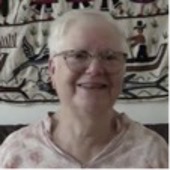
Rose Marie was born in England, where she took part in Ban the Bomb marches as a girl. After she emigrated to Canada, she joined the anti-apartheid movement in the 1970s. Rose Marie is a lifelong activist and host of the radio show Older Women Live, or OWL, on CKUT. She was also a frequent contributor to Amandla!. She is now actively involved in Palestine solidarity work.
Doug Miller 00:03
I'm here today with Rosemary Whalley excuse me, and we appreciate your input as an interviewee, and hope you've saved as well some documents, posters, pamphlets, pictures, whatever. From that time to share with us, we are planning to create a web doc. And these can be scanned and formed part of the resources opened others to see. Do you agree to be interviewed for this Canadian anti-apartheid activist History Project?
Rose Marie Whalley
Yes, Doug, I do.
Doug Miller
Do you agree that the interview will be recorded for later use?
Rose Marie Whalley
Yes, I did.
Doug Miller
Okay. Could you just introduce yourself very briefly and a little bit of your early history?
Rose Marie Whalley 00:45
Well, my name is Rose Marie. I'm originally from the UK. I grew up in a working-class neighborhood. I was lucky enough to get some higher education, which was actually quite unusual at that time, and I became a teacher. And I went to work in London. That was my first job was in London. And that was where I sort of got involved in the anti-apartheid struggle, although I knew about it before.
Doug Miller 01:13
Well, so how did you know about it from?
01:16
Well, my first introduction to the anti-apartheid struggle was the day after the Sharpville, the riots in March of 1960. So I got up and I went down. I was a newspaper, everybody had newspapers in those days. And there was this riveting picture on the newspaper on the Daily Mail. of the 69 people who had been shot these unarmed civilians who had been shot, I was so horrified by this, I remember I couldn't even get ready for school, and I missed the bus, the school. And when I missed the bus, I would have to go to another bus stop quite a way away. And it was down a tree lined streets. There were not too many trees where I grew up. But this was a tree lined street to this bus stop that was farther away. And I kept stopping at the I was crying. I was so upset. And I had dirt on my face when I arrived at school, because I've been, I've been putting my face into the bark of the trees. I remember that. And people were saying when I got to school wasn't that bad. So you've got dirt on your face? So that was my first riveting introduction to what was happening in South Africa. I think I was how old would I have been then? Well, I was coming up to 17. I was 16. Almost 17.
Doug Miller 02:32
So you were in high school by then.
Rose Marie Whalley 02:33
Yes, I was in high school. I was almost finished high school.
Doug Miller 02:36
At what point did you find yourself converting that, that upset into some sort of activism?
Rose Marie Whalley 02:45
Well, almost right away, I went down to the university, there's a university in my town, there's University of Manchester. And I went down there, I was far too shy to go into the student union, or anything like that. But I did try to make contacts with people that were maybe also aware of this terrible things that happened. But I didn't succeed. The first time I got involved with the anti-apartheid movement in London in 1964, which was one of the reasons why I wanted to go to London, because I knew by then I don't know how I found out. But I knew that there were branches of the anti-apartheid movement at that London was sort of headquarters of it. So I got involved.
Doug Miller 03:22
And what did that involvement in?
Rose Marie Whalley 03:25
Well, involvement was, was interesting, I was teaching and teaching is a very, very difficult job I had like 40 students in and I was new and young. By the time four o'clock came, I was exhausted. And so what I would do is I would go home and I would sleep from about four in the afternoon until eight and then I would go out and do political stuff. And then I would go to bed again about 3:30, 4 And I would sleep again for about 7:30 or eight. So I slept for about two years I had interrupted sleep in obviously from foreign to late and then too late.
And the stuff that I was involved with the aim the anti-apartheid movement was boycotting fruits, it was outside the stores. And it was Outspan fruit, it was citrus fruits which they imported from South Africa. I'm trying to think of the slogan. It was something like “outspan hot from the sun, up from the gun boycott Outspan”. It was some and we we've just done screaming on the Edgeware Road even now when I go to the Edgeware Road I think back to those days. So that was it. Yeah.
And that was in England, but I left them in 67 But then I got married and I left England. By then I was also an, even before that I was into band the band stuff that you want to hear about the apartheid, so I won't go on about that. But I was very concerned at that point about the Vietnam War. So I thought, My youth stupidity in my view, if I came to America and I explained the B-52s, where you know what the plane said, I could somehow or other contribute to ending the war in Vietnam. So that was what I did. And for a few years, I didn't do anything against the apartheid issue. Because there I always knew about it because I was doing other stuff.
Doug Miller 05:31
But the anti-war and anti-bomb activism was, although there is overlapping
Rose Marie Whalley 05:37
Of course there is overlapping. Absolutely, yeah.
Doug Miller 05:44
So then you came to North America, and at what point?
Rose Marie Whalley 05:48
I came to North America came to the States and I did anti-Vietnam stuff, day and night for a while. And then I came that, of course, I didn't have a proper visa, and they caught up with me. So I had to run across the border. He said, I came here, just like that. No planning or thought about it.
Doug Miller 06:10
Arrived in Montreal and in Montreal. So then, eventually you did come in contact with the anti apartheid movement here?
Rose Marie Whalley 06:18
Yeah, I did. I think it was with the free South Africa committee, wasn't it? Yes. And that was I met Gwen when she was very young. Because Graham was doing this stuff. And Miguel and I was doing it for Yeah. Free South Africa committee with there were a few of us. It was Tom Holzinger. I don't think he got a hold of Tom. And there was Nigel Thomas and Shirley Small, me and Laura Holbrook, group of people. And we used to do boycotting of the granny smith apples. That was our, our gig. We did different Steinberg's.
Doug Miller 06:55
So that would be about the mid 70s now?
Rose Marie Whalley 07:00
Well, probably the early 80s. Right, more of the early 80s, early 80s.
Doug Miller 07:04
And so the free South Africa committee, you named a few names is was that related to university? What was the context?
Rose Marie Whalley 07:13
It was a community group.
Doug Miller 07:18
And who were the sort of active, most active leaders there?
Rose Marie Whalley 07:25
Well, surely Nigel and Tom and me, I suppose we were the ones that were, you know, that made sure that we've got, we've got leaflets. And another thing that we did, and I love this one. This was a campaign that we had at Christmas. And it was to give something to the people of South Africa. You see, it was like boycott South African because it's not going to cost you anything. We used to say “free gift to them”. So we had a special leaflet for that, but it was terribly cold. Out there in the winter.
Doug Miller 07:53
What was it again? Very cold. Oh, yes.
Rose Marie Whalley 08:04
Oh, yes, of course in the winter. Yeah and so this committee then was a community group.
It was a community group. It was a modular community group. There weren't, there were black people and white people and different people involved. May was involved. She was very involved. Yeah, just an eclectic group.
Doug Miller 08:23
And at that point that you had the campaigns you were leafleting?
Rose Marie Whalley 08:29
Yes. And we were also hosting people that would come from South Africa.
Doug Miller 08:32
Okay, how would they get in touch with you?
Rose Marie Whalley 08:36
Well, we were out and we must have been on some list or something. So we would arrange meetings with them. There was one young man that came and he'd never seen. So instead of him talking, I don't want you to remember that. Instead of him talking about what was happening in his country. He just spent the whole time looking at in terror, fascinated.
Gwen Schulman 09:01
Can I interject, please? A couple of questions spinning off from what you've said, one would be Free South Africa committee didn't have any kind of formal or informal alliances with other anti fatigue organizations in Quebec and Canada?
Rose Marie Whalley 09:20
You know, I don't remember.
Gwen Schulman 09:22
You get the sense that you were kind of working in isolation, or do you not feel like you were part of a large we were part of a larger group?
Rose Marie Whalley 09:27
Yes. We were attached to it. Groups from Toronto and Halifax in different places. Yes. Yeah. And because a lot of the things would have been, like the campaign's say, for you know, Steve Biko day in September, we always did something for that. Yeah. And also, I worked with other groups like there was a point at which we did an action against Bata with a shoe company, you know, because they had factories in the bantustans. And we got arrested. We got put in prison for that.
Doug Miller 10:05
Yes, yeah. What was that, a violence?
Rose Marie Whalley 10:09
It was a non-violence of disobedience action. Plus another thing that we did was we did our own defense afterwards. Now that was all with a group of women. That was nothing to do with the free South Africa committee.
Doug Miller 10:20
Now this group of women was another group,
Rose Marie Whalley 10:23
Ad hoc group. Yeah, that came together to do this. Yeah, to try to move things along in this way.
Doug Miller 10:29
So what led to getting arrested? Now tell us more about that story.
Rose Marie Whalley 10:33
I mean, it was where the action was, we blocked a doorway, or two or three, we blocked some doorway downtown for Bata Shoes door. And we got arrested, and we tried to pull a plea. They, you know, that sort of defensive necessity plea. It didn't go down. It didn't go down well, and then what happened was, we were given a fine, right. So we didn't pay, I mean, paid fines.
And then one day, there's a knock at the door, and it's the cops. They, they, they came to either arrest me, or I had to pay the fine. Now, I was still working at that point. And I'm saying I want to be arrested. So I had to walk down to my bank machine and take out whatever it was that was in there. But the thing that they did was to handcuff me. So we're walking down and arranging bank on Pine Avenue, and some are wrong. And I'm handcuffed and are feeling a little bit bizarre in front of all my neighbors, you know?
Doug Miller 11:44
That was a key memory.
Rose Marie Whalley 11:47
Yeah, it doesn't happen very often to California to say the least.
Doug Miller 11:53
How did you choose the actions to do what did you think needed to be done?
Rose Marie Whalley 11:59
I thought that what we needed to do were more many more nonviolent civil disobedience actions.
Doug Miller 12:07
What was your logic?
Rose Marie Whalley 12:08
So the one that, well, that we would get you see, a nonviolent civil disobedience action is wonderful, because it has echoes and ripples afterwards, you see, you do the action. And there's the publicity with that, like, there was a picture of me getting arrested in the middle of war, I wish I would have kept you because I didn't. And so people were saying, “Are you a nun?”. So now I'm, you know, there's a huge number of people doing that anyway, the effect it has, first of all, there's the publicity of the action. And then afterwards, there's the there's the planning of the court case, because you're going to go and try it or whatever. And so an action like that I think can have, it can last for quite a long time. And it can have quite a bit of publicity attached to it. And that's why I like those actions. They're long, they're complicated. They involve lots of different things.
Doug Miller 12:59
And did you feel you were reaching your goal where you're getting that message out?
Rose Marie Whalley 13:04
Yes, more or less? Yeah, we were meeting when, we met constantly for about 18 months, every Wednesday afternoon, planning out events, you know, that was a bit tedious. I mean, I don't have quite the detailed mind for detail. You see, I don't mind doing the action and then doing a little bit, obviously, you have to prepare for something like that. But every week is a little hard.
Doug Miller 13:26
And so you belong to the free South Africa committee, you had an ad hoc group. And then who were your friends and allies in the work? Like, did you know the student movements at McGill and the other universities? Did you collaborate with the unions or women's groups or black?
Rose Marie Whalley 13:48
Yeah, it's so important. I mean, we were I was on the picket line with people like Gwen and May and different people like that. So and the Voice of Women I've got, so that the voice of women that I was a member of, they were very active. And it's important, I think, to interview members of the Voice of Women, if you can, and the Voice of Women is, I've got groups across Canada, and we were certainly all involved in the struggle against apartheid, all the groups. So an hour impoundment was, it was five o'clock on Thursdays outside Place Ville-Marie because the floor that one of those higher top floors, there was the South Africa consulates, or whatever. And so even though they couldn't see us, we knew they were there. We used to meet and we used to march up and down between what they now called a rule Rabab or SI, you know, whatever it is, realize University streets and Mansfield or whenever we used to walk up and down that block, circle that block every Friday, Thursday afternoon. So that was like a sort of social bit of a social occasion. Yeah. That went on for a long while. That was what I used to see Lael Roebuck, she was very involved.
Doug Miller 15:09
So this this brought in a variety of personalities and activists.
Rose Marie Whalley 15:13
Well, that was it was the Voice of Women. That was what we did. Yeah. That was the Voice of Women. That was mainly, the voices were members. Of course, they would bring on that, bring over their friends and hangers on and there were kids there all kinds of people came to that. Yeah.
Doug Miller 15:28
Do you feel that your message evolved or changed over time? And?
Rose Marie Whalley
No.
Doug Miller
It was one message.
Rose Marie Whalley 15:39
I don't think the message changed over time. I mean, the outrage of the injustice. I mean, that was the thing is the outrage of it. Yeah. I mean, I'm from a refugee background myself. You know, my mother was discriminated against because she was Jewish. You see, I mean, racism on that level is just something about trouble.
Doug Miller 00:00
This is this is from the Second World War.
Rose Marie Whalley 00:02
Yes, yes. So I was very aware of racism, I suppose growing up, as an issue. That's why they, no, it didn't change, the thing never changed. And it still doesn't change. I mean, there's still more or less the same thing now in South Africa.
Doug Miller 00:20
Being official, if you had any criticisms to make of, of the anti-apartheid movement around you at the time, what would they be?
Rose Marie Whalley 00:27
The criticism was that we were always far too lame in our actions. We never, we were never active enough. We always did that, which was, you know, comfortable. And then we went home for supper. We didn't do enough. And I think the situation is still the same now. But different things. We're not doing enough. We're not out there enough. We were too comfortable.
Doug Miller 00:50
So what would you favor?
Rose Marie Whalley 00:52
Well nonviolent civil disobedience.
Doug Miller 00:55
That would include what kind of actions to? Well,
Rose Marie Whalley 00:57
I think that that's where if people were prepared to do that, I think we could come up with some really clever, imaginative, funny stuff. You know, but people don't seem to really think in those terms. And that's something that you can't do on your own. You need it. You need the group? Yeah.
Doug Miller 01:19
Did you feel you've met any opposition as you were participating?
Rose Marie Whalley 01:24
I mean, we were on Saint Catherine Street for years, encouraging people to boycott stuff. And we were outside the grocery stores as well. Yes, they tell us to go back to Russia. Those are the days when we would give them a leaflet. And they would say, “oh, go back to Russia”, you see and throw it down themselves. Communist. Yeah, we were communist. Yeah, there was no real understanding. People didn't really know where South Africa was. It was too far away.
Perhaps people haven't studied geography at school, they've not studied the history of these places. I mean, in a way, that was an advantage I have, because I was from the British Empire. I wasn't even just from England. I mean, I was from a time when Britain simply ruled the waves, there was, the propaganda was enormous, you know, and I was at school. Now, the heinous only believed it, but it was certainly there. Because it was still the British Empire. We learned all the geography, all the history. And then we had to learn all the geography in history of, of our so called enemies you see, like France, or Spain, or whatever it was. So we were certainly informed we could draw, I can still draw the map of Africa even now, because it was so drummed into us, all countries. You see, I mean, the names have changed a little bit, but we would have to be able to do this. And that was not the experience of people here in Montreal and Quebec. Definitely.
Xxxx 02:46
I'd like to return to the previous question about any criticisms of the movements. So I want to take it to another level, when you think back about your participation within the movement itself, did you see challenges around racism, sexism, classism, within the movement, like work that should have been done within the movement as the movement sought liberation elsewhere in the world?
Rose Marie Whalley 03:16
Well, yes, but you see, I think that you are looking at a couple of things. One is getting people out to the events. And the second is having the analysis. So if we would have insisted or spent more time on the analysis, I don't think that we would have maybe got the people out, but I don't know certainly the ins and outs of the class struggle as in South Africa and the union movements and what was happening in the townships and all this kind of stuff. No, we did not look at that. Nor did we look at our own racism, you see because as white people were living in white bodies, we did not look at a whole host of stuff
Doug Miller 04:06
How do you feel you what kind of effect you feel you might have had on others around you and then as it has carried on in long term?
Rose Marie Whalley 04:17
Well, I think in some cases I pissed them off. You know, I annoyed people because I had you know, posters in the house and stuff. So I think it was people find me a little bit too much. That was one thing sorry, what was the question?
Doug Miller 04:40
The question is, maybe that's one answer but I'm quite sure that other people respected what you were doing work with.
Rose Marie Whalley 04:50
Yeah, certainly at work. You know, when I was a teacher so I couldn't really plaster myself with buttons or anything like that, but people you watch side of the fence I was on. And they did sense of respect.
Doug Miller 05:04
And were you able to do anything say through your union?
Rose Marie Whalley 05:08
Well, did I ever try? I was I was the vice president of my union. Montreal Teachers Association at one point. And I just thought they would also trade no union, you know, I didn't think much to them. But anyway, I did try to get them to send money to South Africans through to cross out so you know, the union. They were astounded that I would even ask, they were horrified. This is the level of politicization and this was even into the late 80s. Where we didn't, people were not politicized, then they didn't really know too much about it. And they were, of course, unwilling to send the dollar.
Doug Miller 05:51
If I asked about, at the personal level, do you think that activism by on the part of people like yourselves and others around you had any effect on government policy at the time?
Rose Marie Whalley 06:04
I think that we did have an effect on government policy, but very, very slight, probably. I think there was the embarrassment of the sanctions are certainly embarrassing, although they did, of course, managed to circumvent the sanctions, especially getting oil into South Africa. But do I think, I mean, I can remember us talking once with Joe Clark, you know, “tell us about this, please”. Well, he came to Montreal, and we're saying the post, the blackout said, Talk is cheap. He said, you see, because they would talk about it, the horizontal part of it, they wouldn't do anything about it. I mean, even Joe Clark, who was probably the one that was the most sensitive on the issue, but they were not prepared to stick their necks out. Or anything really. I don't have too much help in politicians. It's the people. This is why I think we have to be much more active.
Doug Miller 07:03
Yeah, this grassroots activism.
Rose Marie Whalley 07:06
Well, the grassroots activism, the grassroots activism out coupled with nonviolent civil disobedience. I mean, it's not no one, is it going to get organized? Not now.
Doug Miller 07:18
Why do you think it appears after Nelson Mandela walked free? And then the elections occurred in 94? It seems like the anti apartheid movement just dried up and blew away here in Canada.
Rose Marie Whalley 07:35
Well, it did. And if you want to know what I think, I think it's because we backed the wrong horse, we backed the ANC. Because the ANC was organized, it was organized internationally, there were officers of the ANC in many, many different countries, losing here. But I later, of course, went to South Africa. And as far as I can tell, we did back the wrong course, because Nelson Mandela was somebody that the white establishment could work with, and that white governments could support. But he wasn't necessarily the one that was most in tune with the demands of the population in South Africa.
Doug Miller 08:15
Hmm. So in that context, here in Canada, that support the anti-apartheid movement fizzled out.
Rose Marie Whalley 08:28
Yes, as soon as the ANC took power, that was our aim of the game. Yes. And so there was the ANC in power. But we never thought, well, wait a minute, maybe that we should be back in the Pan African Congress, or one of the other groups? We didn't even think about that. But we should have done, but they were just not accessible to us. Wow.
Gwen Schulman 08:55
I have a question. What? What impact did the movement have on you?
Rose Marie Whalley 09:01
On me personally? Well, the movement or the anti-apartheid or apartheid itself, I mean, part of that was just riveting, as I say, just changed my life. I've been active ever since I was 16. So it well, totally. It totally politicized me
Gwen Schulman 09:25
Do you think there was something because you talk about Vietnam? I know, you're, you're still very politically engaged now around issues of environmentalism. Yeah, there is something unique or particular about apartheid. As opposed to other social struggles, and political struggles?
Rose Marie Whalley 09:47
Well, it was yes, I mean, apartheid was a symbol of the utter injustice. I think that when we're children, we're very aware of India. And then we get the sensitize most of us, you know, kids always saying we stopped parents. And that that should continue. It's never fair. You see, and I think people should be much more active now.
Doug Miller 10:17
Rosemary, thank you very much for this. We'll continue this discussion.
Rose Marie Whalley 10:23
Well thank you very much, Doug, and Gwen, as well.
Doug Miller 10:26
Is there anything you'd like to add? Oh, of course,
Rose Marie Whalley 10:29
I think it's really important that you're doing this project. Because history continues. And our history has got to be known. Otherwise, we just keep reinventing the wheel. And it just gets weaker and weaker and weaker, as people forget the past. So this is very, very important. Because we were, of course, inspired by the work of AMC. And of course, in England, I was inspired by those fathers and mothers that came before me. In terms of union movements, the women's movement, and the struggles against the wars, you know, in my country, is particularly belligerent, I think they were always at war. And there were these people like Bertrand Russell for example was totally inspirational. I saw Bertrand Russell once in his black cashmere coat that, lying down the ground, and Trafalgar Square getting arrested. You know, he was against nuclear stuff. He was in the Committee for 100. And it was just a riveting experience for me. And so I'd like to think that that say the image of Bertrand Russell getting arrested, and then my stuff, whatever it is that you always have a word continue. You see, I think our legacy lives on in the soul of others.
Doug Miller 11:54
So, very nice, very nice conclusion.
Credits
Bio: Rose Marie was born in England, where she took part in Ban the Bomb marches as a girl. After she emigrated to Canada, she joined the anti-apartheid movement in the 1970s. Rose Marie is a lifelong activist and host of the radio show Older Women Live, or OWL, on CKUT. She was also a frequent contributor to Amandla!. She is now actively involved in Palestine solidarity work.