Three Forms of Sorcery: Bill Orcutt & Wendy Eisenberg, Drainolith, and Setting at Suoni per il Popolo

There are many ways to go about crafting compelling music. Some artists choose to focus on their image or fit into a broader culture, some choose to combine a diverse set of influences, and others are concerned with the essential aspects of sound. All three of the groups I saw on June 25th focus on the concept of repetition, yet they each stretch that basic principle in different directions, arriving at intriguing results that share a common spirit of relishing in the unknown.
I arrived 30 minutes early, making my way into the dark wooden auditorium of Sala Rossa. The venue’s history as a Spanish social club lingers as I walk past the bar downstairs, gazing at the arched windows and red pastel tiles. Nowadays, Sala is known as a haven for experimental music that places local acts and international talents on refreshingly equal footing. Tonight’s show is no exception: we have Montreal mainstays Drainolith alongside American trio Setting and a special partnership between guitar virtuosos Bill Orcutt and Wendy Eisenberg. I find a spot in the center of the room and Drainolith takes the stage, featuring two guitarists and one drummer with a barebones electric kit. Led by CKUT’s very own Alex Moskos, he says a few words of thanks before his guitar takes over.
Alex comes in with a droning riff and Rián takes on a supporting role, plucking rhythmic accents. Destiny drums with a sense of wound-up tension, her synthetic cymbals arriving in quick succession. She bobs up and down, thrusting her shoulders forward with every hit of the pads. After a couple minutes of playing the guitars have melded into one. Even under close observation it’s difficult to separate them in a liquid mass of reverb and delay. Alex’s vocals echo in the top of the room as he plays a repeated five-note refrain with a steadily evolving cadence, driving forward like a gust of wind in the night.
Drainolith’s fourth song moves them further into deconstruction. Rián’s agile fingerpicking advances to the foreground while Destiny increases her snare activity. The tempo keeps speeding up and Alex plays with his back turned to the crowd. Halfway through the song we are dropped into a cavern of echoed drumbeats and spatial chords, forming a jagged contrast with the velocity that came before. New notes arrive with pockets of quiet between them, my ears hanging on to the embers of effect floating in the air.
When the set finishes I find myself under the deceptively simple spell of interplay between three parts. Space alternated with fullness and speed gave way to sludge as every song led to a frame-altering conclusion. This is music that exists in the point of tension where each element is pulling apart from the other, but moderating itself just enough to retain a powerful sense of harmony. As the stage slowly empties I collect my thoughts and stash them away, clearing my head for the next act.
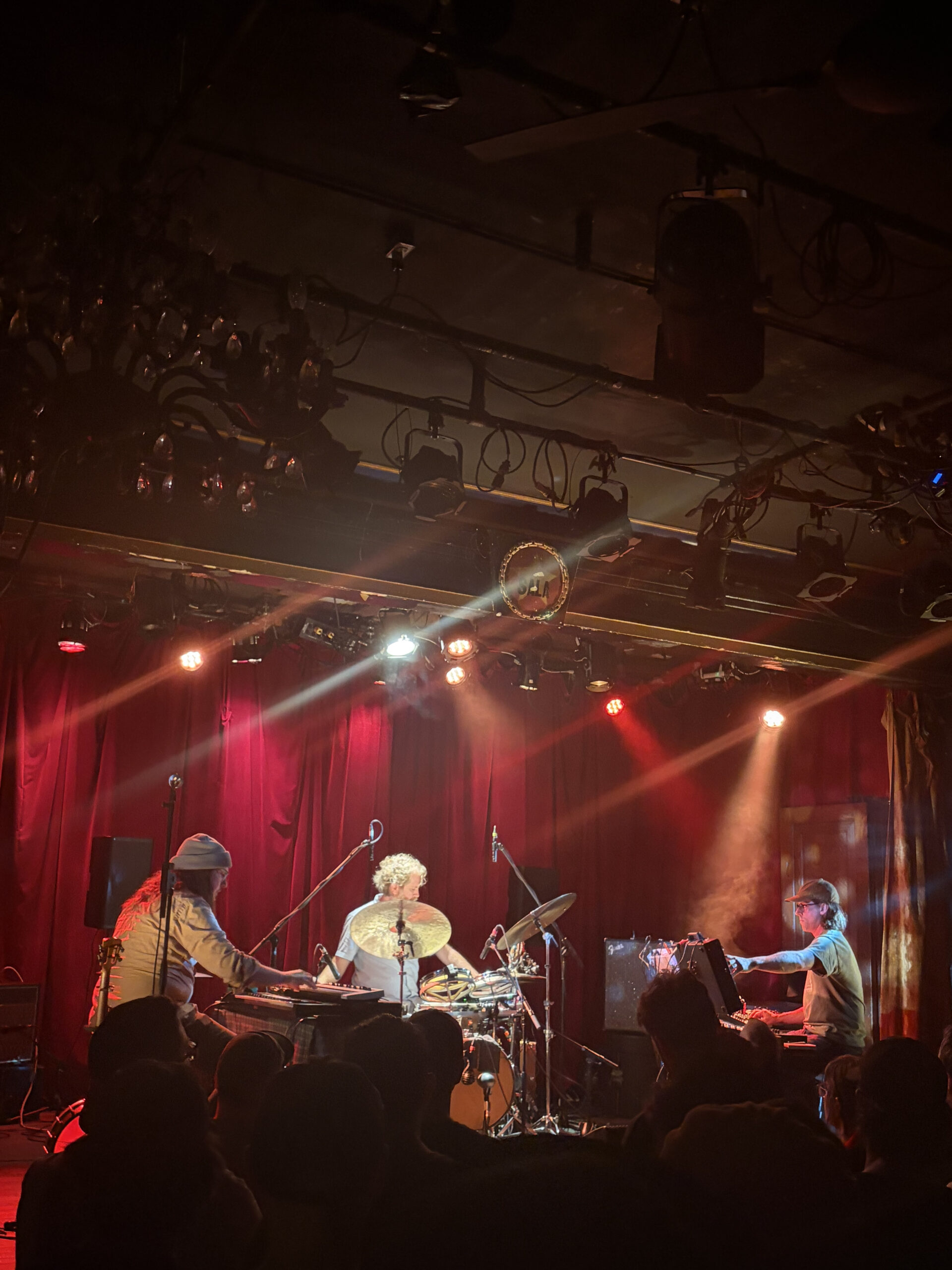
Unlike Drainolith, Setting perform a single extended piece that appears to be largely improvised. They begin their performance in slow motion. The member on the left plays a drone to set the base of their composition, occasionally modulating it into a sharper tone. He layers other sounds on top of it as the drummer starts to fill up more space. He picks up a bunch of shells tied to a rope, shaking them around the microphones on his kit to produce an enveloping sound. A blend of human adjustments and time-based programming characterizes the synthesizers as they swirl around the drums and keyboard. The main synth player on the right watches his machines with a meditative expression, sitting with his hands on his thighs and a straightened back.
Once the first building blocks have been established the groove starts to gain pace and texture. Synths twinkle as the keyboard player picks up a nearby banjo, strumming in time with the tight kicks and snares. The feeling is both earthy and alien as the numerous sounds play off of each other. I imagine that I’m sitting on a rocky ridge in the Appalachian mountains, looking up at an early autumn meteor shower.
Eventually the flurry of activity gives way to a gentle lullaby as the spacious droning returns. When the last note is played, a sustained bout of applause fills the room. Setting’s vastness stood in sharp contrast to Drainolith’s spartan arrangements. They sculpt their music with so many small parts and different sounds that it becomes difficult to zoom in on any single piece of the picture. I was left with a distinct overall impression: a classic circular story informed by the balance of the natural world.
If Drainolith broadly follow a philosophy of subtraction and Setting favor addition, Bill Orcutt & Wendy Eisenberg represent a remarkable synthesis of these seemingly opposed ideas. Across eight separate pieces, they highlight diverse techniques of playing and keeping time in a display of spontaneous creativity.
Orcutt’s talent as a cyclical guitarist who can play with both warmth and precision creates a rhythmic core for Eisenberg’s flourishes to emerge from. His distorted patterns return over and over as Eisenberg works with her tremolo arm, delivering quavering notes in the high register. The heart of Orcutt’s riff is a loop of two strong notes. He modifies the feeling over time by ratcheting the speed up or down or playing related notes with the same timing. His decisions are instantaneous and elegant, taking the music in a new direction with a masterful sense of conviction.
When Orcutt plays his head moves in a swiveling, nodding figure-eight motion, a fitting representation of his sound. Moving into the second piece, Orcutt changes the definition of their pattern from how a note is played to when a note is played. In the first piece, a sharp down-strumming note marked the time and created verses in the music. However, the second piece’s key motif is based on the sustain of his guitar, meaning that he would let a note ring out for an interval of negative space before continuing to strum. This creates anticipation and adds a feeling of lightness to the music. During the third piece Orcutt alters the timing once again, playing two-note patterns with a level hand then switching to an entirely new pattern every 30 seconds instead of carrying the core notes through the entire piece and adding emphasis every 3 to 5 seconds.
In the final pieces the focus shifted from Orcutt to Eisenberg, her highly lyrical fingerpicking forming the basis of the advancement. The time experiments wound down and softened into a casual musical conversation. They took turns, one looking on as the other formed a vignette with a vaguely western feel. It served as a poignant reminder that underneath the layers of talent, ideas, and rigor, a great performance can be boiled down to a simple spark of social connection.

)