A CKUT Intern’s First Anarchist Bookfair
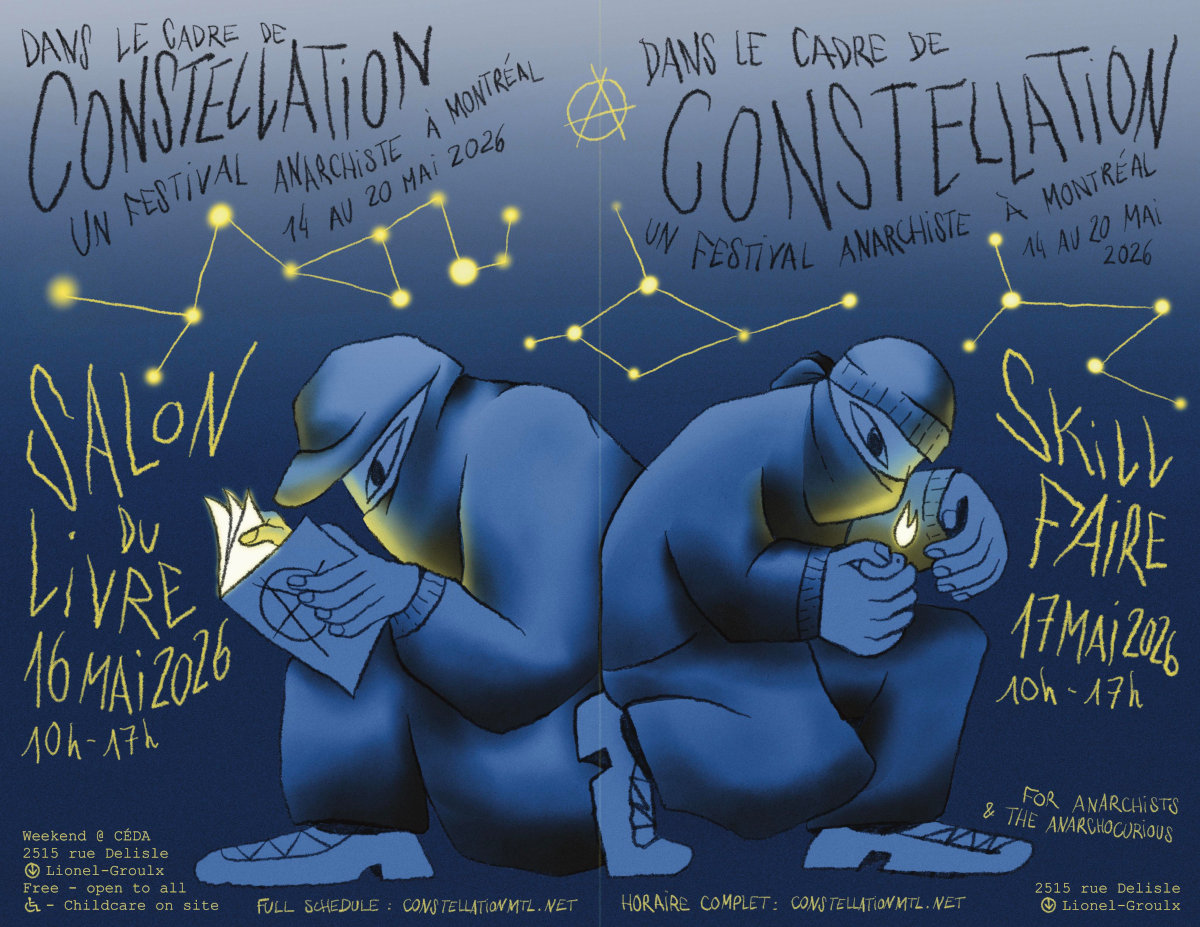
On May 16th, 2026, at around 10:00 am, I arrived at the CEDA community centre with very few expectations, except of course: Anarchism. I attended the third edition of Constellation, an Anarchist Festival in Montreal.
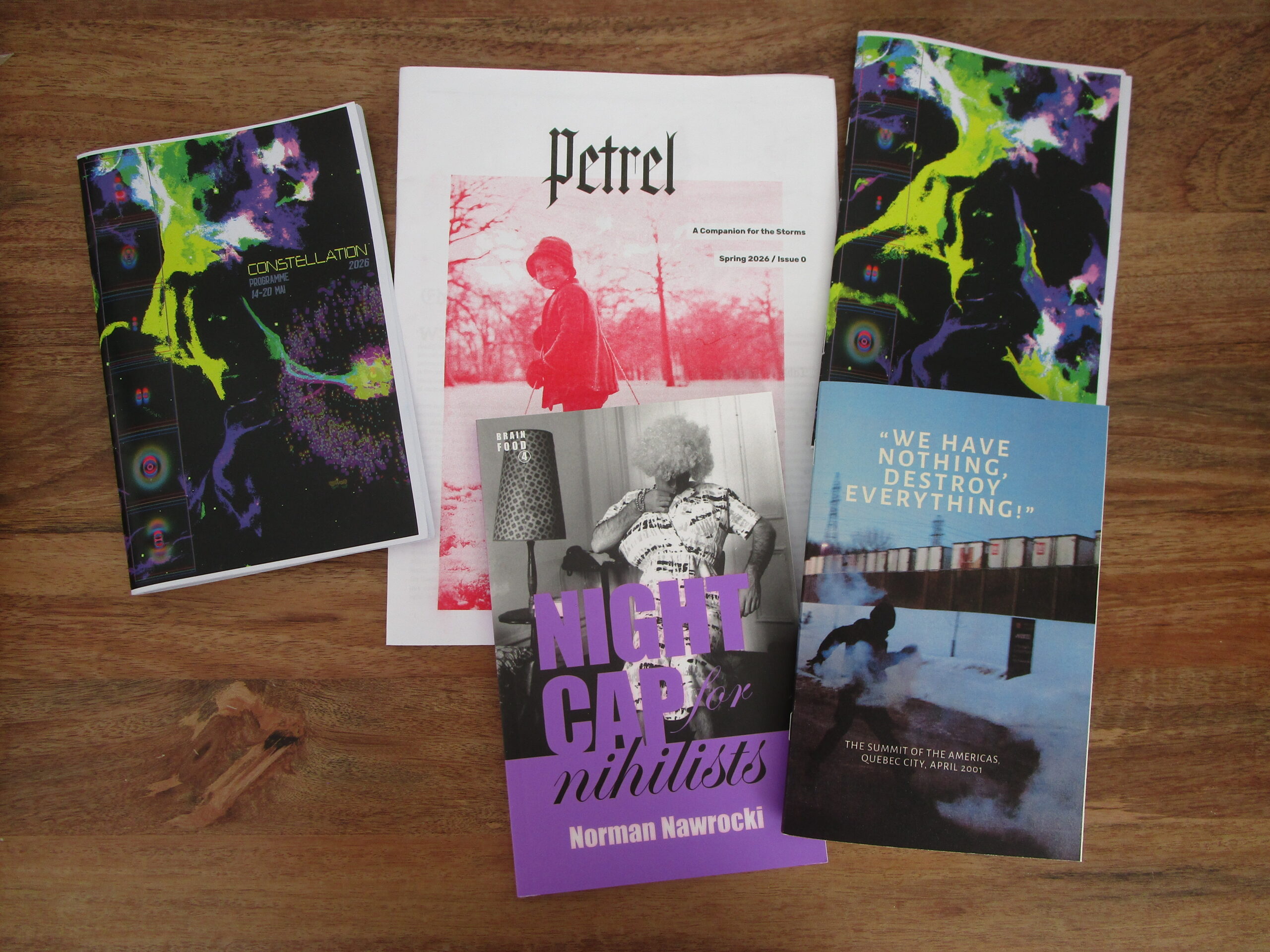
Pictured: my bookfair haul
People were beginning to set up their tables around the main building and along the path leading towards the government building across the park, past the soccer field. There were already books, pamphlets, and zines out, waiting to be picked up.
It was my first time at the annual event. This event was not only a bookfair, but also a place where community organizing and learning was taking place. I went to four workshops throughout the day, at the following times and locations:
- 10:30 – 12:30
- From Minneapolis to Montreal: The Struggle for Migrant Justice at the Centre of the Fight against Fascism (Bilingual)
- CCGV 2.100
- 13:00 – 14:40
- Twenty-Five Years Since The Anti-Capitalist Offensive In Quebec City: Anarchists Confronting the Summit of the Americas (Bilingual)
- CÉDA room 119
- 14:45 – 16:25
- Rébellions et résistances zapatistes au Chiapas (French)
- CÉDA room 119
- 16:30 – 17:30
- Antiauthoritarianism in Translation: Revolutionary Aesthetics in Arab Countries (English)
- CÉDA room 125
The workshops were very accessible to both French and English speakers. There were translators available for both languages at every workshop. The translators were speaking into microphones which were connected to numerous wired earbuds for as many people who needed them. The workshops tended to begin with multiple speakers each representing a distinct but connected context or point to the larger topic of the respective workshop, and tended to end their last thirty minutes with a question/discussion period.
After an informative workshop, you could find free food in the gymnasium, the location of the indoor bookfair. Between workshops, I also perused the books. I got my hands on Norman Nawrocki’s collection of anarchist poems Night Cap for nihilists. Its purple writing matched my cardigan, and the rest was history.
I’ve never seen so many books about a single concept in one single room. The topics were so specific. I noticed a book about anarchism and polyamory. One of the first workshops for that day was titled “Anarcho-Shulginism: A discussion on psychedelic anarchism & drug user liberation.” There were books about anarchism and food, whose connections may have been analogical, but nonetheless, they are very specific analogical connections.
My understanding of the concept of anarchism when first arriving at the event was nominal. I was not expecting for the Anarchist Bookfair to be so intensely committed to its name. To the organizers and contributors of Constellation 2026, I’m sorry I doubted you, if I doubted you.
The workshops were discussing specific times and places where anarchist movements have and are currently taking form.
The last workshop that I attended “Antiauthoritarianism in Translation: Revolutionary Aesthetics in Arab Countries” focused on the history and language of Anarchist movements. Mustafa was the speaker for this discussion. He was working as a volunteer for the event. I had crossed him constantly throughout the day.
During Mustafa’s talk, he represented the history of the existence or the idea of the word ‘anarchy’ in the Arab world, specifically, in Egyptian contexts. After learning about so many historical and present anarchist forms of organization earlier in the day, his talk was extremely helpful in bridging the key takeaways from each workshop. He turned to the question, which reappears constantly within anarchist literature: did we win or lose? He asked an important question: what does anarchism really mean?
Mustafa distinguished it from anti-authoritarianism: anarchism is more so anti-government. The question of winning or losing is irrelevant to anarchism. The fight is never-ending. In fighting, people reclaim their power and independence; people enforce their rights. This point was a thread that connected all the workshops that I had been to that day.
During the first workshop that I attended, Kathleen Cole spoke of how she and her community organized for rapid response and mutual aid during the ICE occupation of Minneapolis. Although they had many successes in protecting members of the community, she touched on the shortcomings of their work: the networks quickly fell apart once the danger was no longer emergent.
Kathleen spoke on her fears about the fragility of these networks. When people feel safer, they don’t see the need to maintain ties with their community at large. She was pointing to a need to continue to forge and preserve these ties. The fight against fascism mirrors the continual anarchist movement against the state. The question “did we win or lose?” is futile.
We must always be engaged and connected to others in our communities. When we let go of our independence, when we leave our freedom in the hands of a higher power, the state, we give up our own power. We give up our freedom. Fascism is always in our midst. It never left. We have just chosen to ignore its existence.
Amel Zaazaa, Director of the Justice Observatory, spoke on fascism and the struggle for migrant justice in the Montreal context. She painted a picture of fascism as a continuum, which undeniably coexists with the colonial and modern state. Amel focused on the question of why some people over others have their rights respected. The past and recent Quebec laws which create systemic barriers for migrants are representative of Montreal’s fascism. “We already have ICE here” was emphasized many times by participants.
I think the two speakers complimented one another well. They both agreed that building networks within your community remains the answer, not just now, but forever.
I recall someone at the end of the workshop sharing how they think the idea of choosing openness over secrecy in the face of fascist regimes is inspiring. This point was one that Kathleen emphasized throughout her talk: scale over security. It’s obviously a difficult thing to instil within oneself and one’s community, but I also think it is the answer. This continuous force of openness allows for fascist ideologies to remain as close to dead as they can be.
Thank you for reading/listening to my first blog post about my first time at the Constellation Anarchist Bookfair.
– Victoria Greco
CKUT 90.3 FM