Montreal refugee advocacy groups rally against Safe Third Country Agreement as challenge to border policy resumes in Federal Court
New hearings examine whether turning back asylum seekers to the U.S. violates Charter equality guarantees
by Ilario Del Guercio-Maridor
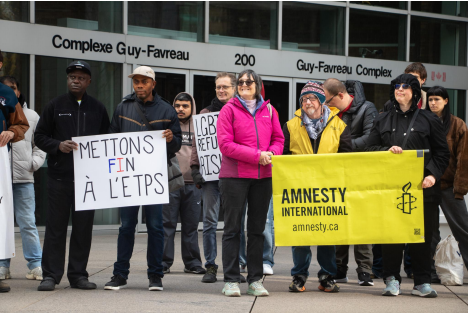
Demonstrators gather outside federal immigration facilities at Montreal’s Guy-Favreau Complex on the afternoon of Nov. 9, brandishing signs denouncing violations of refugees’ human rights. Photo by Ilario Del Guercio-Maridor
On Monday, Nov. 9, a rally co-organized by Amnesty Canada and the Welcome Collective assembled 100 people outside the Immigration and Refugee Board of Canada’s Montreal offices to defend refugee rights and demand an end to the Safe Third Country Agreement
(STCA). Sister protests took place across the country as hearings regarding the constitutionality of the agreement reopened that morning in Toronto federal court after a three-year hiatus.
The bilateral pact, signed with the United States in 2002, requires refugees to file asylum claims in the first of the two countries they enter, effectively barring those traveling north from entering Canada at the U.S. land border. Audry Mackling, a professor of immigration law at the University of Toronto, says the policy was designed “in the service of reducing the number of asylum seekers who could reach our territory.”
To qualify as a safe third country under Canadian law, the U.S. is continuously monitored on its human rights record, asylum practices and adherence to the 1951 Refugee Convention and 1984 Convention Against Torture. Migrant Justice Clinic community organizer Harrold Babon called the designation “madness” and “totally absurd.” Especially under the current administration, he added, “today the United States is not a safe country.”
“[Those] who are returned by Canada to the United States are often catapulted into detention under conditions that are akin to those which constitute cruel and inhuman treatment,” said Macklin.
Since early 2025, Washington closed asylum claims at the Mexico border and expanded agreements with countries Macklin describes as “extraordinarily dangerous, unsafe, human rights-violating [nations]” to refoul asylum seekers and deport migrants with precarious status. These are “abuses of human rights,” she adds, and a “violation of the Refugee Convention.”
“The horrors of ICE […] make it clear that the U.S. asylum system is broken and dangerous – particularly for racialized women, children, and LGBTQIA+ refugees,” said Canadian Council for Refugees (CCR) president Asma Faizi, in a press statement on Monday. Her organization is among the plaintiffs behind the current STCA challenge.
The original suit, launched in 2017, was a wide-ranging constitutional challenge arguing the agreement violated the Charter’s equality guarantees as well as rights to security of the person. In 2023, the Supreme Court of Canada rejected the latter claim, citing legal “safety valves” to prevent abuse, and sent the equality challenge back to Federal Court, where hearings commenced this week.
Lauren Lallemand, co-executive director of the Canadian Council for Refugees, says their arguments for this new chapter of the case demonstrate how the STCA discriminates against women and LGBTQ+ people. “We’ve seen a ‘slew of anti-trans laws,’” she notes, along with a “problematic discourse of violence” in the U.S. targeting queer communities, and a restriction on gender-based violence asylum claims. In the U.S. “conjugal violence [is] not considered [a strong] motive for being able to receive protection through a refugee claim, whereas in Canada [it is],” she adds.
While Canada continues to return asylum seekers to those conditions, demonstration co organizer Flore Morel of the Welcome Collective says Canadians will be “complicit in the xenophobic and racist policies of the United States.”
For Queen’s law professor Sharry Aiken, it is clear the STCA is discriminatory and violates both “the refugee convention that we are a party to [and] our very own Charter of Rights and Freedoms.” However, she does not expect a judgment from the court for a number of months. Regardless of the outcome, Aiken explains, the losing party is expected to appeal. Therefore, “it is not likely that there’ll be a final determination on this matter for a number of years yet, if indeed appeals go forward,” she adds.