Film Review: Unidentified
Haifaa Al Mansour’s "Unidentified" is a film that focuses on the hunt for justice from the lenses of an oppressed woman looking for her own truth in a world built to silence her. [CONTAINS SPOILERS]

From God We Come, and to God We Will Return
The Saudi thriller focuses on Nawal (portrayed by Mila Al Zahrani), a true crime enthusiast who works at a local police station digitizing files all day long. She becomes heavily involved in a case of an unidentified girl murdered and left in the middle of the desert. Driven by her moral obligation, she begins her own investigation against the explicit orders of her superiors. She is even dubbed “The Executioner” by her boss stating that no crime should go unpunished. She begins to question motives behind Jane Doe’s death – was it an honour killing or a domestic case? Yet, the most disturbing detail is the lack of answers: how has no one claimed her body and why has a young girl’s disappearance been met with absolute complicity.
As the story unfolds, we meet different characters and potential suspects including classmates, a cousin, and a boy named Noah who had been texting the schoolgirl prior to her death. It is later revealed that the young girl is Amal, a student who was set up in an arranged marriage and wanted her last hoorah before her life was bound to an inescapable change. The film emphasizes Islamic practices and the social realities it imposes upon women – specifically sacrificing their freedom in order to abide by their laws and maintain an acceptable public image. Amal was fiercely rebelling against the choices made for her even if it was just for a short period of time. Nawal’s past is also revealed as she had been dealing with trauma of her own. Through flashbacks, we learn that she had lost her newborn daughter due to stillbirth and that her abusive ex-husband, Mohammed, was planning on marrying a second wife despite her protests. [SPOILERS BELOW]
The film intensifies when Amal’s cousin, Mishal, becomes the main suspect in the case. Nawal firmly believes that he committed an honour killing motivated by the desire to cleanse the family name caused by her encounters with strange men. However, confessionals reveal a surprising truth: Mishal was merely disposing of the body out of deep respect for his cousin. Desperate to protect Amal from posthumous disgrace, he wanted to shield her memory from a family that would judge her final hours. Though the police close the case as hit-and-run, the narrative highlights a profound cultural reality: Mishal was the only male figure who actually cared about Amal for her – a heartbreakingly rare sight for young women navigating Saudi culture.
As an homage to the young girl, Nawal releases her abaya and nails up a sign, created by Mishal, in the desert that states “I seek God’s forgiveness.”
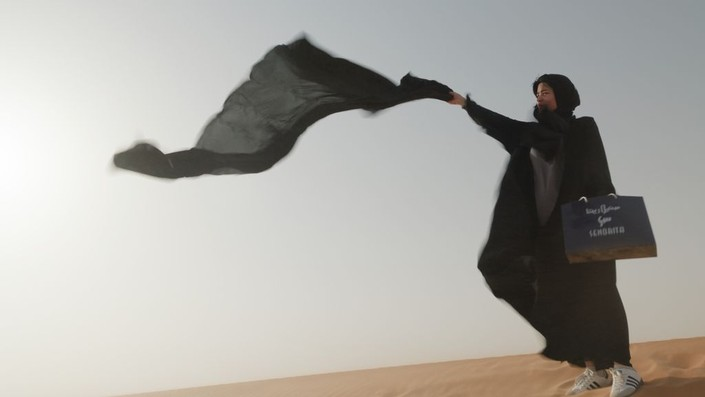
Why? This whole scheme was orchestrated by none other than “The Executioner.” She embodies the unreliable narrator and orchestrates a masterful deception – manipulating not only the characters around her, but the audience as well. It turns out that her ex-husband was planning on marrying Amal as the second wife. Out of anger and pure rage, Nawal created “Noah” to lure the young girl into the desert and murder her. The real question now is, why? Perhaps, Nawal’s fractured psyche and broken mind are the catalysts for her actions. Refusing the hand she was dealt, she decides to play God and chooses the fate of others – leaving devastation in her wake as she escapes.
Unidentified confronts the weight of Saudi culture and religion, and the expectations it institutes upon women. Nawal’s psychological unraveling is fuelled by direct consequences of institutionalized traumas we tolerate under the cover of faith: being submissive to abusive men, forced marriages, and unhealed grief. What if society had offered her grace and mental health support about losing her daughter rather than demanding her silence?
While the climax dissects Nawal’s crimes and motives, it forces us into a familiar, frustrating trap: erasing the actual victim. Amal is left in the shadows, leaving us to wonder how a world meant to protect her could so easily look away from her death.
Review by Kimberly Sahagun – 06/18/2026